 WORKING
 Receipts / 01
01 · THE MICROWAVE OVEN · posted 26 Sep 2026
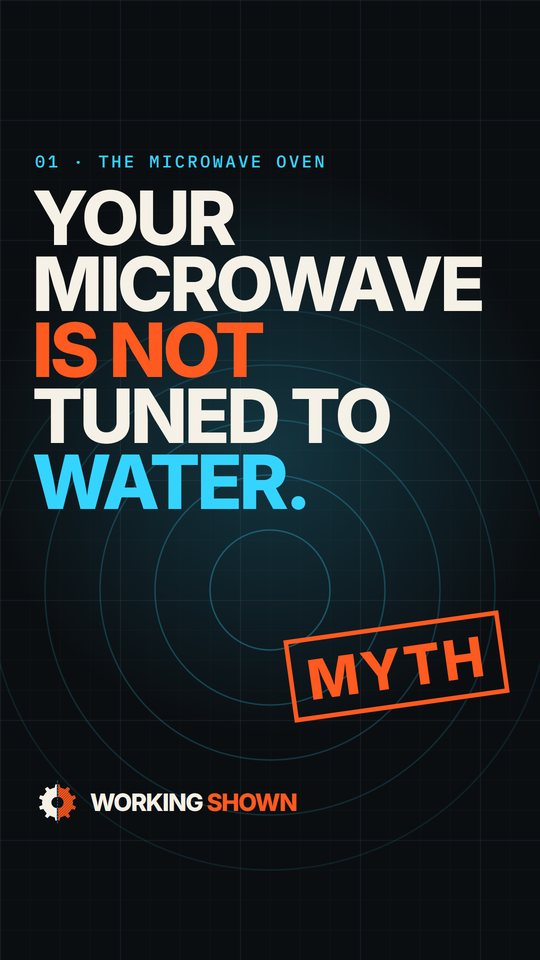
Your microwave is not tuned to water.
- A magnetron makes the microwaves.
- They reflect off the metal walls into the food.
- The electric field flips back and forth, twisting molecules (water and others). They collide, and that motion becomes heat ("dielectric heating").
- It doesn't cook from the inside out: in pure water at 25 °C, about 63% of the power is absorbed in the first ~1.4 cm. The middle cooks by conduction from the hot outer layers.
- Reflections create a standing-wave pattern with cold spots. That's why the plate turns.
- The door screen's holes are ~1 mm and the waves are ~120 mm long, so the microwaves stay in and visible light gets out.
Line by line
Every claim, with its source.
Every spoken or on-screen factual claim is listed here with the source wording it rests on. All sources were re-read on 2026-09-26.
| Shot | Claim as spoken (final) | Source and verbatim support |
|---|---|---|
| hook | "Your microwave is not tuned to water." | Baird (WTAMU, 2014): "The microwaves in a microwave oven are not tuned to a resonant frequency of water." — https://www.wtamu.edu/~cbaird/sq/2014/10/15/why-are-the-microwaves-in-a-microwave-oven-tuned-to-water/ |
| resonance | "Water has no resonance anywhere near its frequency. The first is above a terahertz." | Schmitt, Electromagnetics Explained, quoted by Baird: "there is no resonance of water at this frequency. The first resonant peak occurs above 1THz". HyperPhysics: resonant interactions "are not a major factor in the heating". |
| magnetron | "This magnetron makes the microwaves, at around two point four five gigahertz." | FDA: "A device called a magnetron inside the oven produces microwaves." HyperPhysics: "Modern microwave ovens operate at the frequency 2,450 MHz." "Around": Baird cites an IEEE study that found broad peaks spanning 2.40–2.50 GHz. |
| bounce | "They bounce off the metal walls, into the food." | FDA: "The microwaves reflect off the metal interior of the oven and cause the water molecules in food to vibrate." |
| molecules | "The field flips back and forth, twisting molecules, not just water. They collide. That's heat." | Baird: "the electric field … exerts a force on the molecules in the food, causing them to rotate … the molecules collide into each other … which we macroscopically call heat. Many types of molecules in the food absorb energy … not just water molecules." |
| depth | "It doesn't cook from the inside out. In water, nearly two thirds of the power is absorbed in the first one point four centimetres." | FDA: "microwave ovens do not cook food from the 'inside out.'" HyperPhysics (after Chaplin): the penetration depth "drops the microwave power by a factor 1/e, representing the absorption of 63% … For water at 25°C, this penetration depth is approximately 1.4 cm." The on-screen label states "pure water at 25 °C". |
| conduction | "The middle cooks by conduction, from the hot outer layers." | FDA: "the outer layers are heated and cooked primarily by microwaves while the inside is cooked mainly by the conduction of heat from the hot outer layers." |
| turntable | "Bouncing waves leave cold spots. That's why the plate turns." | US 4,636,605 (background): "The standing microwave pattern creates cold spots which cause the food to heat unevenly … the turntable supports and moves food in a circular path to compensate for the effect of standing wave cold spots." |
| door | "The door's holes are about a millimetre. The waves are twelve centimetres, so they can't get out. Light can." | HyperPhysics: "the holes in the metal screen … are about 1 mm in diameter compared to a 120 mm wavelength … You can see through the holes because … visible light wavelengths are about 2000 times smaller than the holes." |
| payoff | "Why that frequency, then? It's simply the band regulators set aside for ovens." | Schmitt via Baird: "There is no special significance of 2.45 GHz, except that it is allocated by the FCC as being allowable for microwave oven usage." |
What the drawing simplifies
the 3D model is schematic and not to scale. Wave fronts, molecules and hot spots are illustrations, not simulations. The caption says so.
Checked, and cut
"If it were tuned to water, it would only heat the surface." No source says this, so first-batch.md was corrected.
On-screen graphics
- The frequency axis marks the oven at ~2.45 GHz and shades everything above 1 THz as "water's first resonance: above 1 THz". It does not claim an exact location.
- The hole-vs-wave bar is drawn at the sourced 1 : 120 ratio (HyperPhysics).
v2 (motion graphics, 2026-09-26): extra on-screen claims
| On-screen text | Basis |
|---|---|
| "MORE THAN 400× HIGHER" (oven frequency vs water's first resonance) | Arithmetic on sourced figures: first resonance > 1 THz (Schmitt via Baird) ÷ 2.45 GHz ≈ 408, so it is more than 400×. |
| "≈ 2.45 BILLION CYCLES / SECOND" | Definition of 2.45 GHz (HyperPhysics: 2,450 MHz). |
| "ONE MEASURED OVEN: PEAKS 2.40–2.50 GHz" | Baird, citing Soltysiak, Celuch & Erle (IEEE MTT-S): a typical household oven's spectrum had "several broad peaks that spanned from 2.40 to 2.50 GHz". |
| Magnetron: electrons leave the cathode and swirl out to the anode's resonant cavities | Baird: "a resonant cavity … electrons emitted by the cathode hit the anode … slosh around as directed by the magnetron's shape." Motion labelled "ELECTRONS ILLUSTRATIVE". |
| "FIELD SLOWED >1 BILLION×" | The animated field flips about 1.7 times a second (half-period 9 frames at 30 fps). 2.45 × 10⁹ ÷ 1.67 ≈ 1.5 × 10⁹. |
| Power curve e^(−d/1.4 cm), "63% ABSORBED IN THE FIRST 1.4 cm" | HyperPhysics (after Chaplin): the penetration depth is where power drops by a factor of 1/e (63% absorbed), about 1.4 cm in water at 25 °C. The exponential shape is the model that defines that depth. Labelled "PURE WATER AT 25 °C". The wave amplitude is drawn as √power. |
| Heat-diffusion square | Illustrative simulation of the FDA statement (outer layers heated by microwaves, inside by conduction). Labelled "ILLUSTRATIVE". |
| Hot/cold-spot heatmap | An illustrative interference pattern, not a measured oven field. Labelled "ILLUSTRATIVE". The claim itself is the patent's ("standing microwave pattern creates cold spots"). |
| Door: 1 mm hole vs 120 mm wave, drawn to scale | HyperPhysics (about 1 mm vs 120 mm). Labelled "DRAWN TO SCALE · 1 : 120". |
| "ALLOCATED FOR OVENS (FCC)" | Schmitt via Baird: "allocated by the FCC as being allowable for microwave oven usage." |
Sources
- C. Baird, West Texas A&M University, "Why are the microwaves in a microwave oven tuned to water?" (2014), quoting R. Schmitt, Electromagnetics Explained. wtamu.edu/~cbaird/sq/2014/10/15/why-are-the-microwaves-in-a-microwave-oven-tuned-to-water/
- U.S. Food & Drug Administration, "Microwave Ovens". fda.gov/radiation-emitting-products/resources-you-radiation-emitting-products/microwave-ovens
- HyperPhysics, Georgia State University, "Microwave Ovens" (after M. Chaplin, Water Structure and Science). hyperphysics.gsu.edu/hbase/Waves/mwoven.html
- U.S. Patent 4,636,605, "Mode stirring turntable" (background section on standing-wave cold spots). patents.google.com/patent/US4636605A
Found an error?
Tell us at hello@workingshown.xyz or in the comments. We check it against the sources, pin the correction, fix the caption, and log it on the corrections page.