 WORKING
 Receipts / 02
02 · ANTI-LOCK BRAKES · posted 27 Sep 2026
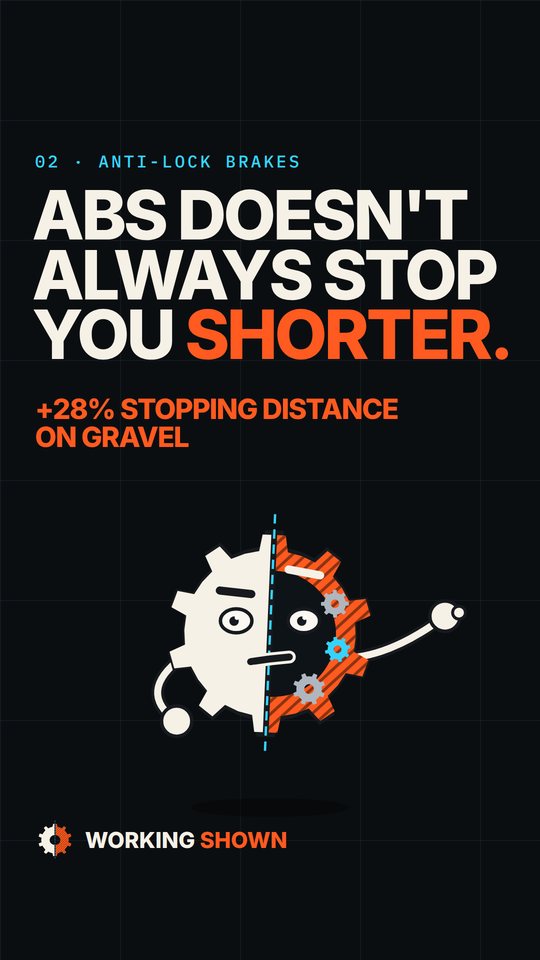
Anti-lock brakes don't always stop you shorter.
- Your brakes are hydraulic. The pedal pushes a small piston, and the fluid carries that pressure undiminished to bigger pistons at the wheels, multiplying the force (Pascal's principle).
- Those pistons squeeze pads onto a spinning disc, and friction turns the car's motion into heat.
- Brake too hard and the wheels lock. Locked front wheels keep going straight, and you can't steer.
- ABS senses a wheel about to lock, releases it, then reapplies it, many times a second. That keeps you steering while you brake. It's the problem ABS was built to solve.
- On gravel, a locked wheel piles gravel up in front of it, "a plowing effect" that stops the car sooner. But it can't steer.
Line by line
Every claim, with its source.
All sources were re-read on 2026-09-26. The quotes are verbatim.
Source key
- [NHTSA] Kahane, The Long-Term Effect of ABS in Passenger Cars and LTVs, DOT HS 811 182 (2009): https://crashstats.nhtsa.dot.gov/Api/Public/ViewPublication/811182
- [HP] HyperPhysics (Georgia State Univ.), Pascal's Principle and Hydraulic Brakes: https://hyperphysics.gsu.edu/hbase/pasc.html and https://hyperphysics.gsu.edu/hbase/pasc2.html
- [PAT] US 8,863,915 B2 (background section): https://patents.google.com/patent/US8863915B2/en
| Shot | Claim as spoken | Verbatim support |
|---|---|---|
| hook | "Anti-lock brakes don't always stop you shorter." | NHTSA: "four-wheel ABS lengthens stopping distances on gravel by 28 percent". It also says ABS reduces stopping distances "on many surfaces", which is why the line says don't always. |
| data | "In government tests, ABS cut stopping distances on wet roads. On gravel, cars took twenty-eight percent longer." | NHTSA: "NHTSA carried out two extensive series of stopping tests … between 1988 and 1991 … 14 vehicles with four-wheel ABS". Table 1-3, median % reduction with ABS: dry concrete 5, wet asphalt/concrete 14, wet epoxy 10, gravel –28. "four-wheel ABS lengthens stopping distances on gravel by 28 percent". |
| hydraulics | "Your foot pushes a small piston. The fluid carries that pressure, undiminished, to bigger pistons at the wheels, multiplying the force." | HP: "Pressure is transmitted undiminished in an enclosed static fluid … making possible a large multiplication of force". Hydraulic brakes: "the pressure in the input line from the brake pedal is exerted … on the movable wheel cylinder pistons … this multiplies the force … by the ratio of the area of the cylinder to the area of the supply line." |
| disc | "They squeeze pads onto a spinning disc, and friction turns your speed into heat." | PAT: "the basic function of disc brakes is to convert kinetic energy, the energy of motion, into thermal energy, or heat. As designed, the friction between disc brake pads and brake rotors during braking generates large quantities of heat". |
| lock | "Brake too hard and the wheels lock. Locked front wheels slide straight, and you can't steer." | NHTSA: "the average driver brakes too hard, locking the wheels … If the front wheels lock, the vehicle will continue in a straight path, but the driver will be unable to steer it." |
| abs | "ABS senses a wheel about to lock, and releases and reapplies it, many times a second." | NHTSA: "ABS senses if any of the four wheels is about to lock, and if so, it quickly releases the brakes on that wheel. Cycles of releasing, holding, and reapplying brakes are repeated many times per second." |
| steer | "So you can still steer while braking. That's what it was built for." | NHTSA: "ABS enables the driver to steer while braking" and "The fundamental safety problem addressed by four-wheel ABS is that … the average driver brakes too hard, locking the wheels, which causes the vehicle to lose directional control." |
| gravel | "On gravel, a locked wheel piles it up like a plough, so it stops sooner. It just can't steer." | NHTSA: "A car with the wheels locked causes gravel to build up in front of the wheels, resulting in a plowing effect that slows the vehicle quicker than ABS (although steering control is lost and the car may yaw)." |
| payoff | "ABS trades a little distance on gravel for control." | A summary of the two NHTSA findings above: longer stops on gravel, steering kept. |
What the drawing simplifies
- The tests date from 1988–91; the label says so.
- Figures are medians across 14 ABS vehicles.
- The ABS cycle graph and the hydraulic piston sizes are schematic.
- Deliberately not claimed: the fatal-crash statistics. The report shows a near-zero net effect with offsetting changes, which is too nuanced for a 50-second reel.
Sources
- NHTSA, "The Long-Term Effect of ABS in Passenger Cars and LTVs," DOT HS 811 182 (Kahane, 2009). crashstats.nhtsa.dot.gov/Api/Public/ViewPublication/811182
- HyperPhysics, Georgia State University: "Pascal's Principle" and "Hydraulic Brakes." hyperphysics.gsu.edu/hbase/pasc.html · hyperphysics.gsu.edu/hbase/pasc2.html
- U.S. Patent 8,863,915 (background: disc brakes convert kinetic energy into heat). patents.google.com/patent/US8863915B2
Found an error?
Tell us at hello@workingshown.xyz or in the comments. We check it against the sources, pin the correction, fix the caption, and log it on the corrections page.