 WORKING
 Receipts / 04
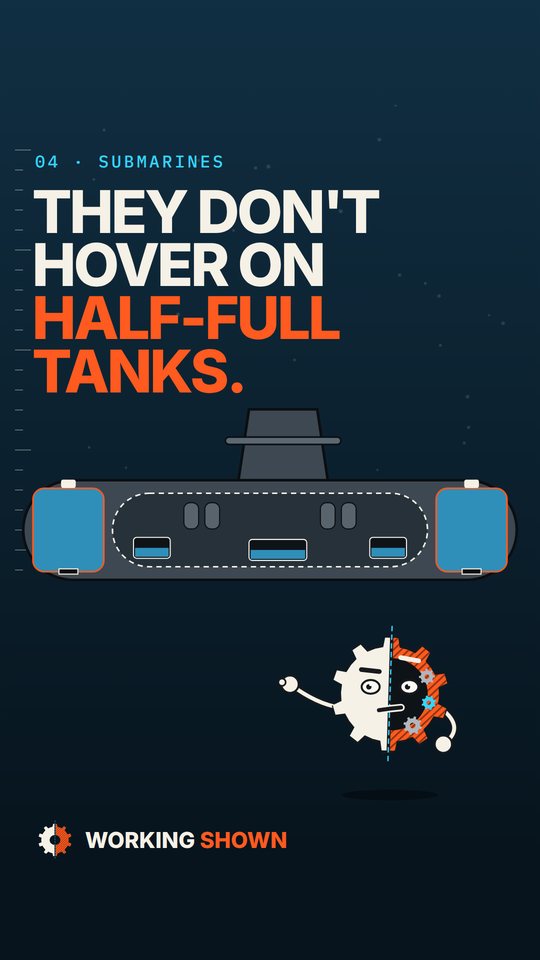
04 · SUBMARINES · posted 29 Sep 2026
A submarine doesn't hover by half-filling its tanks.
- Its main ballast tanks are the biggest tanks on board, and underwater they're carried completely full.
- To dive, vents on top of the tanks open. Air escapes and seawater floods in from below.
- Full, the sub weighs about as much as the water it pushes aside (Archimedes), so it's roughly neutral.
- A surface ship corrects itself by floating higher or lower. A submerged sub has no reserve buoyancy, so the crew has to keep adjusting its weight.
- A small depth control tank takes on or pumps out water, for example when the sea's saltiness (and therefore density) changes.
- Trim tanks move water forward or aft to keep it level.
- Its planes (on the sail, bow and stern) act like small wings, generating lift to control depth.
- To surface, compressed air blows the water out of the main ballast tanks.
Line by line
Every claim, with its source.
All sources were re-read on 2026-09-26. The quotes are verbatim.
Source key
- [USNA] U.S. Naval Academy, EN400 Principles of Ship Performance, Chapter 10: Submarines: https://www.usna.edu/NAOE/_files/documents/Courses/EN400/02.10_Chapter_10-May20-.pdf
- [COD] USS COD Submarine Memorial, "Definitions" (US Navy submarine terminology). The live site failed DNS, so it was read via the Internet Archive: https://web.archive.org/web/2024/https://www.usscod.org/def.html
| Shot | Claim as spoken | Verbatim support |
|---|---|---|
| hook | "A submarine doesn't hover by half-filling its tanks." | COD: main ballast tanks "are habitually carried completely filled when the vessel is submerged". USNA: MBTs alter displacement "from being positively buoyant (surfaced) when empty to somewhere near neutrally buoyant (submerged) when full." |
| full | "Underwater, its big ballast tanks are completely full." | Same as above. USNA: "These are by far the largest tanks on board". |
| dive | "vents on top open. Air escapes, and seawater floods in from below." | USNA Fig. 10.3 labels the main ballast tanks "Air Out" (top) and "Water In" (bottom). COD: "Venting consists of permitting a flow of air into or out of a tank"; "Flood valves are hinged covers at the bottom of certain ballast tanks which may be opened to admit or expel sea water." |
| neutral | "Full, the sub weighs about as much as the water it pushes aside. Neutral." | USNA: "The submarine experiences a buoyant force equal to the weight of liquid it displaces. When surfaced or neutrally buoyant, this buoyant force is equal to the weight of the submarine". |
| reserve | "a floating ship rises or settles by itself. A submerged sub has no spare buoyancy." | USNA: "A surface ship automatically maintains static equilibrium by alterations in its draft and the reserve buoyancy above the waterline … a submerged submarine is given no such luxury … there is no excess or reserve buoyancy as in a surface ship." |
| dct | "the crew fine-tunes its weight, pumping water in or out of a small tank as the sea's saltiness changes." | USNA: "The crew must actively maintain a state of static equilibrium by changing the weight of the submarine"; "Moving water in or out of the DCT can compensate for this"; "Water density (ρ) will change whenever there is an alteration in its salinity level"; "water must be pumped from the DCT". |
| trim | "Trim tanks shift water forward or aft to keep it level." | USNA: "Submarines are very sensitive to longitudinal weight shifts … Moving water between the after and forward trim tanks … can compensate for these changes." |
| planes | "for depth, its planes act like little wings." | USNA: "Submarines use a combination of stern planes, fairwater planes (on the sail), bow planes … to control depth"; "Positioning the planes to the 'up' position causes an upward lift force to be generated." |
| blow | "compressed air blows the water out of the ballast tanks." | COD: "Blowing a tank consists of expelling its contents by admitting compressed air into the tank to force out the water." |
| payoff | "Not half-full tanks. Constant fine-tuning." | A summary of the rows above. |
What the drawing simplifies
the tank sizes and positions, the salinity layer and the tilt angles are schematic. The screen says so.
Sources
- U.S. Naval Academy, EN400 Principles of Ship Performance, Ch. 10: Submarines. usna.edu/NAOE/_files/documents/Courses/EN400/02.10_Chapter_10-May20-.pdf
- USS COD Submarine Memorial, "Definitions" (U.S. Navy submarine terminology). usscod.org/def.html
Found an error?
Tell us at hello@workingshown.xyz or in the comments. We check it against the sources, pin the correction, fix the caption, and log it on the corrections page.