 WORKING
 Receipts / 05
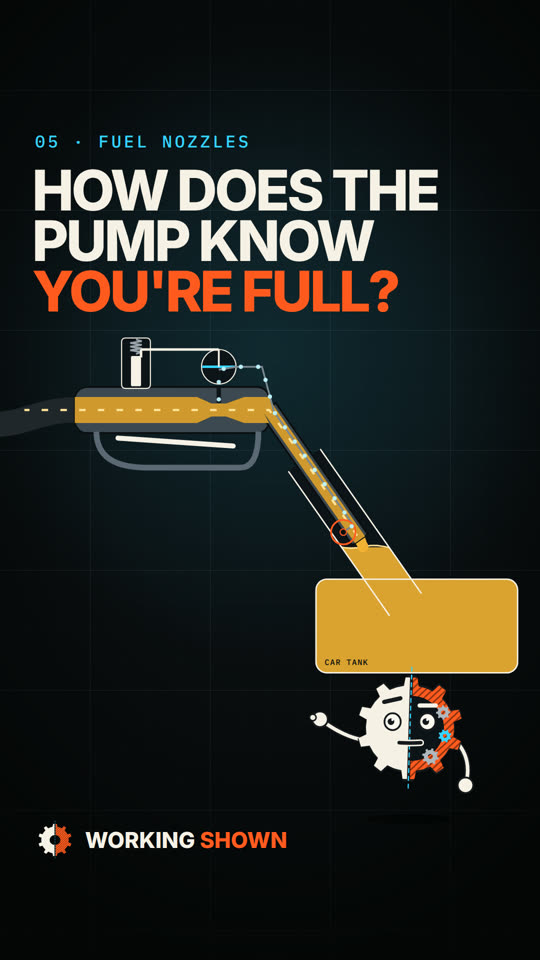
05 · FUEL NOZZLES · posted 30 Sep 2026
How does the pump know your tank is full?
- The fuel sits in an underground tank. At most modern stations, a pump submerged inside that tank pushes it up to the dispenser. (Some stations use a suction pump in the dispenser instead.)
- The tiny hole near the tip of the spout isn't where fuel comes out. It's a sensing port, and it breathes air.
- Fuel rushing through the nozzle creates suction (the Venturi effect). That suction pulls air in through the hole, up a thin tube and past a rubber diaphragm.
- When the fuel level rises and covers the hole, air can't get in. The suction builds rapidly, lifts the diaphragm and trips a latch, and the valve snaps shut. Click.
- Splashing fuel can reach the hole before the tank is full. That's why it sometimes clicks off early.
Line by line
Every claim, with its source.
Every spoken or on-screen factual claim is listed here with the source wording it rests on. Sources were fetched on 2026-09-30.
| Shot | Claim as spoken | Source and verbatim support |
|---|---|---|
| hook | "The nozzle has no electronics." | US3542092A: "no electrical devices are located near the nozzle". Elaflex describes a purely pneumatic and mechanical trip (see trip). The scope is the nozzle only; the dispenser is electric (Elaflex: "for wet-hose use with electrical operated petrol dispensing pumps"). |
| tank | "At most modern stations, a pump inside the tank pushes it up." | PEI (suction system): "In most modern retail stations, however, suction systems have been replaced by remote pumping systems in which the pumping unit is located inside the storage tank." PEI (submersible pump): "normally submerged in the fuel." The on-screen line "some stations use suction pumps instead" rests on PEI: "The pump creates a vacuum. The vacuum pulls product from the storage tank". |
| hole | "That tiny hole? No fuel comes out of it. It breathes air." | Elaflex: "Air is drawn in through the sensing port (1) at the tip of the spout". ScienceABC: "this hole does not pass gasoline to the tank". |
| venturi | "Fuel rushing through the nozzle creates suction. That pulls air in through the hole, up a tube, past a rubber diaphragm." | Elaflex: "The flow through the nozzle creates a vacuum at the valve seat (6). Air is drawn in through the sensing port (1) at the tip of the spout, through the safety cut-out, past the diaphragm, and into the fuel." US2582195A: "The flow passageway of the valve is designed to provide a Venturi effect on the diaphragm." On "a tube": Wikipedia (Gasoline pump), "an auxiliary sensing tube running from just inside the mouth of the nozzle"; Mental Floss, "a tiny hole at the tip of the spout and a tube connected to it". On "rubber": US3542092A, "a combined gasket and diaphragm member 48 formed of synthetic rubber"; US2582195A, "a flexible diaphragm". |
| trip | "When fuel covers the hole, the air is cut off. Suction spikes, the diaphragm lifts, a latch trips, and the valve snaps shut." | Elaflex: "The valve will remain open while the air flows freely. When fuel reaches the sensing port, suction builds up rapidly until it lifts the diaphragm (4) and trips the automatic action which shuts the valve." US3542092A: "diaphragm 48 is lifted…and triggering means 60 in the nozzle are operated to shut it off." ScienceABC: "that movement trips the latch holding the main poppet valve open, and a spring snaps the valve shut". |
| early | "Splashing fuel can hit the hole too. That's why it clicks off early." | Elaflex: "DO NOT FILL TOO FAST: Splashing fuel can trip the nozzle before the tank is full." |
| payoff | "No chips. Just air." | A summary of hook and trip. |
What the drawing simplifies
- The nozzle is a schematic of the principle. The main valve is drawn as a spring-loaded gate held by a latch; real nozzles use a poppet valve.
- Spout angle, hole position, tube routing and tank shape are illustrative, and the drawing isn't to scale.
- The labels on screen say "SCHEMATIC · NOT TO SCALE".
Checked, and cut
- "Invented by Richard Corson in 1939": his patent is a float-operated barrel filler, not this design.
- Any sensing-hole diameter: no source.
- A US/EU split for suction vs. submersible pumps: no primary statistic.
Sources
- ELAFLEX, ZVA Slimline 2 automatic nozzle operating manual. elaflex.com.au/dokumente/download/Manual/Manual_ZVASlimline2.pdf
- US Patent 3,542,092, "Automatic shut-off dispensing nozzle" (Gulf Research & Development). patents.google.com/patent/US3542092A
- US Patent 2,582,195, "Automatic shutoff dispensing nozzle valve" (OPW, filed 1950). patents.google.com/patent/US2582195A
- Petroleum Equipment Institute, "Suction system" and "Submersible pump" definitions. pei.org
Found an error?
Tell us at hello@workingshown.xyz or in the comments. We check it against the sources, pin the correction, fix the caption, and log it on the corrections page.