 WORKING
 Receipts / 06
06 · ESCALATORS · posted 1 Oct 2026
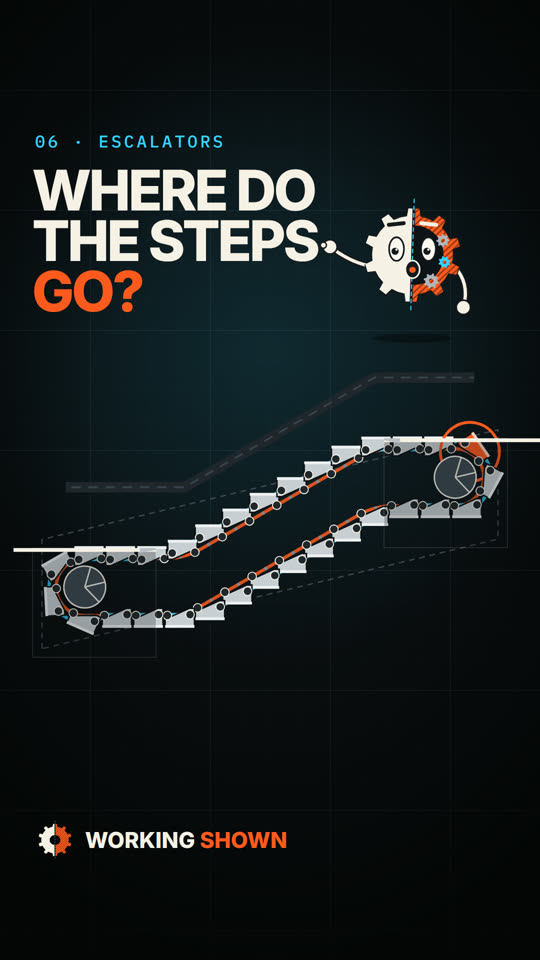
Where do escalator steps go when they disappear?
- The steps form one continuous loop, pulled by a step chain that a motor drives round at the top.
- Past the landing, each step goes round the bend and rides back upside down, under the truss, right beneath the people riding it.
- Every step has two sets of wheels on two separate tracks. One set is pulled by the chain, and the other just follows.
- On the slope the tracks sit far apart, which forces each step up into a stair. At the ends the tracks come together, so the steps lie flat to go round the bend.
- The grooves in every step are there for the comb: its teeth run inside them. If something gets wedged, the comb plate lifts and trips a switch that cuts the power.
Line by line
Every claim, with its source.
Every spoken or on-screen factual claim is listed here with the source wording it rests on. Sources were fetched on 2026-09-30.
| Shot | Claim as spoken | Source and verbatim support |
|---|---|---|
| hook | "Where do escalator steps go when they disappear?" | This is the question; flip answers it. |
| flip | "They flip over and ride back upside down, right under your feet." | US7431139B2 (Inventio/Schindler): "after reversal, return in the opposite direction with the step surfaces facing down." US11572257B2 (KONE): "The steps 20 are hanging i.e. with the step tread 21 facing downwards in the return side RS of the escalator." Madehow: "The tracks carry the steps down along the underside of the truss". |
| flip | "One continuous loop, pulled by a chain." | HowStuffWorks (archive): the steps are attached to step chains driven round gears at the top by an electric motor; the steps form a loop. KONE CE course: step chain. |
| wheels | "Every step has two sets of wheels, on two separate tracks. One set is pulled by the chain. The other just follows." | HowStuffWorks: "Each step in the escalator has two sets of wheels, which roll along two separate tracks"; the upper set is connected to the chain and pulled by it, and the other set "simply glides along its track, following behind." KONE CE course: "There are actually two tracks: one for the front wheels of the steps and one for the back wheels". |
| gap | "On the slope, the tracks sit apart, so each step stands up as a stair. At the ends, the gap closes, and the steps lie flat to go round the bend." | Madehow: on the incline "the tracks are at their maximum distance apart"; at the landings "the two tracks converge so that the front and back wheels of the steps are almost in a straight line… a flat sheet-like arrangement… so they can easily travel around the bend". HowStuffWorks: "the tracks level off to a horizontal position, flattening the stairway". |
| comb | "Those grooves? The comb's teeth run inside them." | US5307918A (Otis): "combteeth which pass through the gaps between the tread cleats". |
| comb | "If something gets wedged, the comb plate lifts and trips a switch that stops everything." | US5307918A: "The upward movement of the combplate operates a power interruption switch". The stop on screen is the result of that interruption. |
| payoff | "One loop. Two tracks." | A summary of flip and wheels. |
How the visual is made
the escalator is a real kinematic model rather than a hand-drawn loop.
- Each step is a rigid body. Its chain wheel rides one closed loop, and its tread is held level on the working side.
- The stair shape on the incline, the flattening at the landings and the upside-down return all follow from the geometry.
- The cyan "trailer track" is traced from where each step's second wheel actually goes.
- Proportions (step size, bend radii, slope length) are simplified, and the on-screen labels say "SCHEMATIC". The 30° incline is the ASME A17.1 maximum (KONE CE course: "not to exceed 30 degrees").
Checked, and cut
- "The handrail runs at exactly step speed": false as a rule. EN 115 allows the handrail to run up to 2% faster, never slower.
- "A federal court killed the Escalator trademark": it was the US Patent Office (Commissioner of Patents).
- "Otis invented it": Reno's 1896 machine came first.
Sources
- US Patent 7,431,139, "Escalator guide system" (Inventio / Schindler). patents.google.com/patent/US7431139B2
- US Patent 11,572,257, "Escalator" (KONE). patents.google.com/patent/US11572257B2
- US Patent 5,307,918, "Escalator combplate stop switch assembly" (Otis). patents.google.com/patent/US5307918A
- T. Harris, "How Escalators Work", HowStuffWorks. science.howstuffworks.com/transport/engines-equipment/escalator.htm
- "Escalator", How Products Are Made. madehow.com/Volume-3/Escalator.html
- "Escalator Basics Today", KONE continuing-education course (BNP Media).
Found an error?
Tell us at hello@workingshown.xyz or in the comments. We check it against the sources, pin the correction, fix the caption, and log it on the corrections page.