 WORKING
 Receipts / 07
07 · RAIN SENSORS · posted 2 Oct 2026
How does your car know it's raining?
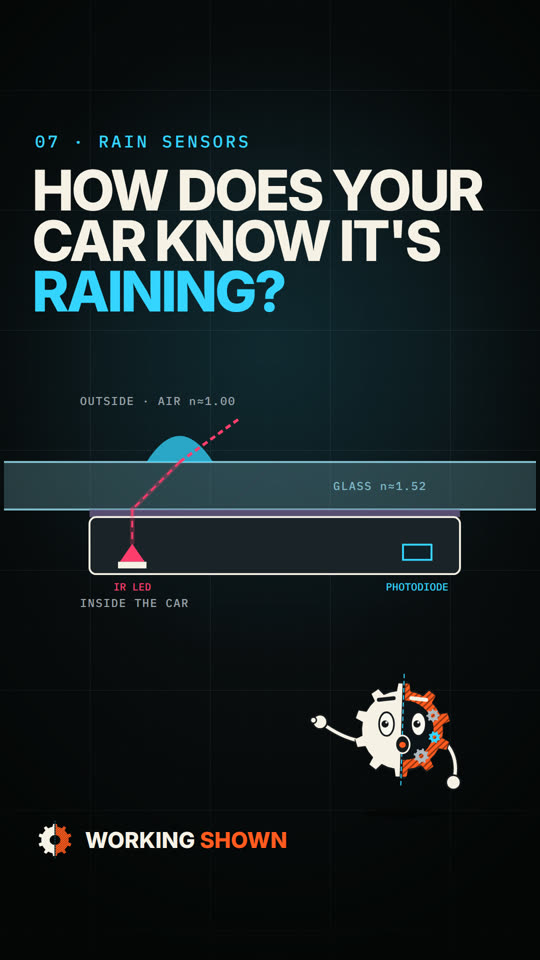
- Behind the mirror, a small module is bonded to the inside of the windshield. It holds an infrared LED and a photodiode.
- The LED sends invisible infrared into the glass at a steep angle (about 45°). Past about 41°, light going from glass into air can't get out. That's total internal reflection, so the glass acts like a mirror and the beam bounces back to the sensor.
- Water is optically much closer to glass (refractive index 1.33 vs 1.52; air is 1.00). Under a raindrop, the escape limit jumps to about 61°, so the 45° beam leaks out into the drop.
- Less light comes back, the module works out how hard it's raining, and the wipers speed up to match.
- It can be fooled: flickering sunlight can look like a burst of rain, and it can't tell snow and ice from rain.
Line by line
Every claim, with its source.
Every spoken or on-screen factual claim is listed here with the source wording it rests on. Sources were fetched on 2026-09-30.
| Shot | Claim as spoken / on screen | Source and verbatim support |
|---|---|---|
| box | "Behind the mirror, a little box is glued to the glass." | HELLA TechWorld (check/change rain sensor): "Initially integrated in the mirror base of the rear-view mirror, the rain sensor is fitted on the inside of the front windshield outside the driver's field of vision." "The optical sensor is fastened on the windshield with the aid of a coupling medium, which forms a level layer on the optical sensor." "Glued" paraphrases "fastened… with a coupling medium"; the on-screen label says "GEL LAYER". |
| box | "Inside: an infrared light and a light sensor." | HELLA: "The sensor element comprises one or more light emitting diodes (transmitters), a prism and a photodiode (receiver)." HELLA: "A light beam produced by the light emitting diode passes via a prism to the windshield… and forwarded to the photodiode". Melexis MLX75308 note: "Dedicated optics within the module ensures total internal reflection". Infrared: Hella (functions page), "the infrared light escapes from the front pane". |
| mirror | "It fires invisible infrared into the glass at a steep angle. So steep, the glass acts like a mirror, and the light bounces back to the sensor." | Renesas AN-CM-219: "the light beam is injected to the glass at a 45° angle". RAA: "at an angle sharp enough that the glass becomes a mirror". HELLA: "is reflected several times by the outer windshield surface and forwarded to the photodiode". HyperPhysics: "For incident angles greater than the critical angle there will be total internal reflection". |
| mirror (screen) | "BEAM 45° > LIMIT ≈41°" | Beam angle from Renesas. The critical angle is computed as arcsin(1.00029/1.52) = 41.2°, using HyperPhysics indices (air "1.00029", crown glass "1.52"). |
| drop | "Water is optically much closer to glass than air is." | HyperPhysics indices: water "1.33", glass "1.52", air "1.00029". |
| drop (screen) | "WATER n≈1.33 · LIMIT JUMPS TO ≈61°"; "≈54° INTO THE DROP" | Computed: arcsin(1.33/1.52) = 61.0°. Snell's law at 45° gives arcsin((1.52/1.33)·sin 45°) = 53.9°. Denso US4867561A: the beam angle is set "between the critical angle with respect to air ... and the critical angle" with respect to the extraneous matter. The screen labels the angles "COMPUTED FROM SNELL'S LAW". |
| drop | "So when a raindrop lands, the light leaks out into it, and less comes back." | HELLA: "If the pane is wet with moisture (water drops), the infrared light escapes from the front pane as a result of the refraction caused". Melexis: "some of the transmitted pulse is lost and the photodiode receives less light". |
| wipe | "More rain, more light lost. The wipers speed up to match." | Melexis: "Rain intensity can then be calculated from the difference in the amount of reflected light". HELLA: "The wiper frequency in the intermittent wiper setting can therefore be automatically adapted to the intensity of the rain". |
| fooled | "Flickering sunlight can look like a burst of rain." | Melexis: "Changes in sunlight can be interpreted as a sudden burst of rain on the windshield, resulting in annoying false wipes." |
| fooled | "It can't tell snow from rain." | HELLA: "The sensor cannot differentiate snow and ice from rain." |
| payoff | "Your windshield is a light pipe. Rain is a leak." | A metaphor summarising mirror and drop. |
What the drawing simplifies
- The cross-section exaggerates glass thickness, and the prism/coupling optics are simplified: the beam is drawn entering at 45°.
- The light meter's drop at a wet bounce uses the Fresnel reflectance for glass→water at 45°, which is about 1% of the light. It's shown as a bar with no number.
- In a real sensor a drop covers only part of the sensing spot, so the drop in signal is partial. The meter illustrates the direction of the change, not a measured value.
- The windshield "driver view" and wiper motion are illustrative.
Checked, and cut
- "Cadillac invented it" / "the first ever": single source, and the 1970 Citroën SM system was not optical.
- "Noack invented today's sensor": his 1978 patent is a partial-reflection design, not the TIR design used today.
- "Dust makes the wipers run": unproven, and the sources point the other way.
- The Tesla camera fact: trade-press source only, and there wasn't time for it.
Sources
- HELLA TechWorld, "Checking and changing the rain sensor" and "Functions of rain sensors / light sensors". hella.com/techworld
- Melexis, "Rain Light Sensor system design with MLX75308" (application note). melexis.com
- Renesas, AN-CM-219 "IR Windshield Rain Sensor". renesas.com
- HyperPhysics (Georgia State Univ.), "Total Internal Reflection" and "Index of Refraction" tables. hyperphysics.gsu.edu
- US Patent 4,867,561 (Denso), optical detection of matter on a windshield. patents.google.com/patent/US4867561A
Found an error?
Tell us at hello@workingshown.xyz or in the comments. We check it against the sources, pin the correction, fix the caption, and log it on the corrections page.