 WORKING
 Receipts / 08
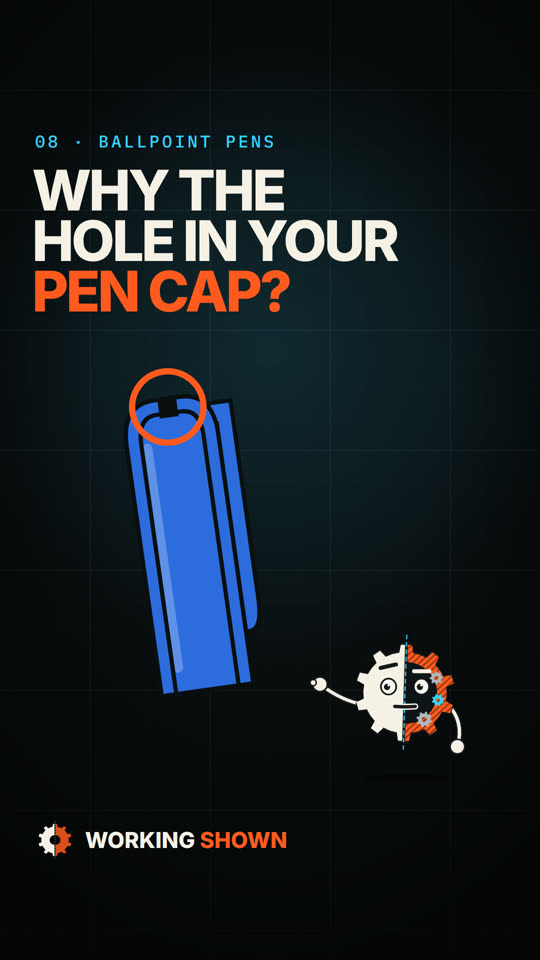
08 · BALLPOINT PENS · posted 3 Oct 2026
Why is there a hole in your pen cap?
- If a child inhales a cap, the hole lets air keep getting through. Pen caps are made to a safety standard for this, ISO 11540 ("caps to reduce the risk of asphyxiation"). A maker can meet it with a hole, or with a cap too big to swallow.
- The writing tip is a ball about 1 mm wide, held in a socket. As it rolls it picks up ink and lays it on the paper: it's basically a tiny lubricated ball bearing.
- The ink is thick. It reaches the ball by gravity and clings to it by capillary action.
- That's why a normal ballpoint starts to fail if you write upside down for long.
- The little hole in the barrel lets air in, so the pressure inside matches the pressure outside as the ink is used up.
Line by line
Every claim, with its source.
Every spoken or on-screen factual claim is listed here with the source wording it rests on. Sources were fetched on 2026-09-30.
| Shot | Claim as spoken / on screen | Source and verbatim support |
|---|---|---|
| cap | "In case a child inhales it. Air can still get through." | BIC FAQ (Wayback, 7 Mar 2017): caps "comply with international safety standards that attempt to minimize the risk of children accidentally inhaling pen caps… the BIC Cristal, has a little hole in the top". IFLScience quotes BIC: "prevent the cap from completely obstructing the airway if accidentally inhaled". |
| cap | "Pen caps are made to a safety standard for exactly that." | ISO 11540:2014 scope: "specifies requirements to reduce the risk of asphyxiation from caps… children up to the age of 14 years". BSI title: "Specification for caps to reduce the risk of asphyxiation". |
| cap (screen) | "(A HOLE, OR A CAP TOO BIG TO SWALLOW)" | Snopes, quoting a BIC spokesperson: caps must have "a single hole, or several holes… or have a large cap [more than 16 millimeters in diameter]". |
| tip | "The writing tip is a ball, about a millimetre wide, held in a socket. As it rolls, it picks up ink and lays it on the paper." | Reverdy (Princeton MAE 559): ball "approximately 1 mm"; the tip is "essentially a lubricated ball bearing… driven by friction between itself and the paper". GB 498,997 (Bíró, 1938): "rotatably-mounted ball". |
| feed | "The ink is thick. It flows down to the ball by gravity, and clings to it by capillary action." | US 2,390,636 (Bíró, filed 1943): ink "is derived by gravity to the conduit c", which is of a "capillary nature… by adhesion". Reverdy: "capillary effects dominate". Snopes: ink with "the viscosity of honey". |
| upside | "That's why a normal ballpoint starts failing if you write upside down for long." | Reverdy: "any normal ballpoint pen will begin to fail if used upside down for an extended period of time". |
| barrel | "The tiny hole in the barrel lets air in, so the pressure inside matches the outside as the ink is used up." | BIC FAQ (2017): the barrel hole is there "To equalize the pressure inside the pen with the pressure outside the pen". "As the ink is used up" describes why air must replace the ink. The FAQ also notes that unvented pens "contain sealed ink systems and are pressurized". |
| payoff | "A tiny ball bearing, and two holes." | Reverdy's "lubricated ball bearing", plus the cap and barrel holes above. |
What the drawing simplifies
- The airway is a schematic tube, not anatomy.
- The ball, socket and ink proportions are schematic.
- The air path from the barrel hole to the back of the refill is illustrative.
Checked, and cut
- "100 US deaths a year" and "BIC added holes in 1991": unsupported. BIC's spokesperson gives 1990, and the documented figure is nine UK children, 1970–84.
- The "8 L/min" airflow requirement: secondary source only; the standard is paywalled.
- "Bíró invented the ballpoint": John Loud patented a ball-tip pen in 1888.
Sources
- BIC, FAQ (archived 7 March 2017). web.archive.org/web/20170307025855/http://www.bicworld.com/en/faq
- ISO 11540, "Writing and marking instruments: Specification for caps to reduce the risk of asphyxiation" (scope). iso.org
- Snopes, "Holes in pen caps prevent choking" (quoting a BIC spokesperson). snopes.com
- P. Reverdy, "Ballpoint pen", Princeton University MAE 559 (2010). princeton.edu/~stonelab
- L. J. Bíró, GB Patent 498,997 (1938) and US Patent 2,390,636 (filed 1943). patents.google.com
Found an error?
Tell us at hello@workingshown.xyz or in the comments. We check it against the sources, pin the correction, fix the caption, and log it on the corrections page.