 WORKING
 Receipts / 09
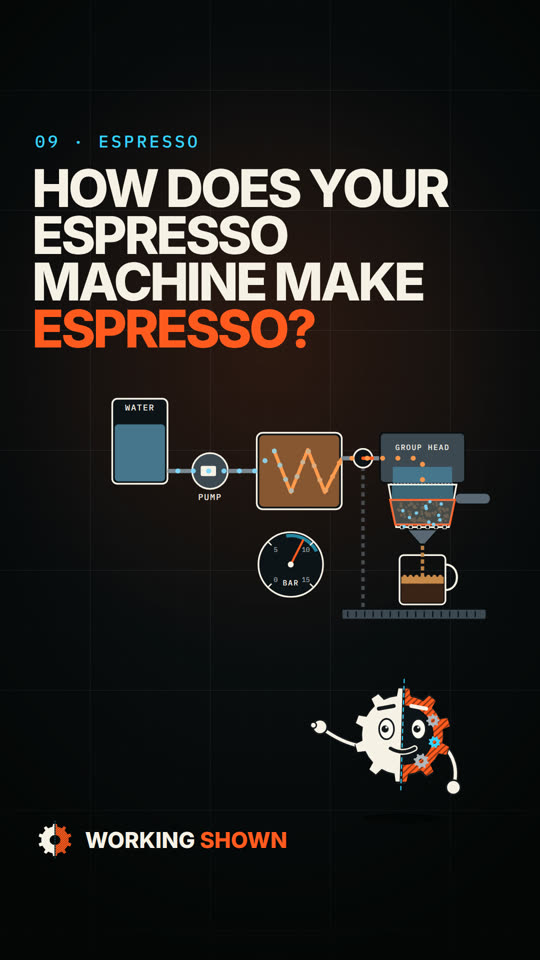
09 · ESPRESSO MACHINES · posted 4 Oct 2026
So how does your espresso machine actually make espresso?
- A pump pushes water through a boiler or a thermoblock (a small block that heats water on demand). It leaves at 92–94 °C.
- The water hits a tamped puck of coffee in a basket full of tiny holes, at about 9 bar.
- That pressure dissolves carbon dioxide from the roast into the water. At the cup the pressure drops, bubbles form, and you get crema.
- Myth: more bars means more flow. A "15 bar" pump is a maximum rating. In a 2026 lab study, flow was roughly linear below about 5 bar, then the puck compressed and the flow stopped rising.
- When the shot ends, a three-way solenoid valve dumps the pressure to the drip tray, so the puck comes out dry.
Line by line
Every claim, with its source.
Every spoken or on-screen factual claim is listed here with the source wording it rests on. Sources were fetched on 2026-10-01.
| Shot | Claim as spoken / on screen | Source and verbatim support |
|---|---|---|
| hook | "How does your espresso machine actually make espresso?" | Question only; no factual claim. |
| heat | "A pump pushes water through a boiler or thermoblock." | Waszkiewicz et al. 2026 (Fig. 1): "Water flows from the pump via pressure regulator, then through a heat exchanger (large amount of water in a boiler is kept at high temperature …) and into the brewing group." Thermoblock: Coffee Parts glossary, "A small aluminium or stainless steel block with a water channel and a heating element that heats water on-demand". Boiler (on screen "stores hot water"): Gaggia, "the new boiler stores more heat". Screen label "heats on demand" rests on the Coffee Parts quote. |
| heat | "It leaves at ninety-two to ninety-four degrees." (92–94 °C stamp) | Illy and Navarini 2011: "Traditional espresso requires specialized equipment that can heat water to a temperature of 92–94 °C and then pressurize it to 9 ± 2 bar." Other standards differ (e.g. INEI 88 ± 2 °C, via Wikipedia): the reel attributes only the Illy figure. |
| puck | "It hits a tamped puck of coffee in a basket of tiny holes." | Waszkiewicz 2026: "the grounds are tamped level with a tamper"; "the water passes through a shower screen then the coffee grounds and filter basket sieve". Illy and Navarini: "The portion is placed in a perforated basket (also known as a filter) and compacted." |
| puck | "The pressure is about nine bar." (9 BAR stamp, gauge climbs to 9) | Waszkiewicz 2026: "hot water is forced at high pressure, commonly around 9 bar"; Illy and Navarini: "9 ± 2 bar". Gauge band 7–11 bar on the dial = 9 ± 2. |
| puck | On-screen "FLOW x.xx g/s" readout | Computed from the paper's fitted model Q = Qc[1 − (1 − P/Pc)^4], Qc = 1.90 g/s, Pc = 12 bar (Waszkiewicz 2026, Eq. 16 and the fit "Qc = 1.90 ± 0.15 g/s … Pc = 12 ± 3 bar"). This is the long-time (equilibrium) flow. Screen label: "FLOW = MODEL FIT, WASZKIEWICZ 2026". |
| crema | "That pressure dissolves carbon dioxide into the water." | Illy and Navarini: "the solubilization of carbon dioxide (present in the coffee bed) in water at high pressure and temperature lead to a supersaturation conditions in the beverage". CO2 origin (screen label): "the carbon dioxide generated during coffee roasting and entrapped within the cell structure". |
| crema | "At the cup it drops, and bubbles form. That's crema." | Illy and Navarini: the CO2 concentration is "approximately three times lower than CO 2 solubility at a pressure of 9.2 bar … but approximately two times higher than the solubility at a pressure of 1 bar", "compatible with a foaming occurring through bubble formation by heterogeneous nucleation and bubble rise". Crema definition: "a coarse dispersion of gas bubbles in a liquid continuous phase … an oil in water (O/W) emulsion of microscopic oil droplets". |
| myth | "Myth: more bars means more flow." (chart, flat curve) | Newswise (University of Warsaw): "as the pressure is increased in the espresso machine, the flow rate of the water through the coffee puck no longer increases". Waszkiewicz 2026: "Darcy-like, linear response is seen at low brewing pressures (< 5 bar), while the flow saturates as a function of pressure in the standard brewing regime". |
| myth | "A fifteen-bar pump is just a maximum." (PUMP MAX 15 BAR marker) | Ulka EAX5 listing: "maximum pressure of 15 Bars". Gaggia page advertises "15 BAR PUMP". Research rig: "Water flows from the pump via pressure regulator". |
| myth | "Past five bar, the puck compresses and flow stalls." | Waszkiewicz 2026: linear only "< 5 bar"; "the coffee bed deforms, and the resulting reduction of inter-pore spaces poses additional resistance to flow"; "for higher pressures the flow saturates". "Stalls": the paper's own word, "However, for higher pressures the flow stalls" (arXiv v1 HTML; the revised PDF says "saturates"). |
| valve | "When the shot ends, a three-way valve dumps the pressure to the drip tray." | Coffee Parts: "releases puck pressure to the drip tray when the shot ends". Whole Latte Love: "cuts the outlet from the brew group and kicks it out into your drip tray"; "instantly relieving the pressure from the brew group". Gaggia: "relieves pressure in the filter-holder immediately after pulling a shot". |
| valve | "The puck comes out dry." | Whole Latte Love: "a dry 'puck' as opposed to a kind of 'mud'". |
| payoff | "Squeezed, then released." | A summary of puck and valve. |
What the drawing simplifies
- The machine is a schematic of the principle, not any model. Real machines differ: a thermoblock has no separate boiler, a heat-exchange machine (Fig. 1 of the paper) is different again, and pump, valve and group positions are illustrative. On screen: "SCHEMATIC · NOT TO SCALE".
- The pressure gauge rises to 9 and the puck flow readout is computed from the fitted model, which describes equilibrium flow (after the usual shot length) for 1 to 12 bar. Early-shot flow is lower and ramps up over 10 to 20 s in the paper's measurements. The chart stops at 12 bar because that is the model's range.
- The dashed "linear, low pressure" line in the myth chart is the model's slope at 0 bar, an illustration of what flow would do if it kept climbing as it does below 5 bar.
- The gauge in the animation stays at 9 bar as the water leaves the basket; the "AT THE CUP: AIR PRESSURE" label indicates where the pressure falls. The CO2 dots are illustrative and have no quantity.
- The drop of the pressure at the cup and the bubble formation are presented as in Illy and Navarini, where they are a hypothesis consistent with the measured CO2 and solubility numbers.
- Dry puck: "a dry puck as opposed to mud" is relative; it is drawn by lightening the puck colour.
- The 15-bar marker is the pump's maximum rating, not any specific machine's brew pressure.
Checked, and cut
- "The 9 bar standard is a scientific optimum": unsupported; the paper traces it to early lever machines (Gaggia, Faema, late 1940s to early 1950s). Kept out of the script for length, but it is the natural follow-up reel or comment reply.
- "Flow decreases above 9 bar": the paper only says it "saturates" (and cites earlier work that flow decreases), so the script says "stalls".
- "Gaggia invented the modern machine in 1948, at 12 atmospheres": Wikipedia only, tertiary.
- SCA standard "9 ± 1 bar, 90–96 °C" and the INEI certified spec (88 ± 2 °C): search-result summaries, not primary pages, so not stated.
- Clive Coffee articles on pump vs brew pressure: blocked (403), not cited.
- Claims about "emulsifying oils": the Illy paper says the crema's liquid phase is an oil-in-water emulsion; it does not say pressure is what emulsifies the oils, so the script does not say so.
Sources
- Illy & Navarini, "Neglected Food Bubbles: The Espresso Coffee Foam", Food Biophysics 2011. pmc.ncbi.nlm.nih.gov/articles/PMC3140933
- Waszkiewicz et al., "Under pressure: poroelastic regulation of flow in espresso brewing", Physics of Fluids 38, 063113 (2026). arxiv.org/abs/2512.21528
- Gaggia Classic product page (three-way valve, 15 bar pump). gaggia.com/manual-machines/new-classic-e24
- Whole Latte Love, "What is a Three-Way Solenoid". wholelattelove.com/blog/a-three-way-solenoid-what-is-that
Found an error?
Tell us at hello@workingshown.xyz or in the comments. We check it against the sources, pin the correction, fix the caption, and log it on the corrections page.