 WORKING
 Receipts / 10
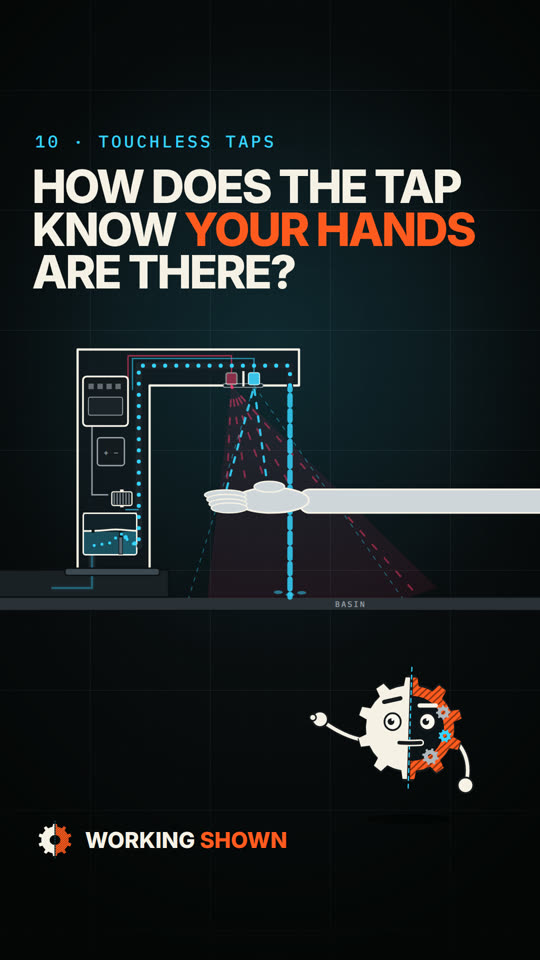
10 · TOUCHLESS TAPS · posted 5 Oct 2026
How does the tap know your hands are there?
- Inside the spout, an infrared LED sends out invisible pulses of light, aimed down at the basin. (Some taps use capacitive sensing instead.)
- Your hands reflect some of it back. A photodiode next to the LED turns that light into a tiny voltage.
- The controller compares the signal with a set level. Hands get closer, more light returns, and the signal crosses the line.
- Then a small solenoid opens a pilot hole. Pressure drops behind a diaphragm, and the mains water pressure pushes the valve open. Battery taps use a latching solenoid; some taps are powered by a small turbine instead.
- Dark, rough fabric reflects less light, so it can miss you. A shiny steel sink can reflect so much that it fools the sensor. Leave your hands there too long, and a timer shuts the water off.
Line by line
Every claim, with its source.
Every spoken or on-screen factual claim is listed here with the source wording it rests on. Sources were fetched on 2026-10-01.
| Shot | Claim as spoken or shown | Source and verbatim support |
|---|---|---|
| hook | "How does the tap know your hands are there?" | A question, no claim. |
| emitter | "Inside the spout, an infrared LED sends invisible pulses of light down at the basin." | US 6,996,863 (TOTO): "The ray emitting section is driven by the microcomputer 1 to emit pulsed infrared rays of a predetermined intensity. A pulsed voltage is applied from the microcomputer 1 to the operation amplifier 52 so as to allow a pulsed constant current to flow through the infrared light emitting diode 51." US 5,025,516: "An emitter is provided for transmitting signals into the area underneath the faucet." TOTO ECOPOWER blog: "Installing the sensor in the spout's tip". "Invisible": infrared is outside visible light; Vishay tests reflective sensors at "950 nm". On-screen "IR shown pink" legend. |
| bounce | "Your hands reflect some back." | US 4,823,414: "light from transmitter 28 is reflected from the hands to the receiver 29". Vishay: "A near by object will subsequently reflect part of that light back towards the sensor." |
| bounce | "A photodiode turns that light into a tiny voltage." | US 6,996,863: "The ray receiving section converts reflected infrared rays from a detected target into a voltage so as to output it." and "composed of a photodiode". ("Tiny" is descriptive: the signal is small compared with the supply; no number is shown.) |
| threshold | "The controller compares it with a set level." | US 6,996,863: "If an amount of reflected rays thereof exceeds a predetermined value ... it is generally determined that something is sensed." US 6,393,634: "the reference value, which the reflection amount is compared with". |
| threshold | "Hands get closer, the signal climbs, and crosses the line." | Vishay: "the amount of radiation that is reflected back depends on ... the distance between the sensor and the reflective object and the reflectivity of the object." The on-screen meter uses relative units computed from distance, cone angle and reflectivity; no numbers shown. |
| valve | "Then a solenoid opens a tiny pilot hole." | US 5,915,665: "the solenoid operates a pilot valve mechanism that includes a cage ... [with] a pilot tube which has a passage ... with a pilot valve seat"; "the plunger 68 ... away from the pilot valve seat 98". Tap patents: US 4,823,414 "turning on a solenoid valve 21". |
| valve | "Pressure drops behind a diaphragm, and the water pushes the valve open." | US 5,915,665: "the pressure in the cavity 85 behind the diaphragm 100 is greater than in the outlet 110, thus maintaining the aperture ... closed."; "This relieves the pressure from within cavity 85 ... With that pressure released, pressure within the inlet 114 forces the diaphragm 100 away from the main valve seat 108 opening a passageway". |
| valve (on screen) | "Latching solenoid: pulse switches it, magnet holds it." | US 5,915,665: "applies a brief electrical current pulse to the electromagnetic coil 52"; "This permanent magnet force is sufficient by itself to overcome the force of spring 70 and hold the [plunger]". Sloan Optima spec: "Bi-stable Magnetic Solenoid Valve". mefe manual: "Solenoid valve: 6 Volt magnet latching". |
| limits | "Dark fabric reflects less, so it can miss you." | Vishay (presence-sensor app note): "a rough dark textile will reflect less light than a smooth light one and this will affect the detection range of the sensor". Vishay VCNT2025X01 app note: "Black velvet 1.5 %" vs "White cotton 110 %" at 950 nm. "Miss you" is the detection-range consequence; the on-screen glove is an illustration. |
| limits | "A shiny sink can reflect too much." | US 6,996,863: "infrared rays emitted from the sensor cause specular reflection on their surfaces to generate reflected rays at an extremely high level. As a result, the sensor erroneously senses the washbasin, the sink or the like as an object such as a hand, and thus the automatic faucet erroneously allows water to run." Also the mefe manual: "Not applicable to stainless steel wash basin or other wash basin which can reflect strong light." |
| limits | "Stay too long, and a timer shuts it off." | US 4,823,414: "timer override means to disrupt fluid flow after a predetermined flow period has timed out". Sloan Optima spec: "Factory Default Timeout: 30s". mefe manual: "If an object is in view continuously for sixty seconds, the faucet will automatically shut off. The faucet will remain off until the object is removed." No number is spoken (varies by model). Timer bar on screen is labelled "SPED UP". |
| payoff | "No eyes. Just reflected light." | Summary of emitter to threshold: one LED and one photodiode measure reflected light; no image is formed (US 6,996,863, US 4,767,922). |
What the drawing simplifies
- The tap is a schematic of the principle, not a specific model. Spout shape, sensor spacing, cone angles, the controller and battery boxes and the valve are illustrative and not to scale. On screen: "SCHEMATIC · NOT TO SCALE · INFRARED SHOWN PINK".
- Infrared is invisible; it is drawn pink (emitted) and cyan (returned) for legibility. The cones are drawn narrow for clarity.
- The received-signal meter uses relative, illustrative units. It is computed as reflectivity x emitter-cone gain x detector-cone gain x inverse-square distance, so it responds to hand position the way the sources describe, but the threshold and values are not from any real product. Reflectivity ratios are inspired by Vishay's table (skin 40% in a worked example; black velvet 1.5%); the glove is a dark fabric, not a statement about skin.
- The steel basin face is tilted by the law of reflection so the centre ray lands on the photodiode. The glare value is illustrative (a mirror keeps the beam concentrated); the TOTO patent says only "extremely high level". A real tap's angle is chosen to avoid this (US 5,025,516).
- The valve is one common pilot-operated diaphragm design, drawn from a latching-solenoid patent for a push-button faucet (US 5,915,665); sensor taps use the same principle with a bi-stable solenoid (Sloan spec). Real valves differ in layout.
- The hand is a stylised outline. Some taps use extra features (modulated light, ambient-light filtering) that are not drawn.
Checked, and cut
- Skin-tone failure claim (2015 soap-dispenser video): not spoken or shown. The fetchable source (Mic, 9 Sep 2015) quotes an engineer who was sceptical that skin tone alone explained the video; no authoritative source (FDA, NIST, manufacturer) was fetched. See dossier.
- "Most taps are infrared": no prevalence statistic. Capacitive faucets exist (Delta, US 8,776,817).
- Specific time-out values (30 s Sloan default, 60 s generic manual): vary by model, so not spoken.
- Sensor range "4 in to 5 in" (Sloan Optima spec): verified but not needed.
- Battery or turbine power (Sloan CR-P2 battery, TOTO EcoPower turbine): verified, in the caption only.
- Kohler "Insight" adaptive sensor and American Standard manuals: UNVERIFIED, not used.
Sources
- US Patent 6,996,863, "Automatic faucet control device and control method" (TOTO). patents.google.com/patent/US6996863
- US Patents 5,025,516 and 4,823,414, "Automatic faucet" and "Automatic faucet-sink control system". patents.google.com/patent/US5025516 and patents.google.com/patent/US4823414
- US Patent 5,915,665, "Latching solenoid valve". patents.google.com/patent/US5915665
- Vishay, application notes on reflective and presence sensors. vishay.com/docs/80000/designingvcnt2025x01.pdf and vishay.com/docs/82904/irreceiversprecencesensorapps.pdf
- Sloan Optima EAF-750 product data sheet. sloan.com/spec-sheet/3335162
Found an error?
Tell us at hello@workingshown.xyz or in the comments. We check it against the sources, pin the correction, fix the caption, and log it on the corrections page.