 WORKING
 Receipts / 13
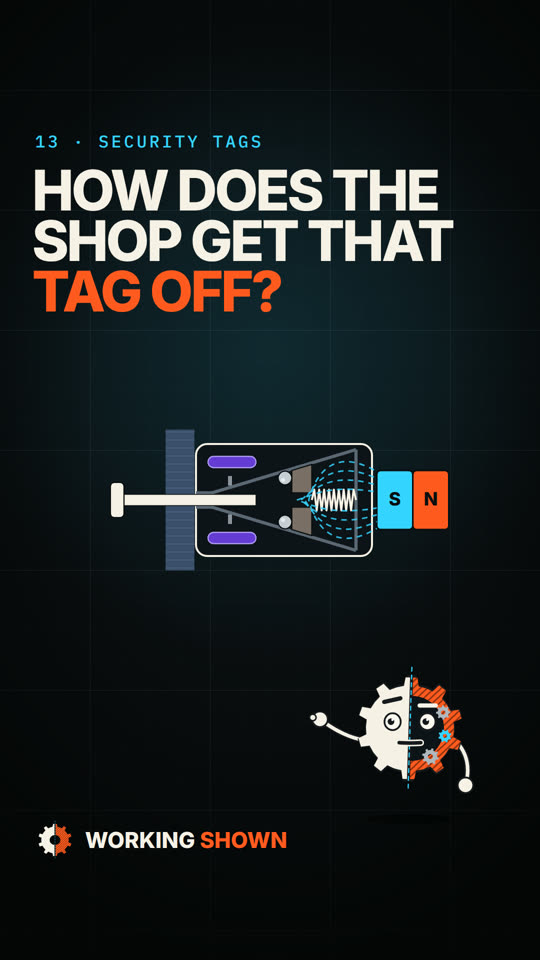
13 · SECURITY TAGS · posted 5 Oct 2026
How does the shop get that tag off your clothes?
- A pin goes through the cloth into the tag. Inside, small balls sit in a tapered cup, pushed by a spring.
- Pull the pin and the balls wedge between it and the narrowing wall.
- At the till, a magnet pulls the spring back. The balls get room, fall outward and the pin slides free.
- Some tags add glass vials of ink. Force the pin and the vials break.
- Many tags also hold a resonant strip or circuit. The exit gate sends a signal (58 kHz for acousto-magnetic, about 8.2 MHz for RF), the tag answers and the alarm sounds.
Line by line
Every claim, with its source.
Every spoken or on-screen factual claim is listed here with the source wording it rests on. Patents fetched on 2026-10-01. The reel explains physics only and gives no removal instructions.
| Shot | Claim as spoken / on screen | Source and verbatim support |
|---|---|---|
| hook | "The lock is hidden." | US7190272B2: "release latch located deep within the interior of the EAS tag and generally beyond the reach of foreign objects". |
| tag | "A pin goes through the cloth into the tag." | US7190272B2: "the tack shaft is inserted through a pin hole in the tag body". |
| tag | "Inside, small balls sit in a tapered cup, pushed by a spring." On screen "BALLS (2 OF 3 SHOWN)". | US4523356A: "a spring for forcing the anvil toward the closed end of the cup"; "the balls are wedged between the tapered interior wall of the cup and the pin". US6631629B1: "an expansion spring which causes the balls to bear against the tapered interwall". Three balls: US7190272B2 claim 7 ("the three ball bearings"); US7073236B2 ("three balls 120"). |
| grip | "Pull the pin, and the balls wedge between it and the narrowing wall. Stuck." | US6631629B1: "Should the first component with the pin be withdrawn by unauthorized personnel, the plug member will be pushed into the tapered recess... and the balls will contract and restrict the shaft or pin member". US7190272B2 claim 7: "the tack shaft will be tightly wedged between the three ball bearings which are tightly held by the wall of said tapered cup". |
| magnet | "At the till, a magnet pulls the spring back." On screen "MAGNETIC DETACHER", "FIELD PULLS THE IRON PLUG BACK". | US7073236B2: "The magnet 170 asserting a pulling force on the spring and the ball holder 125 to move upward"; "applying a magnetic detacher to magnetically pull up a metallic spring and release a locking pin". |
| magnet | "The balls fall outward. The pin slides free." | US7073236B2: "the three balls have open space to move outward from the ball holder 124 thus fall away from the pin 150. the pin 150 is released and the security tag can be unlocked by pulling the pin out". |
| ink | "Some tags add glass vials of ink. Force the pin, and they break." On screen "INK STAINS THE CLOTH". | US5852856A: "the base component contains glass vials (ink ampules)" (in its prior-art summary, via US7652574B2 background); "An attempt to improperly remove the tag causes the pin head and abutment part to push into the ink ampules and fracture them."; "permanently staining the article". US7652574B2: "ink vials that break and release a permanent staining fluid onto the article". |
| gate | "Many tags also hold a resonant strip or circuit." | US4510489A: "an elongated, ductile strip of magnetostrictive ferromagnetic material adapted to ... resonate mechanically"; "an antenna and capacitors forming a resonant circuit". "Many", not "all": some tags carry no EAS element; not counted. |
| gate | "The exit gate pings it, it answers, the alarm sounds." | US12272221B2: "the detectors in an AM system emit periodic bursts at 58 kHz, which causes a detectable resonant response in an AM tag". US4510489A: "if an activated marker passes through the detection system, it is detected ... and an alarm is triggered" (as phrased in US7652574B2 background: "it is detected by the detection system and an alarm is triggered"). |
| gate | On-screen "58 kHz (ACOUSTO-MAGNETIC) · 8.2 MHz (RF)". | US12272221B2 (58 kHz); US7642915B2: "8.2 MHz (+/- about 4%) resonant target". |
| payoff | "Balls, a spring, a magnet." | Summary of tag, magnet. |
What the drawing simplifies
- The tag is a schematic of the ball-clutch principle, after the patents; real tags differ. Ball positions and taper are computed from simple geometry (ball touching pin and wall), not from a product.
- Two of three balls are shown (cross-section). The plug is drawn as iron-coloured; patents call it a metallic spring/ball holder/anvil.
- The ink-vial breaker tongue is illustrative: the patents describe a pin head or breaker element pushing the ampules.
- The magnet is a generic bar magnet, drawn on the right; real detachers and their geometry vary.
- The gate scene is illustrative: wave shapes and the tag's reply are not a true field plot.
- Labels on screen say "SCHEMATIC · NOT TO SCALE".
Checked, and cut
- "No battery": cut in review. US12272221B2 describes tags with "a power source (e.g., a battery or a capacitor)", so the claim isn't universally true.
- "The ink is permanent": patents state it as the aim; no real-world source. Not claimed.
- Magnet strength "150 to 750 Gauss": one patent's background; not shown.
- "All tags have an EAS element": not supported; "many" used.
- Checkpoint and Sensormatic manufacturer pages and reseller "passive, no battery" snippets: UNVERIFIED.
- Any removal method at home: deliberately excluded.
Sources
- US Patent 7,073,236, EAS tag compatible with mechanical and magnetic unlocking detachers. patents.google.com/patent/US7073236B2
- US Patents 4,523,356 and 6,631,629 (ball clutch). patents.google.com/patent/US4523356A and patents.google.com/patent/US6631629B1
- US Patents 5,852,856 and 7,652,574 (ink tags). patents.google.com/patent/US5852856A and patents.google.com/patent/US7652574B2
- US Patents 4,510,489, 12,272,221 and 7,642,915 (EAS markers and gates). patents.google.com/patent/US4510489A
Found an error?
Tell us at hello@workingshown.xyz or in the comments. We check it against the sources, pin the correction, fix the caption, and log it on the corrections page.