 WORKING
 Receipts / 14
14 · TYRE VALVES · posted 6 Oct 2026
Why doesn't the air leak out of your tyre?
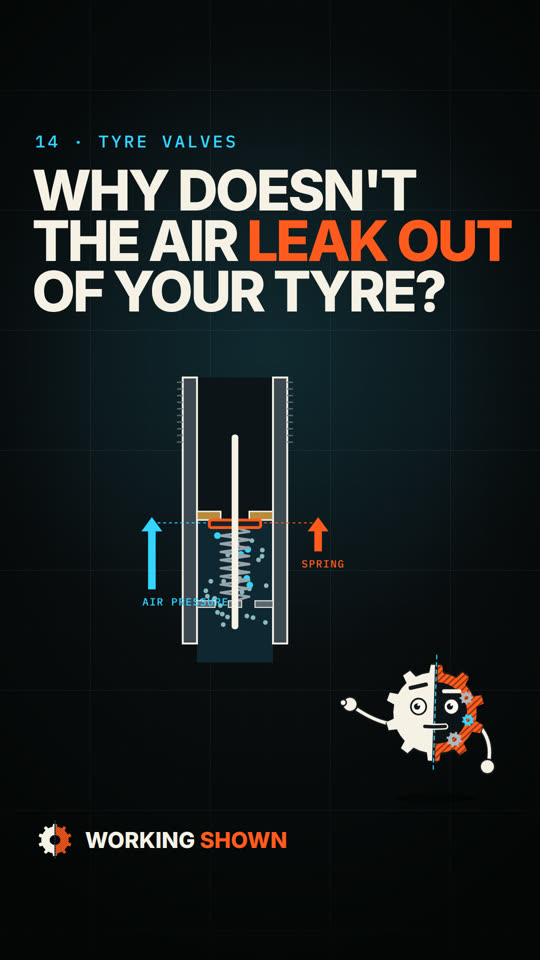
- Inside the valve stem is a valve core: a soft seal on a pin, held against its seat by a spring.
- The spring isn't alone. The manufacturer says the core closes by "the valve core's spring and internal tire pressure". Pressure pushes on the seal, and that adds up to a force.
- Press the pin and the seal lifts off its seat. That's what a pump hose does when you fill a tyre.
- The cap isn't the main seal. It's a backup ("redundant") seal, and it keeps dirt off the sealing surfaces.
- A typical car tyre runs 30 to 35 psi. Your own number is on the label on the driver's door edge, or in the owner's manual.
Line by line
Every claim, with its source.
Every spoken or on-screen factual claim is listed here with the source wording it rests on. Sources fetched on 2026-10-01. SP = Schrader Pacific valve-core datasheet, https://schrader-pacific.com/wp-content/uploads/Valve-Core.pdf.
| Shot | Claim as spoken | Source and verbatim support |
|---|---|---|
| hook | "Why doesn't the air leak out of your tyre?" | A question, not a claim. The answer is the valve core (see core, press). |
| core | "Inside the stem sits a valve core: a soft seal on a pin, held against its seat by a spring." | SP: "Valve cores are a spring actuated cartridge type check valve assembly that screws into a mating threaded cavity (housing). The valve has a soft elastomeric seating washer and an extended actuation shaft." US3568708A (https://patents.google.com/patent/US3568708A/en): "a resilient valve flange bonded to the pin… an axial spring… to bias the valve element closed against the seat". Wikipedia (Schrader valve): "The valve core is a poppet valve assisted by a spring." |
| press | "The spring isn't alone. Air pressure from inside the tyre helps keep it shut." | SP: "When the hose fitting is removed the valve core's spring and internal tire pressure closes the valve." |
| press | "That pressure adds up to a force on the seal." (on-screen: 2.2 bar × 7.1 mm² = 1.6 N) | NASA Glenn, https://www.grc.nasa.gov/www/k-12/airplane/pressure.html: "the molecules impart momentum to the walls, producing a force perpendicular to the wall"; "the force per area (the pressure)". F = P × A is computed in code: 2.2 bar = 0.22 N/mm², Ø3 mm gives 7.07 mm², so F = 1.56 N. Both 2.2 bar and Ø3 mm are illustrative and labelled so. 2.2 bar sits inside 30-35 psi (2.07-2.41 bar). |
| open | "Press the pin and the seal lifts off its seat." | SP: "When the actuation shaft is depressed it forces the pin to move off the valve core's housing seat allowing flow to pass through the valve." |
| open | "That's what a pump hose does." | SP: "When a pressurized hose fitting is placed over the tire valve stem the fitting pushes the valve core pin inwards allowing the flow of air to enter the tire." |
| cap | "The cap is a backup seal." | SP: "the caps serve as a redundant seal to the valve". |
| cap | "It also keeps dirt off the sealing surfaces." | SP: "the caps assure the valves and port surfaces remain clean while valve is in service." Wikipedia: "A valve cap on a Schrader valve prevents the entry of contaminants that may interfere with the sealing surfaces and cause leakage." |
| psi | "A typical car tyre holds 30 to 35 psi." (on-screen: ≈ 2.1-2.4 bar) | Progressive Life Lanes, https://lifelanes.apps.progressive.com/tire-pressure-guide/: "Many passenger car manufacturers typically recommend a normal tire pressure range of 30-35 pounds per square inch (PSI)." bar = psi × 0.0689476 (30 psi = 2.07, 35 psi = 2.41). |
| psi | "Your door sticker has yours." | NHTSA (Wayback of nhtsa.gov/vehicle-safety/tires): "…can be found on the Tire and Loading Information Label on the driver's side door edge or in your owner's manual." TyreSafe (UK): "inside the fuel filler cap or driver's door sill". The door location is car-dependent; owner's manual is the fallback (stated on the caption). |
| payoff | "A spring, plus pressure." | Summary of press (SP: "spring and internal tire pressure"). |
What the drawing simplifies
- Schematic of the principle, not any specific core; proportions, bore width, seat and seal sizes are illustrative. On-screen: "SCHEMATIC · NOT TO SCALE".
- The orientation (seal below the seat, tyre air below, pin pointing out) follows US3568708A's "downwardly facing seat" and spring under the flange. The drawing of the pressure acting on the seal's underside is our geometry from that patent; the datasheet states only that pressure helps close the valve.
- The spring arrow is deliberately not sized: no spring force is sourced. Do not read the arrows as a force comparison. Only the pressure arrow is computed, from illustrative inputs.
- Real cores have slots or openings in the cup so air reaches the seal; the cup is drawn simplified.
- The pump air path (open shot) is illustrative. A pump must exceed the tyre pressure to push air in; not said in the reel.
- The door label is drawn generically, "COLD PRESSURE: ? PSI", wording simplified from NHTSA's "Tire and Loading Information Label".
Checked, and cut
- "The spring only helps / the tyre pressure does the real work": no Schrader source; the manufacturer says "spring and internal tire pressure". Dropped.
- "Poppet valves seal better under pressure" (Wikipedia Poppet valve): the sentence is about exhaust valves. Not used for Schrader.
- "The cap is the main seal" (FleetOwner, unnamed manufacturers) vs "redundant seal" (Schrader Pacific, named): went with the named manufacturer.
- Presta valve (no spring; pressure holds it shut): true per Sheldon Brown, cut for length.
- "Invented 1891 / patented 1893 / unchanged since": the 1893 patent is a nut-clamped packing, not the spring core. Cut.
- Any spring force, seal diameter or seat diameter as a real number: no source.
- NHTSA typical-psi number: nhtsa.gov is blocked (403); only the placard wording was obtained via Wayback.
Sources
- Schrader Pacific, valve core datasheet. schrader-pacific.com/wp-content/uploads/Valve-Core.pdf
- US Patent 3,568,708, "Tire valve core". patents.google.com/patent/US3568708A
- NASA Glenn, "Gas Pressure". grc.nasa.gov/www/k-12/airplane/pressure.html
- NHTSA TireWise, tyre inflation label. nhtsa.gov/vehicle-safety/tires
- Progressive Life Lanes, tire pressure guide. lifelanes.apps.progressive.com/tire-pressure-guide/
Found an error?
Tell us at hello@workingshown.xyz or in the comments. We check it against the sources, pin the correction, fix the caption, and log it on the corrections page.