 WORKING
Receipts / L17
L17 · · posted 24 Oct 2026
How does a jack lift a car with one arm?
Line by line
Every claim, with its source.
Sources were fetched on 2026-10-20.
Source key
- WP-PL: Wikipedia, "Pascal's law". https://en.wikipedia.org/wiki/Pascal%27s_law
- WP-JACK: Wikipedia, "Jack (device)". https://en.wikipedia.org/wiki/Jack_(device)
- GW: GEARWRENCH Bottle Jacks User Manual, 2T / 4T / 6T (GWHBJ2T, GWHBJ4T, GWHBJ6T). https://gearwrench.com/sites/gearwrench/files/2024-12/Q2%20-%20GW%20Bottle%20Jacks%20User%20Manual_2T%204T%206T.pdf
| Shot / text | Claim | Source and verbatim support |
|---|---|---|
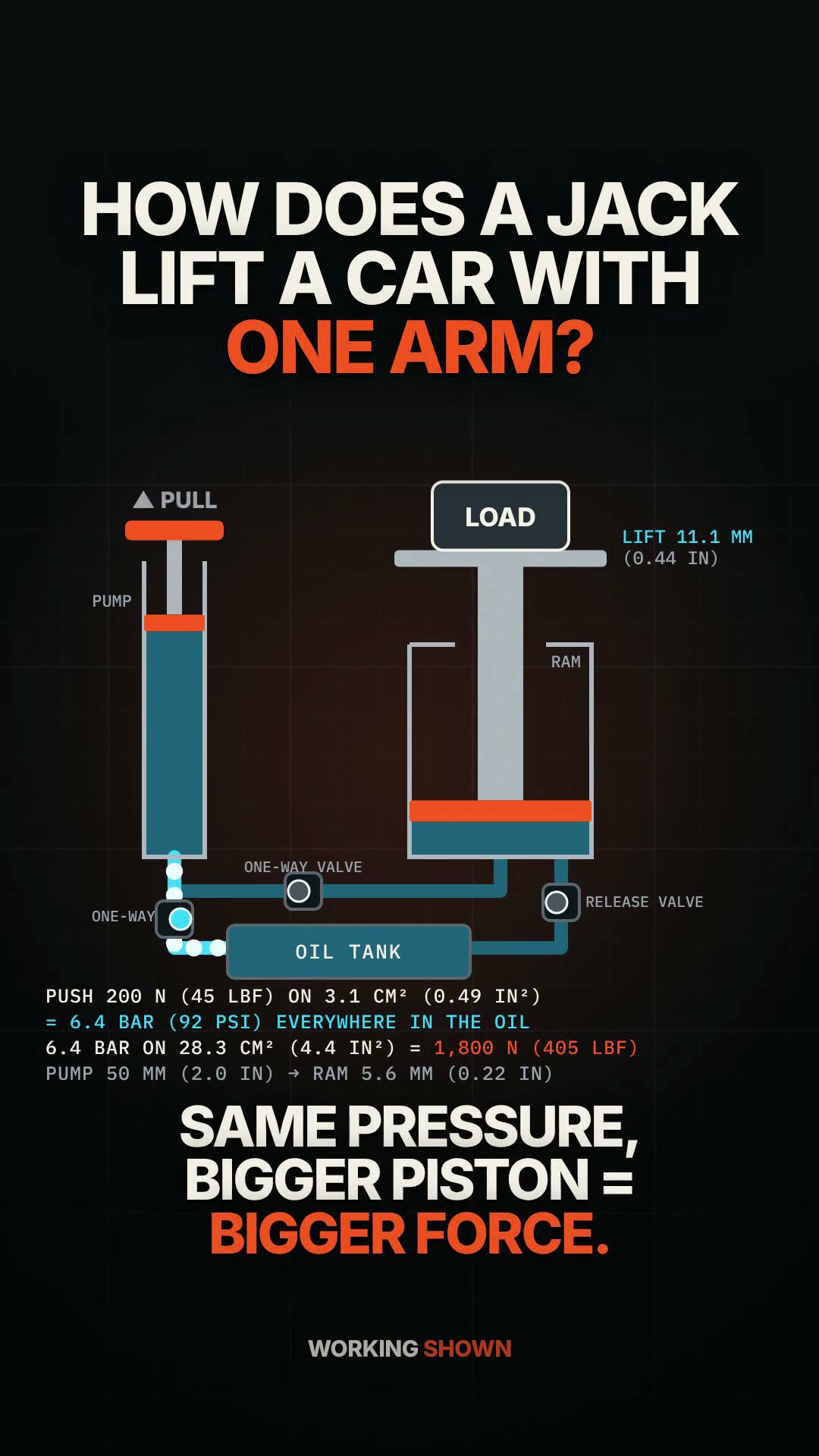
| hook "HOW DOES A JACK LIFT A CAR WITH ONE ARM?" | A hydraulic jack lifts a load by pumping oil into a cylinder. | WP-JACK: "A hydraulic jack uses a liquid, which is incompressible, that is forced into a cylinder by a pump plunger." |
| pump piston, ram, one-way valves | The pump draws oil from the reservoir past a suction valve and pushes it through a discharge check valve into the cylinder. | WP-JACK: the plunger draws fluid from the reservoir past a suction valve into the pump chamber. "When the plunger moves forward, it pushes the oil through a discharge check valve into the cylinder." "…the suction ball within the chamber is forced shut, and oil pressure builds in the cylinder." |
| "= 6.4 BAR (92 PSI) EVERYWHERE IN THE OIL" | Pressure applied to an enclosed fluid is transmitted equally throughout it. | WP-PL: a change in pressure at any point in an enclosed incompressible fluid at rest is transmitted "equally and undiminished to all points in all directions throughout the fluid." |
| answer "SAME PRESSURE, BIGGER PISTON = BIGGER FORCE" | Output force scales with the ratio of piston areas: F₂/F₁ = A₂/A₁. | WP-PL: gives F₂/F₁ = A₂/A₁ (example: area ratio 50, a 1 N input supports a 50 N load). |
| numbers: 200 N, 3.1 cm², 6.4 bar, 28.3 cm², 1,800 N | Worked example on assumed sizes: pump piston 2 cm across (π·1² = 3.14 cm²), ram 6 cm across (π·3² = 28.27 cm²), ratio 9. 200 N / 3.14 cm² = 63.7 N/cm² = 6.37 bar. 63.7 N/cm² × 28.27 cm² = 1,800 N. | Arithmetic on the example (labelled on screen as a schematic example, not a real jack's spec). Conversions: 200 N = 44.96 lbf; 3.14 cm² = 0.487 in²; 6.37 bar = 92.3 psi; 28.27 cm² = 4.38 in²; 1,800 N = 404.6 lbf. |
| "PUMP 50 MM (2.0 IN) → RAM 5.6 MM (0.22 IN)", LIFT counter | The ram moves 1/9 of the pump piston's distance (equal volumes, area ratio 9). | Volume of oil moved is the same: 5 cm × 3.14 cm² = 15.7 cm³ → 15.7 / 28.27 = 0.556 cm = 5.56 mm. 50 mm = 1.97 in; 5.56 mm = 0.219 in. Four strokes per loop = 22.2 mm (0.87 in). Ideal, no leakage or compressibility. |
| release valve opens at the end, ram lowers | A bottle jack is lowered by opening its release valve; it must be closed to lift. | GW: "Lower the Bottle Jack by turning the Release Valve counterclockwise." and "turn clockwise to tighten and close the Release Valve." Troubleshooting: "Release valve is not completely closed" is listed as a cause of the saddle not lifting / not lowering completely. |
| "OIL TANK" | The jack has a hydraulic oil reservoir. | GW: "Adding Hydraulic Oil … The oil level should align with the bottom of the fill hole." WP-JACK: the plunger draws fluid "from the reservoir". |
What the drawing simplifies
- Schematic, not to scale for a real jack: real bottle jacks use a lever handle (a second force multiplier), a much smaller pump piston and many more strokes. The loop isolates the piston-area effect only.
- The loop shows four strokes of 50 mm for a 22 mm total lift; a real jack's saddle rises by roughly the minimum-to-maximum height range, which takes many strokes.
- Valve positions are drawn for clarity; the exact layout varies between jacks.
Sources
Found an error?
Tell us at hello@workingshown.xyz or in the comments. We check it against the sources, pin the correction, fix the caption, and log it on the corrections page.