 WORKING
Receipts / L25
L25 · · posted 27 Oct 2026
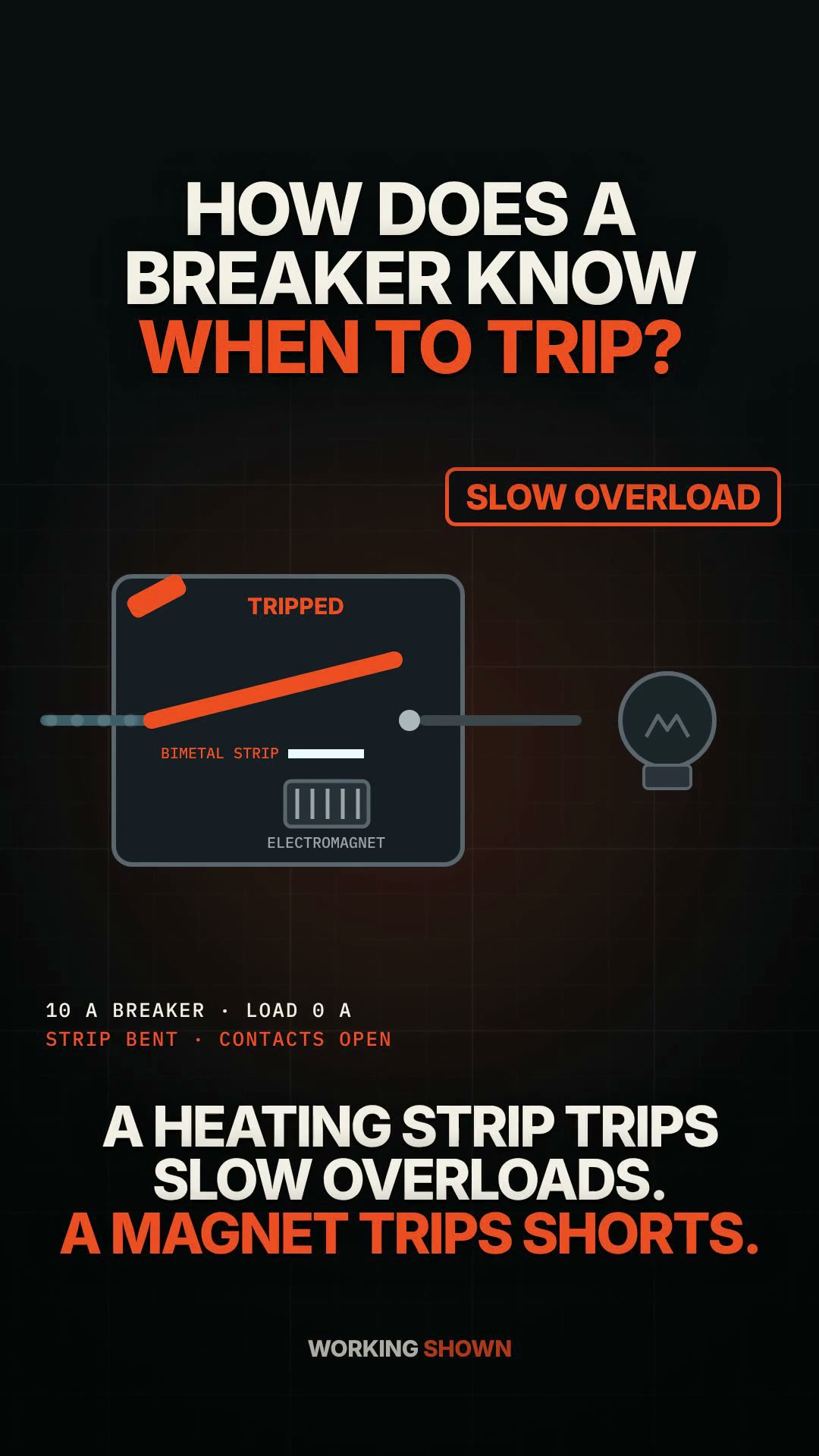
How does a breaker know when to trip?
Line by line
Every claim, with its source.
Sources were fetched on 2026-10-20.
Source key
- WP-CB: Wikipedia, "Circuit breaker" (thermal-magnetic section). https://en.wikipedia.org/wiki/Circuit_breaker
| Shot / text | Claim | Source and verbatim support |
|---|---|---|
| overload: strip heats and bends | A bimetallic strip handles lesser but longer-term overcurrent; brief surges can pass. | WP-CB: it responds to "lesser but longer-term over-current conditions." |
| short circuit: magnet trips at once | The electromagnet responds instantly to large surges, with no intentional delay. | WP-CB: "the electromagnet responding instantaneously to large surges in current"; "the magnetic element trips the circuit breaker with no intentional additional delay." |
| lever ON / TRIPPED, reset | A manual lever is used to trip and reset the breaker. | WP-CB: a manual lever is "used to manually trip and reset the circuit breaker." |
| 10 A breaker; load 10 → 13 A, then 40 A | Type B trips instantly at roughly 3 to 5 times its rating; a 10 A type B at about 30–50 A. | WP-CB: "a 10 A Type B breaker trips instantly at about 30 to 50 A." The 10 → 13 A overload and the 40 A short are illustrative values within those ranges. |
What the drawing simplifies
- Schematic, not to scale. A real breaker's mechanism is enclosed and more complex; trip timing is drawn for clarity (a 13 A load on a 10 A breaker really takes much longer to trip).
- Do not treat the on-screen amps as a real breaker's trip curve.
Sources
Found an error?
Tell us at hello@workingshown.xyz or in the comments. We check it against the sources, pin the correction, fix the caption, and log it on the corrections page.