 WORKING
Receipts / S07
S07 · · posted 16 Oct 2026
A brand-new Boeing 767, sixty-nine people on board, forty-one thousand feet up...
Line by line
Every claim, with its source.
Every spoken or on-screen factual claim, with the wording it rests on. Sources fetched 2026-10-11. The backbone is the Lockwood Board of Inquiry Final Report (April 1985), read from the FAA-hosted PDF; page numbers are the report's own. Lockwood is imperial (feet, pounds) for heights and distances and metric (litres, kilograms) for fuel; every converted unit below is our conversion (1 kg = 2.2046 lb; 1 ft = 0.3048 m; 1 US gal = 3.785 L; 1 in = 2.54 cm).
| Shot | Claim as spoken or shown | Source and verbatim support |
|---|---|---|
| hook | "A brand-new Boeing 767" | ASN C-GAUN: "Year of manufacture: 1983". Lockwood p. 27: of the 767s "12 had been ordered and 4 delivered at the time in question". |
| hook | "sixty-nine people on board" | Lockwood p. 9: "Captain Robert Pearson and First Officer Maurice Quintal. There were 6 cabin crew and 61 passengers." 2 + 6 + 61 = 69. ASN: "Occupants: 69". |
| hook | "forty-one thousand feet up... about to run out of fuel" | Lockwood p. 28: low fuel pressure warning, then the captain "commenced a descent from 41,000 feet"; p. 9: "the aircraft ran out of fuel over Red Lake, Ontario". Worded "about to": the engines did not stop at 41,000 ft (see warning). |
| hook (screen) | "STORY 07 · THE GIMLI GLIDER" | Nickname: CBC Archives, "When a metric mix-up led to the 'Gimli Glider' emergency". |
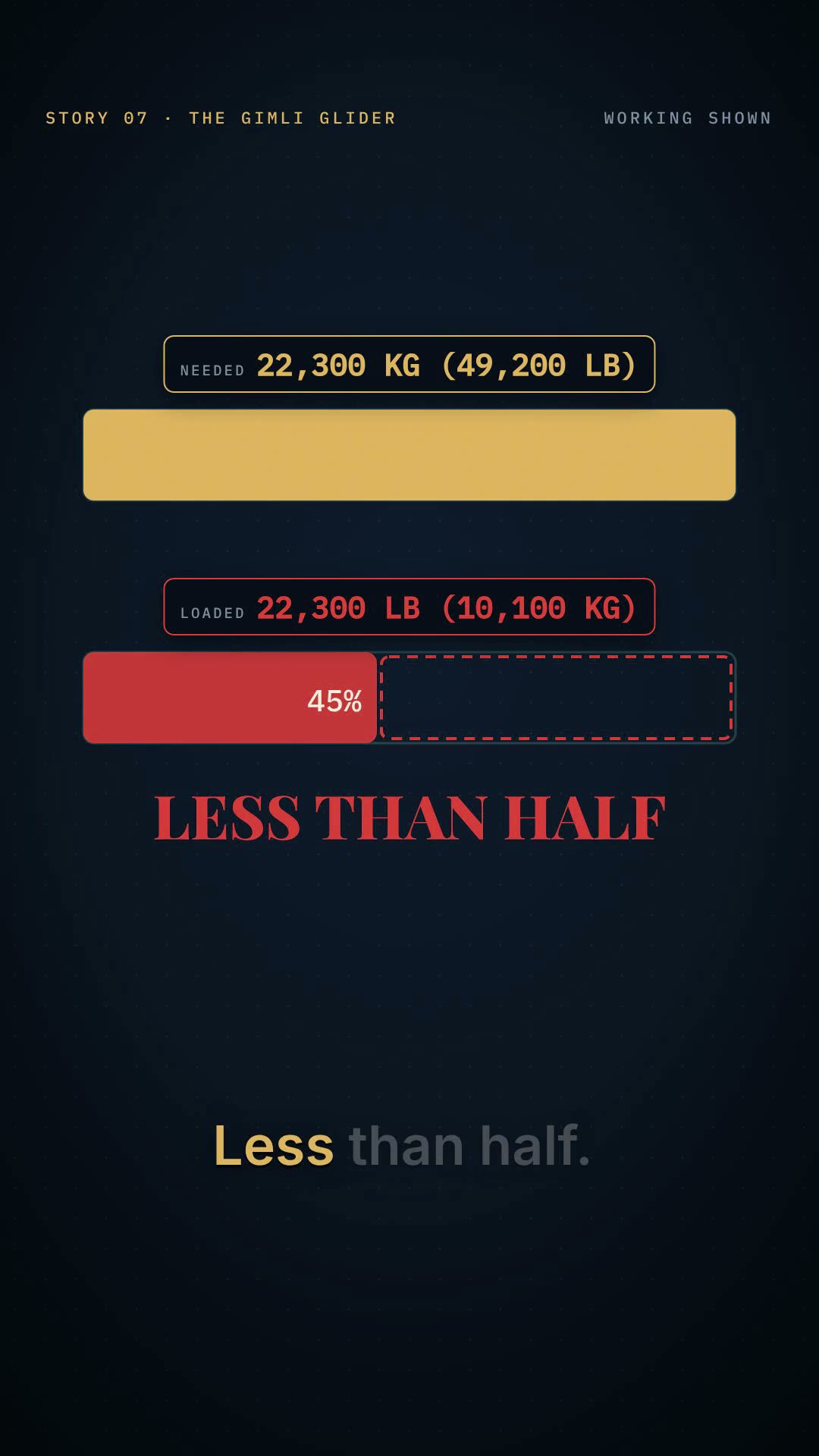
| answer | "They needed twenty-two thousand three hundred kilograms of fuel." | Lockwood pp. 41–42 reconstruction: required (flight-plan minimum) 22,300 kg. (Lockwood adds 300 kg taxi fuel for 22,600 kg total, p. 42.) |
| answer | "They loaded twenty-two thousand three hundred... pounds. Less than half." | Our arithmetic on Lockwood's figures: the crew's believed total, 13,597 + 8,703 = 22,300, was in pounds (Lockwood p. 41: "It was in pounds but everyone involved believed it to be kilograms"). 22,300 lb ≈ 10,100 kg ≈ 45 % of 22,300 kg. Lockwood p. 28: "the aircraft left each airport in turn with only half the amount of fuel the flight crew thought they had." "Loaded" = total on board at departure, not the amount pumped. |
| answer | "So how did all sixty-nine walk away?" | Lockwood p. 9: "no loss of life, nor were there any significant physical injuries." p. 29: "The passengers and crew were safely evacuated." (CBC: minor injuries on the rear slide.) |
| answer (screen) | "22,300 KG (49,200 LB) vs 22,300 LB (10,100 KG)" | 22,300 kg from Lockwood p. 42; 22,300 lb is our arithmetic on Lockwood (above). Both bracketed conversions are ours (49,163 lb; 10,115 kg), rounded. |
| answer (screen) | "69 ABOARD · 0 ENGINES?" | As above (69); both engines failed: Lockwood pp. 28–29. |
| metric | "July nineteen eighty-three." | Lockwood p. 9: emergency landing "on July 23, 1983". |
| metric | "Air Canada's new 767s count fuel in kilograms; the rest of the fleet uses pounds." | Lockwood p. 27: the 767s ordered "with their fuel gauges reading in kilograms, a metric measurement"; p. 60: kilograms for fuel weight was "confined in the Air Canada fleet to the Boeing 767 aircraft". |
| metric | "And this plane's fuel gauges are blank." | Lockwood p. 27: reset breaker "caused the fuel gauges in the cockpit to go blank"; p. 28: Pearson "left Montreal and later left Ottawa with blank fuel gauges". |
| metric (screen) | Fleet row LB vs 767 KG; gauges "- - - -" | As above (p. 27, p. 60). |
| breaker | "A technician had kept them working by pulling one circuit breaker." | Lockwood p. 25 (Edmonton, 22 July): Yaremko "found that he could obtain fuel indication by pulling and deactivating the channel 2 circuit breaker"; p. 26: "All three fuel gauges operated normally" on the flights to Montreal. |
| breaker | "In Montreal, another pushed it back in, then got distracted by the fuel truck. The gauges went dark." | Lockwood p. 27 (Ouellet): "Before doing the test, he reset the number 2 channel circuit breaker. This caused the fuel gauges in the cockpit to go blank." He "was distracted by the arrival of the fueller and forgot to pull the number 2 circuit breaker". |
| breaker | "The captain believed that had been cleared. It hadn't." | Lockwood p. 27: "Captain Pearson knew that the aircraft was not legal to go with blank fuel gauges." He testified a technician assured him Maintenance Central had authorised it; "No such authorization had in fact been given. There is even some question as to whether this conversation took place." |
| breaker (screen) | "NOT CLEARED" stamp | Same (Lockwood p. 27); Board finding p. 28: "contrary to the provisions of the MEL". |
| dip | "So they dipstick the tanks and do the maths by hand. Litres into kilograms." | Lockwood p. 38: "a three step process: (1) the drip ... in centimetres ... (2) conversion of the drip stick readings in centimetres to the volume in litres; and (3) conversion of the volume in litres to the weight in kilograms." |
| dip | "Nobody there had done it before." | Lockwood p. 39: "no one involved in making the calculations in Montreal seemed to know how to convert litres to kilograms"; Bourbeau: "Mr. Quintal says that he never done it before, and we says we haven't done it before either". |
| dip | "The fueller hands them a number: one point seven seven." | Lockwood p. 28: the fueller supplied 1.77, which "is the figure used to convert litres to pounds"; p. 39: Quintal "believed that by multiplying the number of litres by the specific gravity of 1.77 he would have arrived at kilograms". |
| dip (screen) | "64 cm (25 in) / 62 cm (24 in) → 7,682 L (2,029 US gal) · × 1.77" | Lockwood pp. 41–42: drip readings 64 and 62 cm; 3,924 + 3,758 = 7,682 L. Inches and US gallons are our conversions (25.2 in, 24.4 in, 2,029 US gal). |
| maths | "But one point seven seven turns litres into pounds." | Lockwood p. 28: 1.77 "is the figure used to convert litres to pounds. The conversion factor to convert litres to kilograms is typically around .8." |
| maths | "A pound is less than half a kilo, so every number after it is two point two times too big." | Lockwood p. 41: Air Canada manual: "Kilograms loaded = pounds loaded divided by 2.2". 1 lb = 0.4536 kg. The 13,597 figure is 2.2 times the true kilograms (13,597 vs 6,180 kg); everything the crew derived from it inherited the error. |
| maths | "In Ottawa they check again, make the same mistake... and it looks right." | Lockwood p. 43: Pearson got "1.78 from the fueller" and "calculated that he had over 20,000 "units of fuel""; p. 28: left "each airport in turn with only half the amount". "Looks right": over 20,000 matched the roughly 22,300 they believed they had loaded (our reading of p. 43; dossier retention beat 5). |
| maths (screen) | "7,682 × 1.77 = 13,597 → 'KG?' crossed, 'LB'" | Lockwood p. 41: 13,597, "It was in pounds but everyone involved believed it to be kilograms". |
| maths (screen) | "Real: 6,180 kg (13,600 lb)" | Lockwood p. 41: 7,682 × 1.77 ÷ 2.2 = 6,180 kg. 13,600 lb is our conversion (13,624). |
| maths (screen) | "Ottawa: × 1.78 → 'over 20,000' vs real 9,144 kg (20,160 lb)" | Lockwood p. 43: "total number of litres of fuel that was in both tanks, 11,430" × "1.78" → "over 20,000". 9,144 kg = 11,430 L × 0.8 (our arithmetic; matches Nelson, Soaring 1997: "they left ... with only 9144 kilos"). 20,160 lb is our conversion. |
| warning | "Over Red Lake, Ontario, forty-one thousand feet, twelve and a half kilometres up, a warning comes on. Low fuel pressure." | Lockwood p. 28: "instruments in the cockpit warned of low fuel pressure in the left fuel pump" ... "commenced a descent from 41,000 feet"; p. 9: ran out of fuel "over Red Lake, Ontario". 12.5 km is our conversion (12,497 m). |
| warning | "They start down, turning for Winnipeg." | Lockwood p. 28: the captain "commenced a descent from 41,000 feet"; "The Captain at once decided to divert the flight to Winnipeg, then 120 miles away". |
| warning | "Then the left engine stops. Then the right." | Lockwood pp. 28–29: "Within minutes, the left engine failed, followed by failure of the right engine. The aircraft was then at 35,000 feet". |
| warning (screen) | "Ottawa → Edmonton" route line | Lockwood p. 9: "Flight no. AC 143 from Montreal to Edmonton with an intermediate stop at Ottawa". |
| warning (screen) | Altitude chip "starts 41,000 FT (12,500 M) and falls to 35,000 FT (10,700 M) by the time both engines read OFF" | 41,000 ft is where the warning came (Lockwood p. 28). Lockwood pp. 28–29: "Within minutes, the left engine failed, followed by failure of the right engine. The aircraft was then at 35,000 feet". Metres are our conversions (12,497 m; 10,668 m). |
| dark | "No engines, no power. The glass cockpit goes black. Left: a compass, a horizon, an airspeed dial and an altimeter." | Lockwood p. 29: "Without power to generate electricity all the electronic gauges in the cockpit became blank, leaving only stand-by instruments, consisting of a magnetic compass, an artificial horizon, an airspeed indicator and an altimeter." "No power" = no generated electrical power; the ram air turbine still gave some hydraulic pressure for the controls (FSA, Nelson; secondary). |
| dark | "No flaps. One try." | Lockwood p. 29: "the aircraft had no flaps or slats with which to control the rate and speed of descent. There was only one chance at a landing." |
| gimli | "Winnipeg is too far." | Lockwood p. 29: "It soon became evident that they would not be able to make it to Winnipeg." |
| gimli | "But the first officer, Maurice Quintal, knows an old air-force base close by. He'd once been stationed there. Gimli." | Lockwood p. 29: Pearson "redirected the aircraft towards Gimli, some 12 miles away"; p. 9: "a disused military airbase at Gimli, Manitoba". Stationed there: CBC Archives: "First Officer Maurice Quintal had once been stationed at the Royal Canadian Air Force base at Gimli"; FSA 2003: "Quintal had been stationed there when serving in the airforce"; Nelson 1997 agrees. Secondary sources only (not in Lockwood); his role there is not stated. |
| gimli (screen) | Gimli "on Lake Winnipeg's west shore" | Lockwood p. 29: "Gimli, some 12 miles away on the western shore of Lake Winnipeg". |
| strip | "Here's the problem. Gimli is a disused air base." | Lockwood p. 9: "a disused military airbase"; p. 29: "The airfield at Gimli is a disused military base." |
| strip | "Part of the runway is now a drag strip, and tonight racing families are camped just past the end." | Lockwood p. 29: "The far end of the runway from where the aircraft touched down has been adapted for use as a drag racing strip. Just beyond the strip used for racing, drag racing drivers and their families were staying for the weekend in tents and caravans." Evening: first warning "shortly after 8:00 p.m." (p. 28). |
| strip (screen) | "Runway 2,195 m (7,200 ft)"; DRAG STRIP; tents and caravans | Lockwood p. 29: "the 7200 foot runway". Metres ours. (Nelson/FSA say 6,800 ft; we follow Lockwood.) |
| slip | "And they're too high, too fast." | Nelson 1997 (secondary, crew interviews): too high and fast on approach, "slowed to 180 knots". Lockwood p. 29: they discussed a side-slip "to lose height and speed". |
| slip | "But Captain Bob Pearson flies gliders." | Lockwood p. 29: "one of Captain Pearson's skills is gliding. He proved his skill as a glider pilot by using gliding techniques". CBC: "he co-owned a Blanik L-13 sailplane". |
| slip | "One wing down, opposite rudder: he flies the 767 sideways, to dump height without gaining speed." | FAA Airplane Flying Handbook ch. 9: "the wing on one side is lowered by use of the ailerons. Simultaneously, sufficient opposite rudder is used"; "An airplane in a slip is in fact flying sideways through the air"; "A forward slip is used to dissipate altitude and increase descent rate without increasing airspeed." Lockwood p. 29: "executing a side-slip to lose height and speed ... This the Captain did on the final approach". FSA: "turning the yoke to the right at the same time as he jammed his foot against the left rudder pedal". |
| slip (screen) | Banked 767, opposite rudder, path straight, drag grows, altitude falls while airspeed holds | FAA AFH ch. 9: "remains on its original flightpath"; "Slips are characterized by a marked increase in drag"; "descend rapidly without an increase in airspeed". Staged line art. |
| land | "They touch down within eight hundred feet, two hundred and forty metres, of the runway's start." | Lockwood p. 29: "touched down within 800 feet of the threshold." 240 m is our conversion, rounded (243.8 m). |
| land | "The nose wheel never locked." | Lockwood p. 101: gear dropped "by their own weight. But only the main wheels locked". |
| land | "It folds, the nose grinds along the concrete... and the jet stops before the tents." | Lockwood p. 29: friction "caused by contact of the bottom of the nose with the concrete runway. This averted disaster to people at the far end of the runway"; "Fortunately, the aircraft came to a stop before it reached them." Sparks on screen: our dramatisation. |
| myth | "So, a metric mix-up? The inquiry called that simplistic and inaccurate." | Lockwood p. 35: "To suggest that the accident was the result of a metric mix-up is simplistic and inaccurate." |
| myth | "It took a faulty gauge, a breaker, a plane flown against the rules, untrained ground crew, and two missed checks." | Faulty gauge: Lockwood p. 97, processor fault from "a 'cold solder' joint" and "a design error in the processor itself". Breaker: p. 27. Against the rules: p. 28, "contrary to the provisions of the MEL". Untrained: p. 39, "no one involved ... seemed to know how to convert litres to kilograms". Two missed checks: Montreal, Pearson: "your calculations to me look mathematically correct" (p. 41); Ottawa, same error with 1.78 (p. 43). |
| myth (screen) | "'JUST A METRIC MIX-UP' → 'SIMPLISTIC AND INACCURATE' · BOARD OF INQUIRY, 1985" | Lockwood p. 35 (quote above); report dated April 1985. |
| close | "Both fuel tanks were dry." | Lockwood p. 29: "Both fuel tanks were found to be dry." |
| close | "Nobody died." | Lockwood p. 9: "no loss of life". ASN: "Fatalities: 0". |
| close | "The plane flew on until two thousand eight, nicknamed the Gimli Glider." | CBC Archives: "finally retired in 2008"; nickname in CBC headline. This Day in Aviation (secondary): "retired to The Boneyard at Mojave". |
| close (screen) | Tanks gauge: 0 | Lockwood p. 29 (above). |
What the drawing simplifies
- The opening 767 above the clouds, the glide, the slip, the touchdown and the nose-gear collapse are staged line art. No free photo of the flight or the landing exists.
- The breaker panel, fuel truck, drip stick and calculator strip are our own drawings. The Lockwood report is Crown copyright (© Minister of Supply and Services Canada 1985), so its pages are not shown; we redraw its arithmetic as type.
- Photo "C-GAUN, Toronto 1984" is the actual aircraft, a year after the accident (Andrew Thomas, CC BY-SA 2.0).
- Photo "Gimli, July 1983" is the real aircraft after the landing, nose down on the drag strip (photographer unnamed; CC BY-SA 3.0, Wikimedia VRT ticket 2012070510009901). Small file, used as a paper card.
- The 767-200 flight-deck photo (Cory W. Watts, CC BY-SA 2.0) is American Airlines N338AA in 2009, NOT Flight 143's cockpit. It is a reference for the line-art cockpit and must not be captioned as C-GAUN.
- Pearson and Quintal appear only as line-art figures (no licensed photos).
- Map distances and the Ottawa → Edmonton line are schematic.
Checked, and cut
- "They ran out of fuel at 41,000 feet": the first warning came at 41,000 ft; Lockwood puts both engines out by 35,000 ft, Nelson/FSA at about 28,000–28,500 ft. We give no altitude for the flameout.
- "It was just a metric mix-up": rejected by the inquiry (p. 35); we list the chain of causes instead.
- "The conversion factor was 1.76" (FSA): wrong; 1.77 in Montreal, 1.78 in Ottawa.
- "Nobody was hurt": not claimed; minor injuries on the rear slide (CBC). We say "nobody died" and "walk away".
- "Glided for 17 minutes" (FSA only) and "the mechanics sent to fix it ran out of fuel" (Nelson "reportedly"): not used.
- "The 767 was Canada's first metric plane" (CBC caption): not used; Lockwood supports only that kg fuel was confined to Air Canada's 767s.
- "The TSB investigated" (FSA): false; it was the 1985 Board of Inquiry.
- "6,800-foot runway" (Nelson, FSA): we use Lockwood's 7,200 ft.
- Crew discipline (Pearson demoted, Quintal suspended): true per CBC but not used.
Sources
Found an error?
Tell us at hello@workingshown.xyz or in the comments. We check it against the sources, pin the correction, fix the caption, and log it on the corrections page.