 WORKING
Receipts / S08
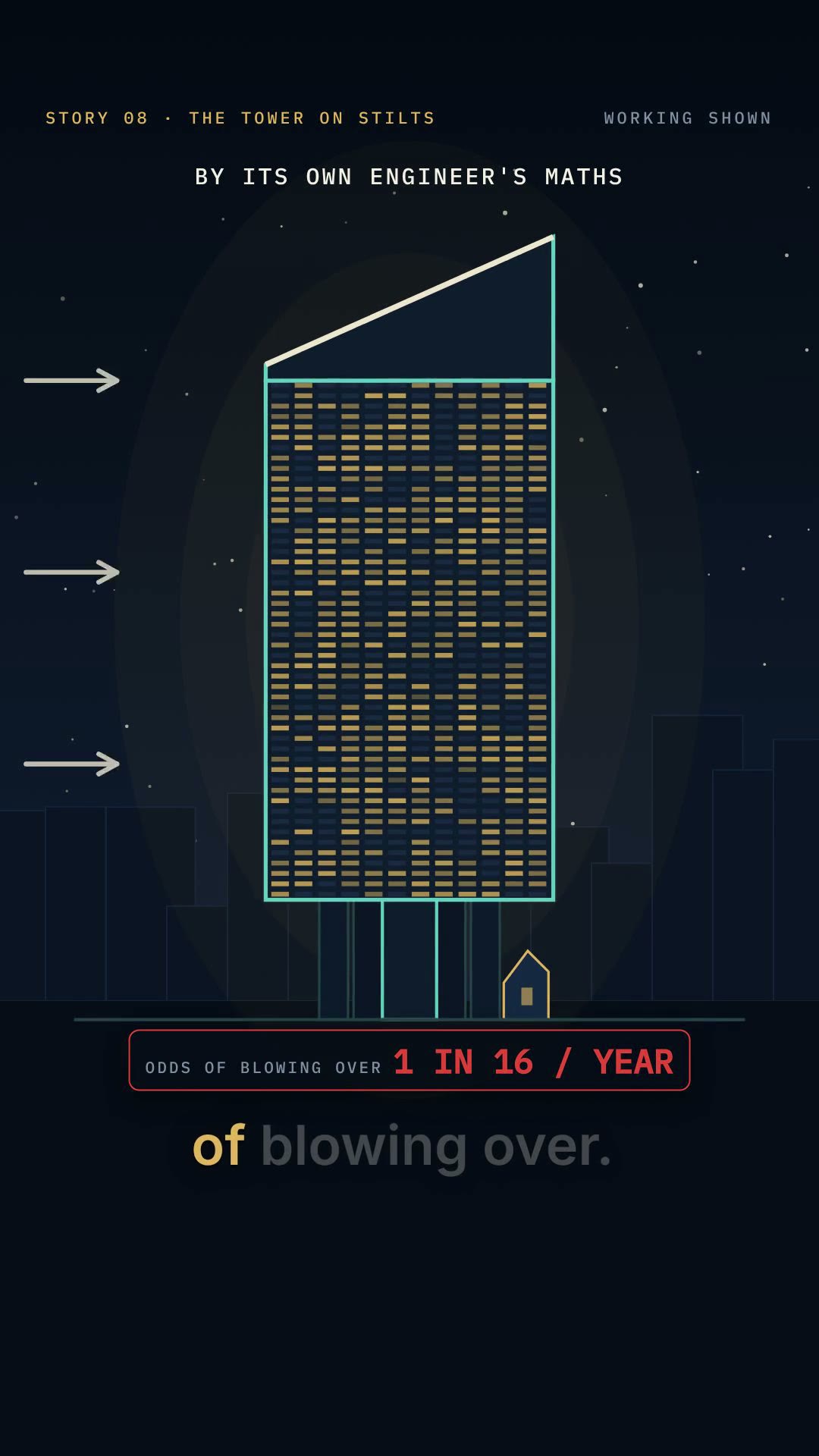
S08 · · posted 17 Oct 2026
A fifty-nine-storey skyscraper in Manhattan, finished in nineteen seventy-seven.
Line by line
Every claim, with its source.
Every spoken or on-screen factual claim, with the wording it rests on. Sources fetched 2026-10-11. The backbone is Joseph Morgenstern, "The Fifty-nine-Story Crisis", The New Yorker, 29 May 1995 [NY], built on LeMessurier's own account; plus the NYC Landmarks Preservation Commission report, 2016 [LPC]; the Online Ethics Center pages [OEC] (read via Wayback); and NIST's 2019 reanalysis. The sources are American and imperial (feet, US short tons, inches); every metric figure below is our conversion (1 US ton = 0.907 t; 1 ft = 0.3048 m; 1 in = 25.4 mm).
| Shot | Claim as spoken or shown | Source and verbatim support |
|---|---|---|
| hook | "A fifty-nine-storey skyscraper in Manhattan" | NY: "their fifty-nine-story tower"; 99PI: "The bottom nine of its 59 stories are stilts." LPC: east side of Lexington Avenue between 53rd and 54th Streets (NY). |
| hook | "finished in nineteen seventy-seven" | LPC: "on October 12, 1977, the tower was dedicated". |
| hook | "By its own engineer's maths, it had a one-in-sixteen chance, every single year, of blowing over." | NY, LeMessurier: "there was one chance in sixteen in any year, including that one"; the storm had "a statistical probability of occurring as often as once every sixteen years"; failure of the weakest joint meant "catastrophic failure of the whole structure would follow". Hedged ("by its own engineer's maths") because it is LeMessurier's 1978 estimate, not an independent figure, it assumes the damper is off (power cut), and NIST later disputed the premise (see twist). |
| hook (screen) | "1 IN 16 / YEAR"; "STORY 08 · THE TOWER ON STILTS" | As above (NY). Stilts: NY "four massive, nine-story-high stilts". |
| answer | "The man who found the flaw was that engineer." | NY: LeMessurier ran the quartering-wind check himself and on 24 July found "his people had taken only perpendicular winds into account". DeCarolis (OEC 2022), the student who phoned: "I didn't tell LeMessurier there was anything wrong with his building." |
| answer | "So: stay quiet... or tell the bank its new tower could fall?" | NY: at his summer house in Maine he weighed his options, then chose to tell: "sixteen years to failure—that was very simple, very clear-cut". |
| answer (screen) | "SAY NOTHING / TELL CITICORP" | As above. |
| stilts | "It's Citicorp Center." | NY; LPC: "Citicorp Center (now 601 Lexington Avenue)". |
| stilts | "A church owned one corner of the block" | NY: "the northwest corner of that block was occupied by St. Peter's Church"; the church "was able to strike a deal": "its old building would be demolished and a new one built as a freestanding part of Citicorp Center". |
| stilts | "so the engineer, William LeMessurier, put the tower on four nine-storey stilts, in the middle of each side, not at the corners." | NY: Stubbins and LeMessurier "set their fifty-nine-story tower on four massive, nine-story-high stilts, and positioned them at the center of each side, rather than at each corner". LPC: "four 24-foot-square 'super' columns". |
| stilts (screen) | "corners hang 22 m (72 ft) out" | NY: "cantilever the building's corners seventy-two feet out over the church"; LPC: "cantilevers, 72 feet from column to corner". Metres ours (21.9 m). |
| chevrons | "To carry the wind down to those stilts, he wrapped the frame in giant steel V's." | LPC: "Arranged in eight-story tiers, the V-shaped steel bracing wraps around the sides, transferring the load in six stages to the four 'super' columns and elevator core". NY: "forty-eight braces, in six tiers of eight, arrayed like giant chevrons". |
| chevrons | "And because the steel was so light, the top held a four-hundred-ton block of concrete, floating on oil, to calm the sway." | LPC: "Located on the 59th floor, the main component is a 400-ton, 30 by 30 foot, concrete block"; "diminishes sway by as much as 50 per cent". NY: "a four-hundred-and-ten-ton block of concrete, attached to huge springs and floating on a film of oil", needed because "twenty-five thousand tons of steel in its skeleton contrasted with the Empire State Building's sixty-thousand-ton superstructure". OEC: "400-ton concrete block, which floated on pressurized oil bearings". Tons are US short tons. |
| chevrons (screen) | "~400 US TONS (~360 t)"; block slides opposite to sway | LPC: "the block is set in motion opposite to the direction in which the building is swaying". 360 t is our conversion (363 t; NY's 410 tons = 372 t). |
| call | "June nineteen seventy-eight." | NY: "On a warm June day in 1978". |
| call | "The way LeMessurier told it, a student phoned. His professor thought the columns were in the wrong place." | NY: a call "from an engineering student in New Jersey. The young man, whose name has been lost"; "According to his professor, LeMessurier had put them in the wrong place." Hedged ("the way LeMessurier told it") because the only account of the call is LeMessurier's, his own memory later wavered (OEC addendum: he "had not actually spoken with the student"), and the student's identity is contested (Lee DeCarolis says he was the caller; Diane Hartley separately raised diagonal winds with the New York office). |
| call | "LeMessurier explained why they were right... and then kept thinking about winds hitting the corners." | NY: he "explained how the peculiar geometry of the building, far from constituting a mistake, put the columns in the strongest position to resist what sailors call quartering winds"; then, out of "intellectual play", ran the braces against 45° winds. |
| call (screen) | "THE WAY HE TOLD IT"; wind arrow face-on → 45° | As above. |
| bolts | "And he already knew something else. A month earlier, he'd learned the joints in those V's, meant to be welded, had been bolted instead to save money." | NY (dossier): at "a May 1978 meeting about two Pittsburgh towers", a month before the June call, Goldstein told him: "Oh, didn't you know? They were changed—they were never welded at all, because Bethlehem Steel came to us and said they didn't think we needed to do it." NY: welding is "labor-intensive and therefore expensive". The New York office accepted the change "On August 1, 1974". "To save money" is our summary of why Bethlehem proposed it (dossier retention beat 4: "bolted instead, to save money"). |
| bolts | "Fine on its own." | NY: "The choice of bolted joints was technically sound and professionally correct". |
| bolts | "But his team had checked them only for wind hitting the faces head-on." | NY (24 July): "his people had taken only perpendicular winds into account". (NY also cites a second error: braces treated "not as columns but as trusses, which are exempt from the safety factor. As a result, the bolts holding the joints together were perilously few".) |
| bolts (screen) | "BOLTED, 1974"; "Wind check: 0° ✓ 45° ?" | NY: "On August 1, 1974"; perpendicular winds only. |
| maths | "He ran the corner winds. In half the braces, the force jumped forty per cent." | NY: "In four of the eight chevrons in each tier, a quartering wind increased the strain by forty per cent." OEC: "stresses in half of a certain number of structural members increased by 40 percent". |
| maths | "On the bolts, a hundred and sixty." | NY: the 40 % "became a hundred-and-sixty-per-cent increase on the building's bolts". OEC: "a 40 percent increase in stress ... resulted in a 160 percent increase of stress on the building's joints". |
| maths | "The weakest joint sat on the thirtieth floor. If it went, the whole tower could follow." | NY: "The weakest joint ... was at the building's thirtieth floor; if that one gave way, catastrophic failure of the whole structure would follow." |
| maths (screen) | "BRACE +40 % → BOLTS +160 %"; floor 30 | As above. |
| storm | "A storm strong enough comes along about once every sixteen years." | NY: "a statistical probability of occurring as often as once every sixteen years" (from New York weather records with Davenport's wind-tunnel data). LeMessurier's estimate. |
| storm | "The concrete damper made it rarer. But it needed electricity, and a big storm can cut the power." | NY: with the damper running "the probability dwindled to one in fifty-five", but "the machine required electric current, which might fail as soon as a major storm hit". |
| storm (screen) | "1/16 (damper off) vs 1/55 (damper on)" | NY (above). |
| night | "He told them." | NY: Citicorp's leaders (Reed, Wriston) were told and approved repairs. |
| night | "Every night, eight p.m. to four a.m., welders behind plywood" | NY: welding "from 8 p.m. until 4 a.m., with the building's fire-alarm system shut off"; carpenters built "plywood enclosures around the chevrons"; "The welders worked seven days a week." |
| night | "fixed more than two hundred joints with steel plates two inches, five centimetres, thick." | NY: "welding two-inch-thick steel plates over each of more than two hundred bolted joints". LPC also "more than two hundred". 5 cm is our conversion (5.08 cm). |
| night | "By morning, the office workers were back, none the wiser." | NY: cleaners finished "before the first secretaries arrived"; tenants were not told the true reason. (Citibank's 8 Aug press release announced "additional welding" and said there was "no danger", so the work was public; its danger was not.) |
| night (screen) | "20:00 → 04:00"; "200+"; "51 mm (2 in)" | NY (above). 51 mm ours. |
| hurricane | "Then, on September first, a hurricane named Ella was heading up the coast." | NY: "Shortly before dawn on Friday, September 1st, weather services carried the news ... Hurricane Ella, was off Cape Hatteras and heading for New York". |
| hurricane | "The repairs weren't finished." | NY: welding "was completed in October"; LeMessurier told the bank "the most critical joints had already been fixed". |
| hurricane | "The Red Cross had up to two thousand people ready to evacuate the neighbourhood." | NY: the Red Cross "would mobilize between twelve hundred and two thousand workers"; police and the mayor's Office of Emergency Management "would evacuate the building and the surrounding neighborhood". OEC: "up to 2,000 emergency workers". (99PI's "2500" not used.) |
| hurricane (screen) | Ella's track from Cape Hatteras; "NOT FINISHED"; evacuation radius | NY (above); Environment Canada 1978 summary: "925 kilometres southeast of Cape Hatteras". OEC: "the ten-block-diameter surrounding neighborhood". |
| turn | "Hours later, Ella turned out to sea." | NY: "A few hours later, Hurricane Ella veered from its northwesterly course and began moving out to sea". 99PI: "Hurricane Ella never made landfall". |
| turn | "The welding was finished in October." | NY: "Welding was completed in October"; LPC: "completed in about two months, during October 1978". |
| turn | "And the story stayed hidden for seventeen years" | LPC: "the story remained, for the most part, unknown until May 1995". 1978 → 1995 = 17 years. "Hidden" = the danger; the welding itself was announced (8 Aug press release). |
| turn | "helped by a newspaper strike that began the very evening a reporter came asking." | NY: on Wednesday (9 Aug) a Times reporter was chasing LeMessurier; at "Two minutes after six o'clock" he called back and "heard a recording. The Times, along with all the other major papers in the city, had just been shut down by a strike". Paris Review: "from August 10 to November 4, a multiunion strike shuttered all three of New York City's major newspapers". |
| turn (screen) | "ON STRIKE · AUG 1978"; "THE NEW YORKER · MAY 1995" | Paris Review: strike "from August 10 to November 4"; NY puts the shutdown on the evening of Wed 9 Aug. Either way, August 1978. OEC: the article "appeared in the May 29, 1995 issue". |
| twist | "But here's the twist. In two thousand nineteen, engineers at NIST re-ran the winds on a building of similar shape." | Park, Duthinh, Simiu & Yeo, J. Struct. Eng. 2019 (NIST): "The building analyzed in this paper is similar to the Citicorp Building"; title: "a tall building with square cross-section and mid-side base columns". The original wind data were confidential, so they used "a building of similar proportions" (dossier). |
| twist | "They found corner winds were never the worst case." | NIST 2019 abstract: "The results show that corner winds are less demanding than face winds, both globally (overturning moments) and locally (DCIs)." |
| twist | "The repair may not have been needed at all." | Duthinh, NIST blog 2019: "if the building had been safely designed for head-on winds, then it would have been safe for quartering winds, regardless of the connection details ... the strengthening of the diagonal braces would have been unnecessary"; NIST 2019: "a re-examination of the history of the Citicorp Building design and retrofit may be warranted". Hedged ("may") because the study used a similar building, ignored neighbouring buildings and exact geometry (Duthinh 2020), and does not address NY's separate truss-vs-column safety-factor error in the bolt count. |
| twist (screen) | "NIST, 2019 · SIMILAR-SHAPED BUILDING, NOT THE REAL TOWER"; face winds > corner winds | As above. |
| close | "Either way, the engineer went looking for his own firm's mistake, and told the people who paid him." | NY: he checked the quartering winds out of "intellectual play", found his office's error, and took it to Citicorp. |
| close | "The tower still stands." | LPC 2016 designation of the building (renamed 601 Lexington Avenue in 2010); photos 2015 and 2021 (LICENSES.md). |
What the drawing simplifies
- The tower at night, the chevrons, the damper, the joint close-ups, the phone call, the plywood boxes and welders, the weather map and the wind-tunnel model are all staged line art. No licensed 1970s or 1978 photo of the tower, the repair or Hurricane Ella exists on Commons.
- "Photo card: the base" uses modern photos: Andrew Moore, 2015 (street level, mid-side columns; CC BY-SA 2.0) and/or Trxr4kds, 2006 (base from across Lexington Ave; public domain). The tower today in
closeis also a modern photo. - The Epicgenius 2021 photo (CC BY-SA 4.0) shows the present St. Peter's Church, built 1977. It is not the old 1905 church, which was demolished under the deal.
- LeMessurier and the student are silhouettes or typography; no licensed photos exist.
- The NIST wind-tunnel bar chart is schematic and is labelled as a similar building, not the real tower.
- CC BY-SA photos are credited in the caption; any crop or tint stays under the same licence.
Checked, and cut
- "A student found the flaw" / "the student was Diane Hartley": not claimed. In LeMessurier's own account a male New Jersey student asked only about the column placement; Lee DeCarolis (NJIT) says he was that caller; Hartley (Princeton) separately asked the New York office about diagonal winds and never spoke to LeMessurier.
- "The church refused to sell, so they built over it" (and NIST's "now demolished"): false; the church made a deal, its old building was demolished and a new one built on the same corner.
- "Kept totally secret": not claimed; Citibank issued a press release on 8 Aug 1978. We say the story (the danger) stayed hidden.
- "Ella nearly hit New York": not claimed; it was forecast to head for New York and turned out to sea, never making landfall.
- A single "collapse wind speed": LeMessurier refused to give one; none used.
- "The first tuned mass damper in a skyscraper": not claimed (LPC: "one of the first").
- "The building was never in danger": not claimed; we say the repair "may not have been needed".
- LeMessurier's thoughts of suicide: in NY, deliberately left out.
- Repair cost ($4.3 M or $8 M) and the $2 M settlement: true per NY, not used.
Sources
Found an error?
Tell us at hello@workingshown.xyz or in the comments. We check it against the sources, pin the correction, fix the caption, and log it on the corrections page.