 WORKING
Receipts / S09
Line by line
Every claim, with its source.
Every spoken or on-screen factual claim, with the wording it rests on. Sources fetched 2026-10-11. The backbone is the 1955 Court of Inquiry report, C.A.P. 127, HMSO [Report], read from the FAA-hosted scanned PDF; quotes were transcribed from the page images and cite the report's own paragraph numbers. The report is imperial (feet, lb/sq in, lb); every metric figure below is our conversion (1 ft = 0.3048 m; 1 psi = 6.895 kPa; 1 lb = 0.4536 kg).
| Shot | Claim as spoken or shown | Source and verbatim support |
|---|---|---|
| hook | "January nineteen fifty-four." | Report: Comet G-ALYP lost "on 10th January, 1954" (report title). |
| hook | "The world's first jet airliner climbs out of Rome" | Report para 29: G-ALYP "entered scheduled passenger service and was the first jet-propelled passenger carrying aircraft in the world to do so" (2 May 1952). Para 26: left Ciampino (Rome) at 0931 GMT for London. |
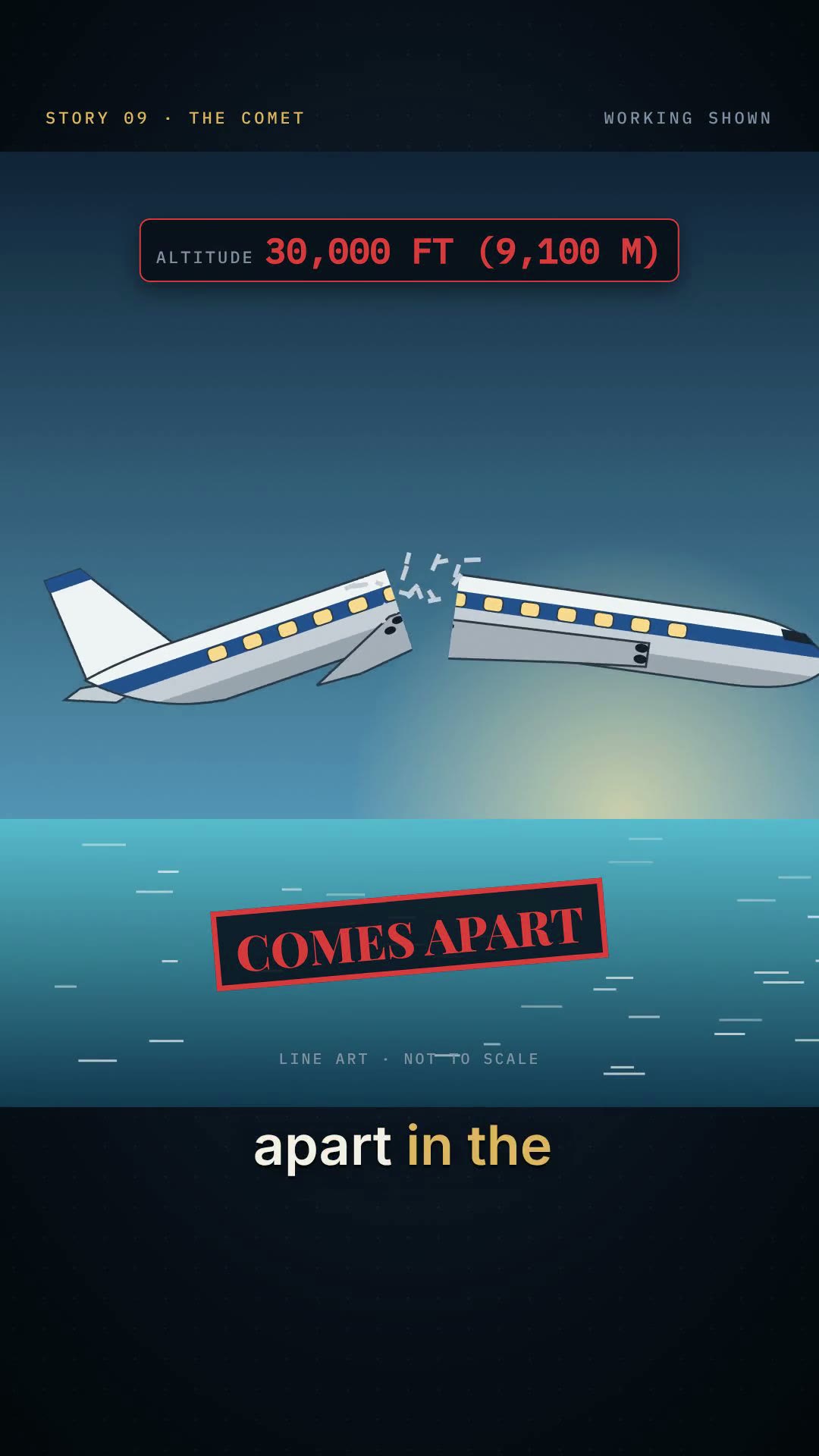
| hook | "reaches about nine kilometres, thirty thousand feet... and simply comes apart in the sky." | Report App. VI (RAE): break-up at "about 30,000 feet"; para 28: about 27,000 ft at 0951. Q&A Answer 1: "the structural failure of the pressure cabin brought about by fatigue". 9 km is our conversion (9.1 km). |
| hook (screen) | Comet 1 in BOAC colours; "STORY 09 · THE COMET" | G-ALYP was a BOAC aircraft (Report para 26, BOAC service). Staged line art. |
| answer | "Then it happens again." | Report para 58: G-ALYY lost off Naples, 8 April 1954, "at approximately the same height and after approximately the same lapse of time after departure from Rome". |
| answer | "It's a big reason the window next to your seat has rounder corners today." | FAA Lessons Learned (secondary): "the window shape was changed from squarish to the now-conventional oval shape". de Havillands' statement (Report App. VIII): "strengthen and re-design windows and cut-outs, and so lower the general stress". "A big reason", not "the reason". |
| answer | "But the famous version of the story is wrong." | See myth: Report para 79 never says "square"; Aerossurance names "that the fatigue failures occurred from a square cabin window" a misconception. |
| jet | "The de Havilland Comet began carrying passengers in nineteen fifty-two." | Report para 29: "On the 2nd May, 1952 ... entered scheduled passenger service". |
| jet | "Jets pay off up high, so it cruised at double the height of the airliners of its day" | Report para 14: to be economic it had to cruise "upwards of 35,000 ft. — double that of the then current air-liners". |
| jet | "with fifty per cent more pressure pushing out on the cabin than was normal." | Report para 15: "The difference between the internal and external pressure (8¼ lb./sq. in) was about 50 per cent. greater than that in general use". "Pushing out" = that inside-minus-outside difference across the skin. |
| jet (screen) | "Comet 10.7 km (35,000 ft) — 'DOUBLE'" | Report para 14 (above). 10.7 km ours. |
| jet (screen) | "8¼ PSI (57 kPa) · +50 %" | Report para 15 (above); para 29: max difference "8·25 lb/sq. in.". 57 kPa ours (56.9). |
| balloon | "Every flight, the cabin inflates like a balloon, and on landing, lets go. Up, down. One load cycle per flight." | Report counts life in "pressurised flights" (paras 23, 64, 71); App. IV (1): metal "will break under a load which is repeatedly applied and then removed". Balloon analogy is ours. |
| elba | "January tenth, off the island of Elba." | Report: crashed "at about 1000 G.M.T." off Elba (G-ALYP title page), 10 January 1954. |
| elba | "The crew is mid-sentence on the radio... and the message just stops." | Report para 26: last message from G-ALYP to BOAC Argonaut G-ALHJ, "George How Jig from George Yoke Peter did you get my", broke off about 0951. The report quotes the aircraft's call sign, not a named crew member, hence "the crew". |
| elba | "Thirty-five people are killed." | Report G-ALYP title page: 6 crew and "29—All Killed". 6 + 29 = 35. |
| elba | "The fleet is grounded, and investigators suspect fire." | Report para 52: BOAC suspended services the same day. Para 53: the Abell Committee "still regarded fire as the most likely cause". |
| elba (screen) | "did you get my—"; Map of Elba; "35 KILLED"; "FIRE?" | As above (paras 26, 52–53, title page). |
| naples | "After a long list of fixes for fire, the Comets fly again." | Report para 53: "a large number of modifications"; para 55 (ARB): modifications "to cover every possibility that imagination has suggested as a likely cause"; para 57: passenger service resumed "on the 23rd March, 1954". |
| naples | "Sixteen days later, a second one is lost off Naples" | Para 57: resumed 23 March; G-ALYY lost 8 April 1954 "at about 1910 G.M.T." SE of Naples (G-ALYY title page): 16 days. "Lost", not "breaks up": its cause was left open, "no positive answer can be given ... but ... makes it at least possible that the cause was the same" (G-ALYY Q&A 1); little wreckage was recovered (water 520–580 fathoms). |
| naples | "at almost the same height and time after leaving Rome." | Report para 58: "at approximately the same height and after approximately the same lapse of time after departure from Rome". |
| naples (screen) | "23 MAR resumed → 8 APR Naples" | Paras 57–58. |
| tank | "So Britain's aircraft lab puts a whole Comet in a giant tank of water, and pumps its cabin up and down, flight after flight." | Report para 61: Sir Arnold Hall (Director, RAE) "decided that a repeated loading test of the whole cabin ought to be made"; para 62: the whole cabin immersed "in a tank, and filling the tank and the cabin simultaneously with water"; para 63: tests began "early in June on aircraft G-ALYU (Yoke Uncle)". |
| tank | "Why water? With air, a burst would hit like a five-hundred-pound bomb." | Report para 62: an air burst would be "equivalent in the case of the Comet's cabin to the explosion of a 500 lb. bomb". |
| tank (screen) | "AIR BURST ≈ 500 LB (227 kg) BOMB" | Para 62. 227 kg ours. |
| split | "After the equivalent of three thousand and sixty flights, the cabin splits open." | Report para 64: "Yoke Uncle had made 1,230 pressurised flights before the test and after the equivalent of a further 1,830 such flights, making a total of 3,060, the cabin structure failed". (Fig. 9 caption: 3,057.) |
| split | "The crack starts at the corner of a window, from a tiny rivet hole." | Para 64: "the starting point of the failure being the corner of one of the cabin windows" (Figs 7–10: "THE FORWARD ESCAPE HATCH ON THE PORT SIDE"); Fig. 8: "FATIGUE AND DISCOLOURATION AT THIS RIVET HOLE". |
| split (screen) | "3,060"; "RIVET HOLE" | As above. |
| corners | "Cut a hole in a stretched skin and the load has to flow around it. It piles up at the corners, and a rivet hole there makes it worse." | Report para 149: "points, generally near to the cut-outs, where the stress is appreciably higher than the average". App. IV (Murphy): "it required only a mild stress raiser† to initiate failure", "† Such as a rivet or bolt hole". |
| corners | "At those corners, the metal was carrying far more stress than it was designed for." | Report para 127: "probably over 40,000 lb./sq. in."; para 118: de Havillands' design figure "28,000 lb./sq. in.", an average "over a width of 2 or 3 inches"; para 124: RAE strain gauge "43,000 lb/sq. in." at normal pressure. |
| corners (screen) | "DESIGN 28,000 PSI (193 MPa) · ACTUAL >40,000 PSI (276 MPa)" | Paras 118, 127. MPa ours. "ACTUAL" = the Court's best estimate ("probably"). |
| test | "But hadn't the Comet been tested? It had: a cabin section survived sixteen thousand cycles." | Report para 153: "the survival of the test specimen of the forepart of the cabin to over 16,000 cycles". (Paras 23 and 53 say 18,000; the report's own counts differ, and we use the lower.) |
| test | "The catch? It had first been pumped up to double pressure, which stretched and toughened its corners" | Para 153: the specimen had "two applications of 2 P in addition to nearly twenty of between P and 2 P"; para 130: "static tests up to a differential pressure of 16½ lb/sq. in."; para 150: "there will remain a permanent stretch. The pre-loaded cabin is therefore physically different from a new one"; para 151: "the stress concentration in such areas is therefore relieved". |
| test | "and likely helped it outlast the planes." | Para 130 (Hall): "the effect of such a test might be to prolong the life of the specimen"; para 153: "there is no doubt that the phenomenon described above provides at any rate a partial explanation" of the specimen outlasting Yoke Uncle. FAA: "The significant misstep was the decision to perform the fatigue test on the same prototype fuselage that had undergone the pressure test and had been cold-worked". Hedged ("likely helped") because the report calls it only a "partial" explanation. |
| test (screen) | "16,000+ CYCLES ✓"; "PRE-LOADED AT 2×"; "PRE-TOUGHENED" | As above (paras 150–153). |
| roof | "Meanwhile, an Italian fishing boat hauls up a piece of the Elba jet's roof, with two small windows for radio aerials." | Report para 73: "a piece of cabin skin, which had been found by an Italian fishing boat ... from the centre of the top of the cabin ... It contained the two windows in which lie the aerials which are part of the A.D.F. (Automatic Direction Finding) equipment". App. V: recovered 12.8.54. |
| roof | "The crack most likely started there, at a bolt hole." | Para 76: "the first fracture of the cabin occurred near the rear A.D.F. window"; para 77: "probable that it started near the starboard aft corner of the rear A.D.F. window ... at the edge of the countersunk hole through which a bolt passed"; para 79: "I find it impossible to say, definitely ... which of these operated first", the bolt hole being "the more probable". Hedged ("most likely") to match the Court. |
| roof | "Not at a passenger window at all." | Paras 73, 76–77: the ADF aerial windows on the roof. |
| roof (screen) | Roof panel with two aerial windows; crack from a bolt hole; "NOT A PASSENGER WINDOW" | Report Fig. 12, "PHOTOGRAPH OF WRECKAGE AROUND ADF AERIAL WINDOWS—G-ALYP"; Fig. 19 "PROBABLE FATIGUE ORIGIN". |
| myth | "So: did square windows bring down the Comet? The inquiry never says square." | Report, all pages read: the word "square" does not appear in the findings. Aerossurance: the misconception "that the fatigue failures occurred from a square cabin window". (FAA uses "squarish".) |
| myth | "Its windows already had rounded corners." | Report Fig. 7 (escape-hatch window) and Fig. 12 (ADF panels) show rounded corners; RAF Museum Cosford panel of G-ALYU (photo, LICENSES.md) likewise. |
| myth | "It blames high stress at the corners of every cut-out, made worse by holes." | Report para 79: "the fundamental cause of the failure of the cabin structure was that there existed around the corners of the windows and other cut-outs a level of stress higher than is consistent with a long life of the cabin, bearing in mind the unavoidable existence of points ... at which it will be still further raised by relatively local influences, such as the countersunk hole near the starboard rear corner, and the small crack with its 'locating' hole". "Every" is our compression of "the windows and other cut-outs". |
| myth (screen) | "'SQUARE WINDOWS' → 'NOT QUITE'"; Comet rounded-rectangle outline vs today's oval | As above; FAA: changed "from squarish to the now-conventional oval shape". |
| after | "The Elba jet had made just one thousand two hundred and ninety pressurised flights." | Report para 71: "Yoke Peter had made 1,290 pressurised flights". (Designers had assumed "say 10,000 pressurised flights", para 121.) |
| after | "After the Comet, Britain required new airliner designs to sacrifice a whole extra airframe, just for fatigue testing." | Report App. VII (ARB): future prototypes need "at least two airframes ... one for static testing and the other for fatigue testing". |
| after (screen) | "1,290 FLIGHTS"; two test airframes, "ONE FOR STRENGTH, ONE FOR FATIGUE" | 1,290: para 71. Report App. VII (ARB): "at least two airframes ... one for static testing and the other for fatigue testing". |
| close | "Next time you rest your head against that rounded window, you're looking at a lesson paid for twice." | Two fatal crashes (Elba, 35 killed; Naples, 7 crew and 14 passengers, "All Killed"). Rounded window: FAA (secondary). |
What the drawing simplifies
- The climbing Comet, the radio waveform, the fuselage "breathing", the stress-flow mechanism, the tank cycle animation, the trawl net and the modern rounded window are staged line art.
- "BOAC Comet, 1952" (IWM TR 6113, public domain) is a BOAC Comet 1 at Entebbe on a London–Johannesburg service. It is NOT G-ALYP or G-ALYY and must not be captioned as either.
- Report Fig. 6 (public domain, HMSO 1955) is G-ALYU in the RAE water tank, seen from above.
- Report Fig. 12 (public domain, HMSO 1955) is the real Elba roof wreckage with the two ADF aerial windows.
- The RAF Museum Cosford panel (Alan Wilson, CC BY-SA 2.0) is G-ALYU's tank-test panel showing rounded window corners. Per its museum label it failed later, "after a total of 5546 pressurisations"; it is NOT the first (3,060-flight) failure, which was the forward escape hatch. Commons' description calls the windows "square"; we do not reuse that wording.
- The design-vs-actual stress readout is the Court's estimate ("probably over 40,000"), and the design figure was an average over 2–3 in (51–76 mm).
Checked, and cut
- "Square windows brought down the Comet": not claimed. The report blames stress at the corners of windows and other cut-outs, raised by holes; its windows had rounded corners.
- "The Elba crack started at a passenger window": not claimed; it began at the rear ADF aerial window on the roof. (The tank failure did start at a passenger-side escape-hatch window, which we show as "a window".)
- "Punch riveting caused the cracks": common online, not in the report pages read. Not used.
- "De Havilland was negligent": not claimed; the Court found the accident "was not due to the wrongful act or default or to the negligence of any party".
- "Naples was proven to be the same cause": not claimed in the report ("at least possible").
- "First use of underwater TV in a search": true as the report states it, not used.
- Withey's 1997 fracture-mechanics initial-defect size: unverified, not used.
- The Comet 4 return four years later: true per FAA, not used.
Sources
Found an error?
Tell us at hello@workingshown.xyz or in the comments. We check it against the sources, pin the correction, fix the caption, and log it on the corrections page.