 WORKING
Receipts / S11
S11 · · posted 20 Oct 2026
The blue dot on your phone's map started with two physicists, a two-foot piece of wire, and the beep of the first satellite.
Line by line
Every claim, with its source.
Every spoken or on-screen factual claim, with the wording it rests on. Sources fetched 2026-10-11. "G&W" = Guier & Weiffenbach, "Genesis of Satellite Navigation", APL Technical Digest 19(1), 1998 (reprint of 1997). Ashby's Living Reviews was read via Europe PMC; his Physics Today article via a course-site mirror of the AIP PDF. Values marked "(our arithmetic)" or "(our conversion)" are ours.
| Shot | Claim as spoken or shown | Source and verbatim support |
|---|---|---|
| hook | "The blue dot on your phone's map started with two physicists, a two-foot piece of wire, and the beep of the first satellite." | G&W: "a 2-ft wire hanging from the receiver was an adequate antenna"; "The present Global Positioning System is the result of APL's pioneering work with Transit, progress in electronics, and the global economy." Sputnik 1 launched 4 Oct 1957 (NASA chronology: "October 4, 1957 USSR: Sputnik 1 (83.6 kg) launched"). "Started with" = the chain G&W → Transit → GPS as G&W tell it; GPS also had other inputs (Parkinson: "no one person did"). |
| hook | "Nobody asked them to listen." | G&W: their assigned work was missile signal processing ("beam rider performance of the Terrier and Talos missiles"); "It was not organized; we all just did it"; APL let "inquisitive kids felt free to follow their curiosity". |
| answer | "They worked out where the satellite was, just from how its beep changed pitch." | G&W: "a complete set of orbit parameters for a near-Earth satellite could be inferred to useful accuracy from a single set of Doppler shift data". (This took weeks of work, incl. Sputnik II data; see orbit.) |
| answer | "Then someone at their lab asked the opposite question." | G&W: "'Mac' asked if we could invert the solution, i.e., determine the station position while assuming the orbit is known." |
| answer | "That question led, step by step, to the blue dot in your phone." | G&W: "The present Global Positioning System is the result of APL's pioneering work with Transit, progress in electronics, and the global economy." "Step by step" = inverse problem → Transit → GPS (see transit, gps); GPS also had other inputs (Parkinson: "no one person did"). |
| answer (screen) | "SATELLITE? → YOU?" | As above (the inverse problem). |
| launch | "October nineteen fifty-seven. The Soviets launch Sputnik on a Friday." | NASA chronology: "October 4, 1957 USSR: Sputnik 1 (83.6 kg) launched". Harford (NASA History): "Friday evening, October 4". |
| launch | "By Monday lunch, at a Johns Hopkins lab, physicists William Guier and George Weiffenbach are surprised: nobody there has even tried to listen." | G&W: "The Monday after the launch of Sputnik I, we met in the cafeteria for lunch... We remember the widespread surprise that apparently no one had come to the Laboratory over the weekend and attempted to receive the signals." Author bios: Guier "a theoretical physicist", Weiffenbach "a physicist", both at the APL Research Center. "Johns Hopkins": their paper appeared in the Johns Hopkins APL Technical Digest (dossier source list). |
| launch (screen) | "FRI 4 OCT → MON 7 OCT" | 4 Oct 1957 per NASA; "The Monday after" = 7 Oct 1957 by the calendar (our date arithmetic). |
| launch (screen) | "JOHNS HOPKINS APPLIED PHYSICS LAB" + cafeteria table | G&W: "we met in the cafeteria for lunch". APL = Johns Hopkins Applied Physics Laboratory (Johns Hopkins APL Technical Digest). |
| wire | "So they do. A good radio, tuned to twenty megahertz," | G&W: "George had a good 20-MHz receiver"; "The Russians had set the Sputnik frequency about 1 kHz from an exact 20 MHz". Siddiqi (NASA): "20.005 and 40.002 megacycles". |
| wire | "and for an antenna, a wire about two feet long, sixty centimetres, hanging off the back." | G&W: "a 2-ft wire hanging from the receiver was an adequate antenna". 2 ft = 0.6 m (our conversion). "Off the back" is staging; the source says "hanging from the receiver". |
| wire | "That afternoon, they hear it. Loud and clear." | G&W: "Late that afternoon we heard the signals from Sputnik loud and clear". |
| wire (screen) | "20 MHz · wire 0.6 m (2 ft)" | As above. |
| pitch | "And the beep isn't steady. It slides." | G&W: "any receiver would produce an audio tone of 1 kHz plus or minus the Doppler shift". |
| pitch | "You've heard this: an ambulance passing, the siren high as it comes, low as it goes." | Analogy for the Doppler effect (standard physics, not quoted). G&W: "what we would later call a 'pure Doppler shift.'" |
| pitch | "Sputnik's tone slides from about fifteen hundred hertz down to five hundred, on every pass." | G&W: "varying from about 1500 Hz to about 500 Hz, clearly audible throughout an entire pass." Cross-check (our arithmetic): 20 MHz × 8 km/s ÷ c ≈ 530 Hz maximum shift, using Siddiqi's "about 8,000 meters per second". |
| pitch (screen) | "TONE 1,500 Hz → 1,000 → 500 Hz" | G&W: "audio tone of 1 kHz plus or minus the Doppler shift ... from about 1500 Hz to about 500 Hz". |
| record | "They record whole passes, horizon to horizon, as they put it, with nothing specifically in mind." | G&W: that evening they recorded "complete passes of the satellite from horizon to horizon"; Guier brought "his newly acquired audio high-fidelity tape recorder... again with nothing yet specifically in mind." Hedged ("as they put it") because these are their own phrases, quoted. |
| record | "Then they realise that sliding pitch is a measurement." | G&W: "It took awhile to realize that we could use the shifting frequency to advantage... We estimated the total swing in frequency, substituted it into the simplest equation for the Doppler shift to yield an estimate of the speed of the source". |
| record (screen) | "'WITH NOTHING YET SPECIFICALLY IN MIND'" | G&W, verbatim. |
| curve | "The moment the tone passes its middle note is the moment the satellite is closest." | Standard Doppler physics (dossier mechanism section; not a quote): at zero shift the satellite moves neither towards nor away from the listener. |
| curve | "And how steeply the pitch falls tells you how close: right overhead, a sudden drop; far away, a gentle slope." | G&W: "we could estimate the closest approach of Sputnik to George's antenna by determining the maximum slope of the Doppler shift—a method APL used in estimating the distance of closest approach of a guided missile to its target." Slope ≈ f·v²/(c·d) is the dossier's derivation, not quoted. |
| curve (screen) | "Doppler S-curves, near (steep) vs far (gentle); CLOSEST APPROACH" | As above; curves are schematic, not their data. |
| orbit | "From one spot on the ground, they work out a satellite's whole orbit." | G&W: "a complete set of orbit parameters for a near-Earth satellite could be inferred to useful accuracy from a single set of Doppler shift data". "A satellite", not "Sputnik": this came after weeks of further work with the Univac and the Sputnik II data, not on the first night (dossier). |
| orbit | "Everyone else was tracking satellites by measuring angles with big antenna arrays." | G&W: "Every organization in the United States, Europe, and the USSR that had a charter to track satellites had elected to use angle measurements based on radio interferometers". ("Big" is our gloss on interferometers.) |
| orbit | "Looking back, they called themselves fortunate: they only had the pitch." | G&W: "We did not realize at the time that we were fortunate to have only Doppler data... We were the only ones to analyze the application of Doppler data to this problem—these were the only data we had!" |
| orbit (screen) | Orbit ellipse "from one ground dot (the lab)"; "big interferometer arrays, crossed out" | Orbit from one station and interferometers: as above; crossing out the arrays is a visual gloss on "fortunate to have only Doppler data". "Maryland": UNSUPPORTED in the dossier (no fetched source places APL in Maryland); keep the dot unlabelled or add a source. |
| flip | "Then, March nineteen fifty-eight." | G&W: "On Monday, 17 March 1958"; McClure memo dated 18 March 1958 (Pisacane). |
| flip | "Frank McClure calls them into his office and closes the door." | G&W: "Frank McClure called us to his office and asked us to close the door". (Strictly, they closed the door at his request.) |
| flip | "If you know where the satellite is, can you turn it around? Can the listener find where he is?" | G&W: "'Mac' asked if we could invert the solution, i.e., determine the station position while assuming the orbit is known." McClure memo: "their work provided a basis for a relatively simple and perhaps quite accurate navigation system." |
| transit | "Yes. That becomes Transit, the first satellite navigation system." | G&W: the "inverse problem, later to become known as the 'navigation problem'"; McClure and Kershner "designed the essentials of the complete Transit Navigation System". Danchik: "Transit 5BN-2 ... became the first operational navigation satellite." |
| transit | "From the nineteen-sixties it guides America's missile submarines," | Danchik: "SSBNs and aircraft carriers used Transit's precision navigation from the beginning of system operation in 1964." G&W: concern about "navigating Polaris submarines". |
| transit | "which can fix their position without making a sound." | Gibson letter, 4 Apr 1958 (Pisacane): "completely passive". G&W: active sonar was "a 'no-no' for Polaris submarines, which were to be undetectable". |
| transit (screen) | "FIX ≈ ONCE AN HOUR" | G&W: a fix "about once an hour anywhere on Earth". |
| gps | "GPS came next, designed in nineteen seventy-three." | MIT AeroAstro: "The critical design meeting took place at the Pentagon during Labor Day weekend in 1973." First satellite 1978 (AFHF). |
| gps | "It swaps pitch for timing: your phone measures how long signals take to arrive from four or more satellites," | Pisacane: GPS uses "measurements of the pseudo-range from four or more satellites that are simultaneously in view". Ashby (PT): receiver solves propagation-delay equations "for the unknown space-time coordinates". Parkinson: "simultaneously passively range to four satellites". |
| gps | "each about twenty thousand kilometres up, twelve and a half thousand miles." | GPS.gov: "approximately 20,200 km (12,550 miles)". |
| gps (screen) | "20,200 km (12,550 mi)" | GPS.gov, verbatim figures. |
| gps (screen) | "1 ns error ≈ 30 cm (1 ft)" | Ashby (LRR): "Timing errors of one ns will lead to positioning errors of the order of 30 cm". 30 cm ≈ 1 ft (our conversion). |
| einstein | "Up there, weaker gravity makes the satellite clocks run fast, and their speed makes them run slow." | Ashby (LRR): "the standard clock in orbit is beating too fast, primarily because its frequency is gravitationally blueshifted." Ashby (AAPT): gravitational shift "≈ 5.288 × 10⁻¹⁰" (fast); velocity shift "−8.228 × 10⁻¹¹" (slow). |
| einstein | "Net result: about thirty-eight millionths of a second gained every day." | Ashby (LRR/AAPT): net fractional rate "4.4647 × 10⁻¹⁰". × 86,400 s = 38.6 µs/day (our arithmetic; no fetched Ashby text prints "38 µs"). |
| einstein (screen) | "+45.7 µs gravity" | 5.288 × 10⁻¹⁰ × 86,400 s = 45.7 µs/day (our arithmetic). Ashby (AAPT): "a navigational error of 13.7 km" per day. |
| einstein (screen) | "−7.1 µs speed" | 8.228 × 10⁻¹¹ × 86,400 s = 7.1 µs/day (our arithmetic). Ashby (AAPT): "a navigational error of order 2.13 km/day". |
| einstein (screen) | "NET +38.6 µs/DAY" | 45.7 − 7.1 = 38.6; and 4.4647 × 10⁻¹⁰ × 86,400 = 38.6 µs (our arithmetic). |
| error | "Sounds tiny. But light travels about three hundred metres in a millionth of a second." | c ≈ 3 × 10⁸ m/s, so ≈ 300 m per µs (our arithmetic); consistent with Ashby (LRR) "one ns ... of the order of 30 cm". (300 m ≈ 1,000 ft, our conversion.) |
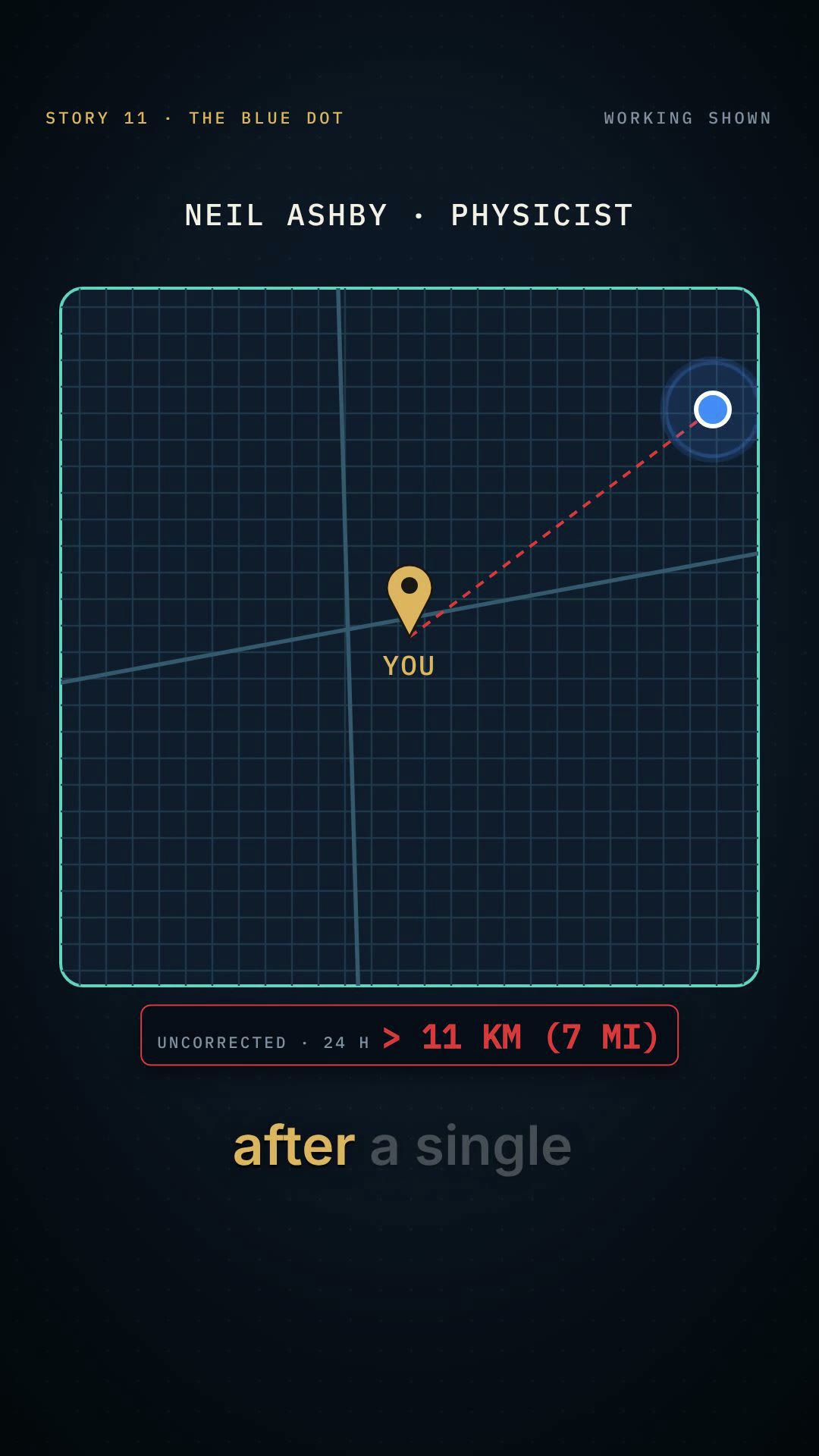
| error | "Left uncorrected, physicist Neil Ashby says, your position would be off by more than eleven kilometres, seven miles, after a single day." | Ashby (PT): "If these relativistic effects were not corrected for, satellite clock errors building up in just one day would cause navigational errors of more than 11 km, quickly rendering the system useless." 11 km ≈ 7 mi (our conversion). Hedged ("Ashby says") because it is the ranging error a 38.6 µs clock offset implies (38.6 µs × c = 11.6 km); a drift common to all satellites would partly be absorbed by the receiver's clock solution, so the real failure would be messier. |
| error (screen) | "> 11 km (7 mi) / DAY · ASHBY" | As above. |
| close | "So the satellite clocks are set to tick slow before launch." | Ashby (LRR): clocks set on the ground to "10.22999999543 MHz" instead of 10.23 MHz. Ashby (PT): before the first launch "there was uncertainty as to its magnitude, and even its sign. So correcting frequency synthesizers were built into the clocks". |
| close (screen) | "Clock set to 10.22999999543 MHz" | Ashby (LRR), verbatim figure. |
| close | "And every blue dot still traces back to two curious physicists and a beep." | G&W: "The present Global Positioning System is the result of APL's pioneering work with Transit". "Curious": G&W "inquisitive kids felt free to follow their curiosity". Rhetorical summary; GPS had other roots (Parkinson: "no one person did"). |
What the drawing simplifies
- No openly licensed photo of Guier, Weiffenbach or McClure exists (APL photos are © JHU/APL); all three are line-art figures. The cafeteria, the closing door and the office are staged line art.
- The receiver, the 2 ft (0.6 m) wire, the speaker, the tape recorder and the Doppler curves are illustrative line art, not the 1957 equipment or their recorded data.
- The Sputnik photo (NASA / NSSDC, public domain) is a museum replica at the National Air and Space Museum, not the flown satellite; it is captioned "replica".
- The Transit artwork (Roger Simmons for the US Navy, 1960, public domain) shows Transit 3A, 1B and 2A; it is a Navy illustration, not a photo in orbit.
- The NOAA photo (public domain) shows surveyors using a Navy Transit receiver at Goldstone Lake, California, c. 1980, not a submarine. The submarine is a silhouette; no image shows Transit gear on a Polaris boat.
- The GPS photo (US Air Force, public domain) is a full-scale Block I satellite in a test chamber in 1977, before the first launch in 1978.
- Orbit, four-satellite geometry, the two clocks and the drifting blue dot are our own animation.
Checked, and cut
- "They did it for fun": not said; script uses "nobody asked them" and "curious".
- "They found the orbit on the first night": not claimed;
orbitsays "a satellite's whole orbit", which took weeks and Sputnik II data. - "Your phone uses Doppler": not said; "It swaps pitch for timing".
- "Parkinson invented GPS over Labor Day weekend": not said; only "designed in 1973".
- "Reagan made GPS free after KAL 007": not used (statement text not read).
- "Satellite clocks run slow because they move": avoided; the net effect is fast, and the script says so.
- "10 km a day": replaced with Ashby's "more than 11 km", attributed.
- A single "GPS fully operational" date (1993/1994/1995 conflict): not used.
- Selective Availability (2000) and smartphone accuracy (4.9 m / 16 ft): checked, not used.
- Siddiqi's "wavelengths of 1.5 and 7.5 meters" (a slip): not used.
Sources
Found an error?
Tell us at hello@workingshown.xyz or in the comments. We check it against the sources, pin the correction, fix the caption, and log it on the corrections page.