 WORKING
Receipts / S13
Every claim, with its source.
Every spoken or on-screen factual claim, with the wording it rests on. Sources fetched 2026-10-14. The backbone is Charles Tomlinson (ed.), Rudimentary Treatise on the Construction of Locks, 1853 [TOM], the book Hobbs supplied and corrected; George Price, Treatise on … Locks and Keys, 1856 [PRICE]; Samuel Orcutt, History of … Stratford and Bridgeport, 1886 [ORC], written from Hobbs's own sketch; the Yale patents US 3,630 (1844) [P3630], 31,278 (1861) [P31278] and 48,475 (1865) [P48475]; the Science Museum Group records [SMG]; Matt Blaze, 2003 [BLAZE]; MeasuringWorth [MW]. No 1851 newspaper was fetched directly; contemporary papers are quoted through TOM, PRICE and ORC. The sources are British and American and imperial; every metric figure is our conversion (1 in = 25.4 mm; 1 lb = 0.4536 kg).
URLs:
- TOM: https://archive.org/details/in.ernet.dli.2015.220709 (1853) · https://archive.org/details/rudimentarytreat00hobb (reprint)
- PRICE: https://www.e-rara.ch/zut/content/structure/29616457
- ORC: https://archive.org/details/ahistoryoldtown00orcugoog
- P3630: https://image-ppubs.uspto.gov/dirsearch-public/print/downloadPdf/0003630
- P31278: https://image-ppubs.uspto.gov/dirsearch-public/print/downloadPdf/0031278
- P48475: https://image-ppubs.uspto.gov/dirsearch-public/print/downloadPdf/0048475
- SMG: https://collection.sciencemuseumgroup.org.uk/objects/co50473/bramah-padlock-and-key · https://collection.sciencemuseumgroup.org.uk/objects/co50474/challenge-board-for-bramah-padlock
- BLAZE: https://www.mattblaze.org/papers/mk.pdf
- MW: https://www.measuringworth.com/calculators/ukcompare/relativevalue.php (1851, £210, 2023)
- HAGLEY: https://hagley.org/node/3696
OPEN ISSUES
None blocking. Two notes for the orchestrator:
answer/still: P31278 says the old pin shape was "enhancing the facility of picking the lock" but does not mention twisting or binding by name. "Designing against it" (Hobbs's trick) is our reading, supported jointly by Chubb's post-1851 anti-pressure teeth (TOM p. 121) and the 1861 pin change. Acceptable, but keep the wording no stronger.dealnote says "only the keyhole visible" while narration now says "keyhole and shackle"; let the shackle show in the block render too (TOM p. 123: "the key-hole and the hasp only being accessible").
Claims
| Shot | Claim as spoken or shown | Source and verbatim support |
|---|---|---|
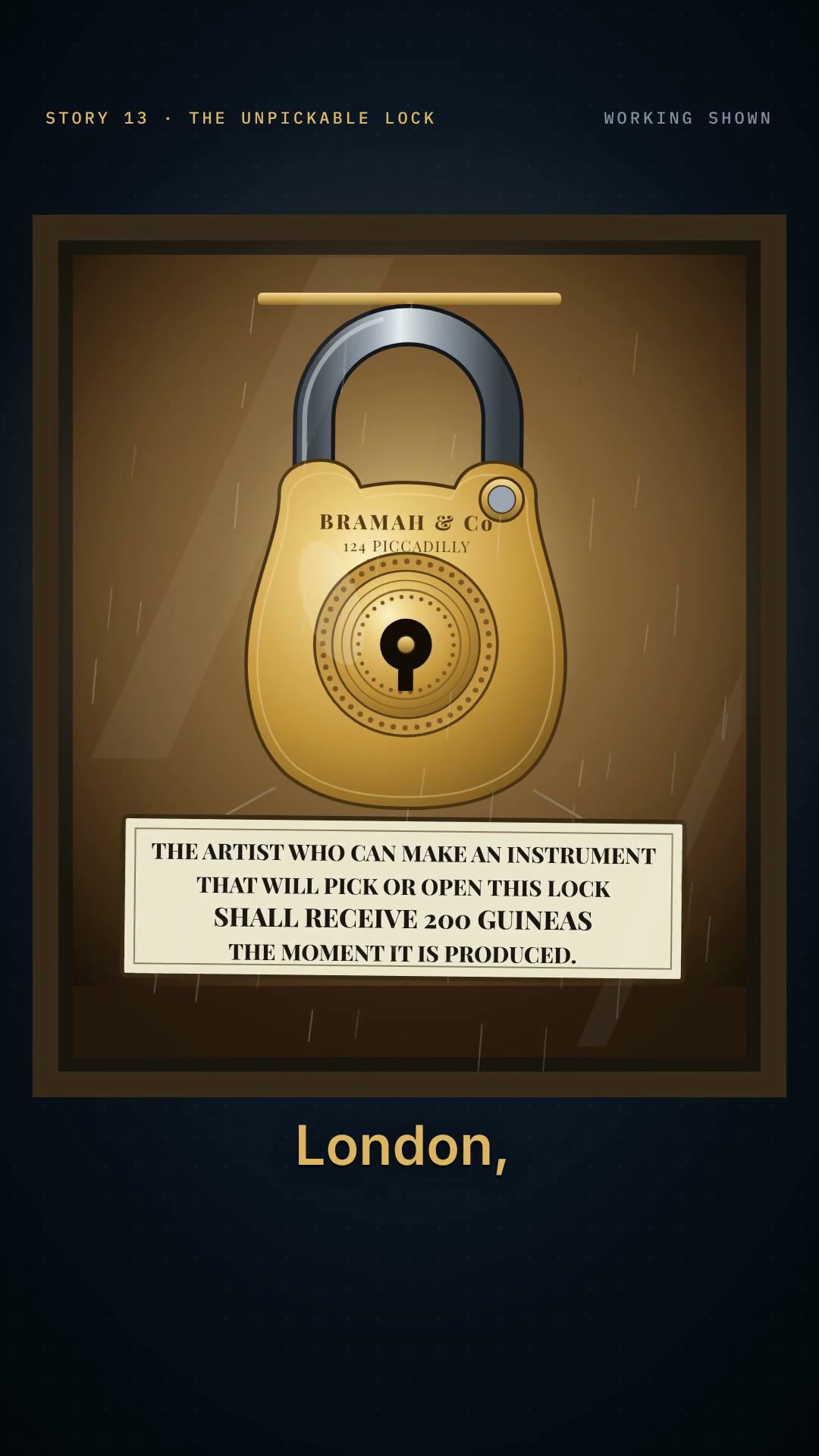
| hook | "London, eighteen fifty-one." | TOM ch. IX "The Lock Controversy"; certificate "London, July 22, 1851"; award "Sept. 2, 1851" [TOM pp. 116, 124]. |
| hook | "A padlock hangs in a shop window on Piccadilly, with a sign: two hundred guineas to anyone who can pick it." | Arbitrators' report: "a padlock has been exhibited in the window of Messrs. Bramah's shop, in Piccadilly, to which was appended a label with these words: 'The artist who can make an instrument that will pick or open this lock shall receive two hundred guineas the moment it is produced'" [TOM p. 123; PRICE p. 565; ORC p. 883]. Shop at "124, Piccadilly" [PRICE p. 561]. Board survives: SMG 1972-291 "Challenge board for Bramah padlock … Made: 1801". |
| hook | "For about fifty years, nobody has collected." | PRICE p. 559: "exhibited in the window of Messrs. Bramah's shop for nearly half a century"; PRICE p. 560: "appears to have been made in the year 1801"; SMG dates the board "1801". Other contemporary figures are lower ("made forty years since", 1851 newspaper in TOM p. 125; "nearly forty years", Bramah 1853, TOM p. 130), hence "about". |
| hook (screen) | "200 GUINEAS (£210)" | TOM p. 126, Bramah: "beg to hand you the 210l. awarded by the arbitrators". |
| hook (screen) | "STORY 13 · THE UNPICKABLE LOCK" | Title; Bramah 1851: "We believe the Bramah lock to be impregnable" [TOM pp. 127–128]. |
| answer | "an American lock salesman, Alfred Hobbs" | ORC p. 872: "born in Boston, Mass., October 7, 1812"; ORC p. 877: "continued traveling and selling bank locks", carrying tools "to demonstrate the insecurity of the locks in use". |
| answer | "takes the bet" | TOM p. 122: agreement "signed on the 19th" [July], allowing "thirty days"; PRICE p. 561, Hobbs to Bramah: "in relation to the offer you make on the sign in your window". |
| answer | "After fifty-one hours of work, it's open." | TOM p. 124: "the number of hours he was actually in the room with the lock was fifty-one" [also PRICE p. 566; ORC p. 883]. |
| answer (screen) | "0 → 51 HOURS"; shackle pops | As above. |
| answer | "And the trick he used? Lock makers were still designing against it years later, including the man behind the lock on your front door." | Chubb after 1851: "a series of teeth and notches to the stump and tumblers" so pressure locks things up [TOM p. 121]. Yale Jr., 29 Jan 1861, ten years later: Fig. 17 "showing the flattening of their abutting ends", because the old shape was "enhancing the facility of picking the lock" [P31278]. "The man behind the lock on your front door" = Yale Jr., US 48,475 (1865), the flat-key cylinder [P48475]; BLAZE §2: the pin tumbler cylinder is "By far the most common … keyed lock mechanism". |
| chubb | "A strong room in Westminster, a Chubb lock: six levers, three bolts." | Certificate: "a lock throwing three bolts and having six tumblers, affixed to the iron door of a strong-room or vault"; Hobbs's letter: "on the door of a Strong-room at 34, Great George-street, Westminster" [TOM p. 116; PRICE pp. 551–552; ORC p. 880]. Plate: "Chubb's New Patent (No. 261,461)". "Levers" = Chubb's pivoted tumblers [TOM pp. 56–57]. |
| chubb | "But first, a warm-up." | Chubb test 22 July; Bramah trial began 24 July [TOM pp. 116, 123]. |
| chubb | "Hobbs has never seen its key." | Certificate: the keys "had never been accessible to Mr. Hobbs, he having had permission to examine the key-hole only" [TOM p. 116]. |
| chubb | "In front of eleven witnesses" | Certificate "London, July 22, 1851" signed by 11 men, including G. R. Porter, "Late Secretary to the Board of Trade" [TOM p. 116; PRICE pp. 551–552; ORC p. 880]. |
| chubb | "he opens it in twenty-five minutes, then locks it again in seven." | Certificate: "commenced at 35 minutes past 11 o'clock a.m., and opened the lock within 25 minutes. Mr. Hobbs having been requested to lock it again with his instruments, accomplished it in the short space of 7 minutes, without the slightest injury to the lock or door" [TOM p. 116]. |
| chubb (screen) | "CHUBB'S NEW PATENT"; 6 levers; 11 witnesses; "25 MIN → LOCKED AGAIN 7 MIN" | As above. |
| deal | "Critics say that wasn't a proper test lock." | TOM p. 117: the lock "was not a test lock, prepared expressly for challenge". ORC p. 880: "Mr. Chubb continued to deny that his lock had been fairly opened". |
| deal | "Two days later, Hobbs starts on the big one." | Chubb certificate "London, July 22, 1851" [TOM p. 116]; "On July 24 Mr. Hobbs commenced his operations" [TOM p. 123]. 22 → 24 July = two days. (Agreement signed 19 July, TOM p. 122.) |
| deal | "The Bramah padlock is sealed inside a block of wood, only the keyhole and shackle showing." | TOM p. 123: "The lock should be enclosed in a block of wood, and screwed to a door, and the screws sealed, the key-hole and the hasp only being accessible to Mr. Hobbs; and, when he was not operating, the key-hole was to be covered with a band of iron and sealed … The key was also sealed up." |
| deal | "He gets thirty days." | TOM p. 122; PRICE p. 561: "thirty days". |
| deal (screen) | "30 DAYS"; wax seals; three judges' names | Arbitrators: "George Rennie, Esq., F.R.S., of London; and Professor Cowper, of King's College, London; and Dr. Black, of Kentucky" [TOM p. 123]. |
| inside | "Inside, eighteen thin sliders stand around a turning barrel." | 18 sliders [TOM p. 129; ORC p. 882]. TOM pp. 74–75: "two concentric brass barrels, the outer one fixed, and the inner rotating within it"; "thin pieces of steel are able to slide, in a direction parallel with the axis of the barrel". |
| inside | "The real key is a little tube with slots of different depths." | TOM p. 76: the key "has notches or clefts at the end of the pipe equal in number to the slides". |
| inside | "It pushes each slider in just far enough that all eighteen notches line up. Only then can the barrel turn." | TOM p. 76: "the key presses each slide, and pushes it so far as the depth of its cleft will permit; and all these depths are such that all the slides are pushed to the exact position where their notches all lie in the same plane"; TOM p. 75: "if this groove be brought to the plane of the locking-plate, the barrel can be turned". Supported. |
| inside (screen) | "18 SLIDERS · SPRING 30–40 LB (14–18 KGF)" | TOM p. 129: a spring pushed the sliders out "with a force of between 30 and 40 lbs." 13.6–18.1 kgf is our conversion. |
| feel | "Hobbs keeps a gentle twist on the barrel." | TOM pp. 129–130: "he kept constantly pressing on the cylinder which moved the bolt". ("Gentle" is our characterisation.) |
| feel | "Under that twist, the sliders don't all drag the same. One drags harder than the rest." | TOM pp. 129–130: "he could feel the varying resistance to which the sliders were subjected". |
| feel | "He eases it until it stops. Then the next one drags. One by one." | TOM pp. 129–130: "he adjusted them one by one until the notch came opposite the steel plate". Same method on Chubb: "until the tumblers are, one by one, raised to the proper height" [TOM pp. 119–120]. |
| feel (screen) | "PRINCIPLE ONLY · SCHEMATIC" | Deliberate: no tool or step detail given. |
| decoys | "But some notches are fakes, cut shallow. They let the barrel turn a little, then jam" | TOM p. 111: "The false notches are not so deep as the true; they will permit the barrel to turn partially but not wholly round". Introduced "by Mr. Russell, in 1817" [PRICE p. 560]. |
| decoys | "and he has to start again." | TOM p. 130: "when he had partially rotated the cylinder by means of the false notches, he had to begin again". |
| decoys | "So he records his progress on a strip of brass, and comes back the next day." | TOM p. 129: progress recorded on "a thin and narrow plate of brass". 16 working days [TOM p. 124]. |
| decoys (screen) | "FALSE NOTCH"; brass strip; day counter | As above. |
| open | "Sixteen days. Fifty-one hours in the room." | TOM p. 124: "The number of days occupied by Mr. Hobbs was sixteen, and the number of hours he was actually in the room with the lock was fifty-one". |
| open | "On August twenty-third, the shackle swings open." | TOM pp. 123–124: "On July 24 Mr. Hobbs commenced his operations; and on August 23 Mr. Hobbs exhibited the lock opened to Dr. Black and Professor Cowper". |
| open | "A week later, the real key still works. He's broken nothing." | TOM p. 124: "On Saturday, Aug. 30, the key was tried, and the padlock was locked and unlocked with the key … thus proving that Mr. Hobbs had fairly picked the lock without injuring it". |
| open (screen) | "24 JUL → 23 AUG"; "51 HOURS"; "UNDAMAGED" | As above. |
| paid | "Bramah pays the two hundred guineas" | Award: "we award that Messrs. Bramah and Co. do now pay to Mr. Hobbs the two hundred guineas" (2 Sept 1851) [TOM p. 124]; Bramah 9 Sept: "beg to hand you the 210l." [TOM p. 126]. |
| paid | "about twenty-nine thousand pounds today" | MW (UK, 1851 → 2023): "A simple Purchasing Power Calculator would say the relative value is £29,040.00" (RPI). |
| paid | "and protests in the papers: 'We believe the Bramah lock to be impregnable.'" | Bramah in the Observer, 10 Oct 1851, reprinted TOM pp. 127–128: "We believe the Bramah lock to be impregnable; and we cannot open it ourselves, with the knowledge Mr. Hobbs has given us." |
| paid (screen) | "£210 ≈ £29,000 TODAY"; "IMPREGNABLE?" | As above (MW RPI 2023). |
| twist | "Three years later" | Certificate "London, Feb. 20, 1854" [PRICE pp. 713–714] (two and a half years after Aug 1851; "three years" by calendar year). |
| twist | "One of Hobbs's own locks is bought over the counter and handed to a Chubb workman." | PRICE pp. 713–714 (from the Morning Advertiser, 24 Feb 1854): John Goater, a Chubb employee, picked Hobbs's patent "protector" locks bought over the counter at Hobbs & Co., Cheapside. |
| twist | "Sealed at nine in the morning... picked by three that afternoon." | PRICE pp. 713–714: handed over sealed "at nine o'clock on Thursday morning"; Goater "picked and returned it (sealed as when given to him) at three o'clock the same afternoon". |
| twist (screen) | "HOBBS & CO"; "9:00 → 3:00 PM"; "PICKED" | As above. |
| yale | "Not quite Yale, as the story usually goes." | Yale Sr. 1844 spring-loaded pin lock [P3630]; gravity pin lock far older [TOM pp. 14–16]. HAGLEY: the 1844 lock "was not produced by the company that now bears his name". |
| yale | "Pins that drop into a bolt are ancient." | TOM pp. 14–15 (Eton, 1790s): "the upper pins fall into the holes in the bolt by their own weight"; TOM p. 16: "This primitive lock comprises many of the best features of the tumbler or lever-locks of later days". Dossier script-safe line: "versions of it are ancient." No date given (none is sourced). |
| yale | "Linus Yale and his son made the idea small, spring-loaded, and turned by a flat key." | P3630 (Yale Sr., 13 June 1844): pistons pushed "by springs G" into a "revolving cylinder or tumbler E". P48475 (Yale Jr., 27 June 1865): "each is provided with a spring, L"; "The key K is a thin slip of steel"; "This plan of a thin key and narrow key hole … are of my invention". |
| yale (screen) | "YALE INVENTED IT → NOT QUITE"; Egyptian pin-lock engraving; 1865 patent drawing; "1844 / 1865" | As above; engraving from TOM p. 15. |
| pins | "Inside yours: a turning plug, and stacks of pins, each split in two." | BLAZE: "a rotatable cylinder tube, called a plug"; "pin stacks, typically under spring pressure". P48475: "The tumblers or pins are each made in two pieces, I and J". |
| pins | "The wrong key leaves the splits at the wrong heights." | BLAZE: "The plug will be blocked from rotating if any pin stack is lifted either not far enough … or too far." |
| pins | "The right key lifts every split to exactly the same line. And it turns." | P48475: "must all be arranged by the key, so that the various lines of division between the two parts of the tumblers are all in the same line before the cylinder D can be turned". BLAZE: "The plug/shell border is called the shear line." |
| pins (screen) | "SHEAR LINE"; "4–7 PINS, OFTEN 5" | BLAZE §2.2: "Typically, the number of pins is in the range of four to seven"; worked example "a key for a five pin lock". |
| still | "And Hobbs's trick? His eighteen fifty-three book spelled it out: if pressure on the bolt shows where the parts resist, the lock can be picked." | TOM 1853 p. 118: "whenever the parts of a lock which come in contact with the key are affected by any pressure applied to the bolt … in such a manner as to indicate the points of resistance … such a lock can be picked". "His" book: Hobbs supplied the materials and corrected every sheet [TOM preface]; IA catalogues it under "Hobbs, A. C.". |
| still | "In eighteen sixty-one, Yale's son reshaped his own pins, because the old shape made picking easier." | P31278 (Yale Jr., 29 Jan 1861): Fig. 17 shows "a 'piston' and 'driver' showing the flattening of their abutting ends"; the old shape was "enhancing the facility of picking the lock". |
| still (screen) | Yale 1861 fig. 17 card "flattening of their abutting ends"; "1861" | P31278. |
| close | "As the book Hobbs helped write put it: 'Rogues knew a good deal about lock-picking long before locksmiths discussed it among themselves.'" | TOM 1853, Introduction pp. 2–3, verbatim: "Rogues knew a good deal about lock-picking long before locksmiths discussed it among themselves, as they have lately done." Authorship: Hobbs supplied the materials and "each sheet … was submitted to Mr. Hobbs, who read it with care, and made his annotations and corrections thereon" [TOM preface, July 1853]. |
| close (screen) | 1853 book page card | TOM 1853 scan (archive.org in.ernet.dli.2015.220709). |
What the drawing simplifies
- The Bramah barrel, the Chubb strong-room door and levers, the wooden block, and the modern pin cylinder are 3D or line-art rigs: schematic, not to scale, and not models of the actual 1851 locks. The real challenge padlock is 4 in (102 mm) wide [PRICE p. 560; TOM p. 125].
- Slider and pin counts in the rigs: the Bramah rig shows 18 sliders (sourced); the Chubb rig shows 6 levers and 3 bolts (sourced); the modern cylinder shows 5 pin stacks, a representative choice (Blaze: 4–7, five as the worked example). Slider/pin depths, spring shapes and notch depths are illustrative.
- The
stillbeat shows one pin glowing red under torque: an illustration of the 1853 principle applied to pins, not a sourced claim about modern locks. - The "feel" and "decoys" beats are labelled PRINCIPLE ONLY · SCHEMATIC: the red/green binding glow, the torque arrow and the ~15° false-notch turn illustrate the principle, not Hobbs's actual tools or steps (deliberately not shown). Hobbs also used a spring-holding fixture, which is not depicted.
- £29,000 is MeasuringWorth's RPI figure for £210 from 1851 to 2023 (£29,040); by wages it would be about £214,600.
- Staged: the Piccadilly shop window, rain and reflection; the challenge board (the real board survives at the Science Museum, but no image is online, so ours is a recreation); the 11 witness silhouettes; the wax seals; the coins and newspaper prop (the quote is verbatim, the newspaper layout is ours); the calendar and clocks; the Hobbs & Co. counter; the modern front door.
- The "Egyptian pin lock" engraving (TOM 1853) shows the type still used in 19th-century Egypt and Turkey, not an ancient artefact.
- Hobbs's portrait is the 1886 engraving from Orcutt (low resolution), drawn 35 years after the events.
- The Science Museum photo of the real padlock is CC BY-NC-SA and not used.
Checked, and cut
- "The lock sat in the window since 1790": no source says 1790; the lock and board date to about 1801 (PRICE, SMG). We say "about fifty years".
- "The Bramah lock went unpicked for 67 years" (1784–1851): misleading; before the 1817 false notches, it was advertised that "an individual of great dexterity could perform this operation almost with certainty" [TOM pp. 110–111]. We say only that nobody collected the prize.
- "The Egyptians invented the pin tumbler 4,000 years ago": unsourced; Tomlinson himself hedged ("It is difficult, by mere inspection of the bas-reliefs … to decide", TOM p. 13). We say only "ancient", with no date.
- "Yale invented the pin tumbler": false as stated; shown as myth-check "NOT QUITE".
- The Duke of Wellington calling Hobbs "one of the cleverest of men" and the Queen visiting his lock: only in Orcutt 1886, from Hobbs's own memory. Not used.
- "Bramah withdrew its second challenge out of fear": contested (Bramah's J. Smyth says it stayed four months and was removed to stop "impertinent applications"). Not used.
- "Rebuilt with 13 steel slides" (Wikipedia, on the surviving lock): unverified. Not used.
- Bramah's 1853 excuses (iron sliders, oversize keyhole, short barrel): true as Bramah's claims, not used.
- The actual opening took "an hour or two" once a stronger tool was made: true, not used (we give the 51-hour total).
- Goater's "picked the lock in five minutes … one minute and a half" and Hobbs & Co.'s "six hours" retort: true as claims, not used.
- Modern pin-depth dimensions (0.015 in steps, Schlage): unverified, not used.
- The Crystal Palace informal Chubb picking "in a few minutes": true, not used.
- The 1868 Yale Lock Manufacturing / Yale & Towne founding: true (HAGLEY), not used.
- Security-through-obscurity link to modern computer security: no source fetched; not claimed.
Sources
Found an error?
Tell us at hello@workingshown.xyz or in the comments. We check it against the sources, pin the correction, fix the caption, and log it on the corrections page.