 WORKING
Receipts / U02
U02 · · posted 11 Oct 2026
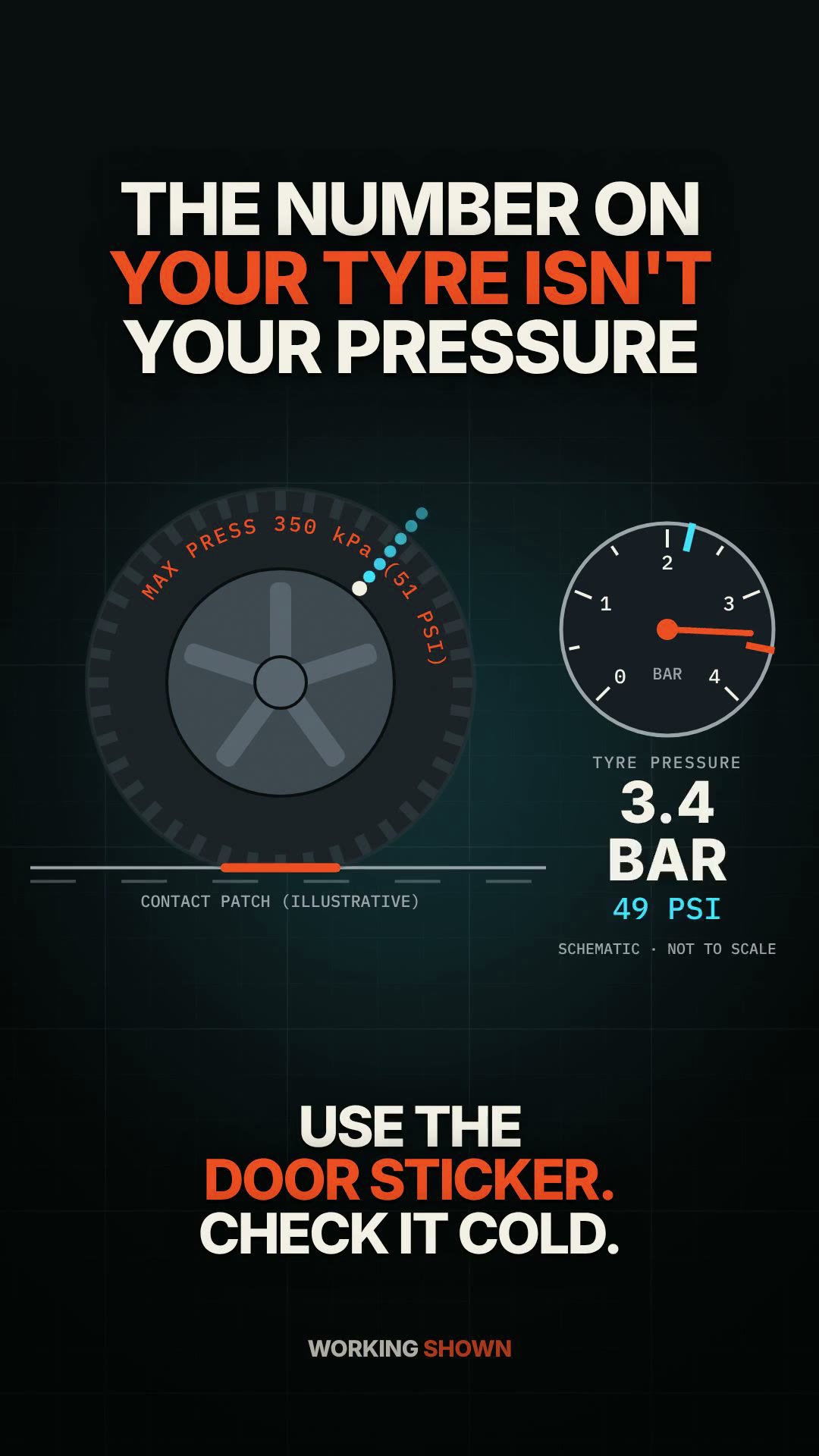
The number on your tyre isn't your pressure
Line by line
Every claim, with its source.
Every on-screen or caption claim is listed here with the source wording it rests on. Sources fetched on 2026-10-09. nhtsa.gov returns 403 to scripts, so NHTSA's tires page was read via the Wayback Machine capture of 2026-01-01 (https://web.archive.org/web/20260101210046/https://www.nhtsa.gov/equipment/tires).
| Shot | Claim (on screen / caption) | Source and verbatim support |
|---|---|---|
| hook | "The number on your tyre isn't your pressure." | NHTSA, Tires page: "Remember, the correct pressure for your tire is what the vehicle manufacturer has listed, NOT what is listed on the tire itself." |
| max | The sidewall number is the tyre's maximum pressure (on screen: "SIDEWALL MAX", "A LIMIT, NOT A TARGET"). | 49 CFR 571.139 (FMVSS 139), S5.5: each tire must be marked with "(c) The maximum permissible inflation pressure"; S3 definition: "Maximum permissible inflation pressure means the maximum cold inflation pressure to which a tire may be inflated." (https://www.law.cornell.edu/cfr/text/49/571.139). NHTSA, Final Rule, 67 FR 69600 (18 Nov 2002): the agency expects better placards and consumer information to "reduce the number of consumers who mistake the maximum inflation pressure for the recommended inflation pressure." (https://www.govinfo.gov/content/pkg/FR-2002-11-18/pdf/02-28682.pdf) |
| max | Sidewall reads "MAX PRESS 350 kPa (51 PSI)", which is 3.5 bar. | Illustrative example. 49 CFR 571.139 S5.5.4: "For passenger car tires, if the maximum inflation pressure of a tire is 240, 280, 300, 340, or 350 kPa, then: (a) Each marking of that inflation pressure ... must be followed in parenthesis by the equivalent psi, rounded to the next higher whole number". 350 kPa = 50.76 psi → "51 PSI"; 350 kPa = 3.5 bar (conversion). "MAX PRESS" wording simplified. |
| max | Over-inflating shrinks the contact patch (drawn: orange patch shortens). | Drawn illustratively, magnitude not sourced; labelled "CONTACT PATCH (ILLUSTRATIVE)". Wikipedia (Contact patch), citing NHTSA "The Pneumatic Tire": "The larger the inflation pressure, the smaller the contact patch." Michelin Australia (https://www.michelin.com.au/auto/auto-tips-and-advice/tire-damage/over-inflated-tires): "On an overinflated tire, the center of the tread bears most of the load and wears out faster than the outside edges." The patch length in the code (sag = 70/bar − 10) is invented for the drawing. |
| door | "USE THE DOOR STICKER." The recommended pressure is on the door label or in the owner's manual. | NHTSA, Tires page: "Locate the recommended tire pressure on the Tire and Loading Information Labels on the driver's side door edge or post or in the owner's manual." Also: "Your tires' proper tire inflation pressure—measured in both kilopascals (kPA) and pounds per square inch (PSI or psi)—can be found on the Tire and Loading Information Label on the driver's side door edge or in your owner's manual." Placement is US rule (FMVSS 110: "permanently affixed to the driver's side B-pillar"); UK cars may put it in the fuel-filler flap (TyreSafe, reel 14 claims), so the caption says "door sticker (or owner's manual)". |
| door | Door value "EXAMPLE: 2.2 BAR (32 PSI), COLD". | Illustrative example, labelled EXAMPLE. Sits inside reel 14's sourced typical range (Progressive: "normal tire pressure range of 30-35 pounds per square inch (PSI)"). 2.2 bar = 31.9 psi → 32 (conversion). |
| caption | "often around 2.1-2.4 bar (30-35 psi)" | Reel 14 claims, psi row. Progressive Life Lanes (https://lifelanes.apps.progressive.com/tire-pressure-guide/): "Many passenger car manufacturers typically recommend a normal tire pressure range of 30-35 pounds per square inch (PSI)." 30 psi = 2.07 bar, 35 psi = 2.41 bar (conversion). Secondary source (insurer), caption only. |
| cold | "CHECK IT COLD." Cold = not driven for at least three hours ("PARKED 3+ HOURS"). | NHTSA, Tires page: "Check the pressure of all tires, including your spare, at least once a month when the tires are "cold," meaning that the car hasn't been driven for at least three hours." And: "The vehicle manufacturer's recommended tire inflation pressure is the proper psi (pounds per square inch) or kPa ... when a tire is cold, meaning it has not been driven on for at least three hours. To get an accurate tire pressure reading, you must measure tire pressure when the tires are cold or compensate for the extra pressure in warm tires." |
| warm | Driving warms the tyre and raises the reading ("CHECKED WARM", "DRIVING RAISES IT"). | NHTSA, Tires page (TPMS): tyre pressure "rises to an acceptable level as the tires heat up through vehicle operation". Polestar 2 owner's manual (2024, https://www.polestar.com/ie/manual/polestar-2/2024/article/6f91de2d681fb3dfc0a8015169ce1032/): "The tyres are warm due to driving and it is normal for the pressure to increase above the recommended pressure for cold tyres." "After having driven approximately 1.6 km (1 mile) these tyres are considered as warm." Michelin Australia: "always check tires when they're cold or before they've been driven." |
| warm | Gauge climbs 2.2 → 2.4 bar (32 → 35 psi) after driving: about +0.2 bar (3 psi). | Dacia Logan owner's manual (https://www.user-manual.dacia.com/da/node/2813; same text in Alpine and Renault manuals): "If tyre pressures cannot be checked when the tyres are cold, the pressure values indicated must be increased by 0.2 to 0.3 bar (or 3 PSI)." Caveat: this is the maker's warm-check allowance, which implies warm tyres read about that much higher; the actual rise varies with driving, load and weather. The on-screen rise is an example at the low end of that allowance; no number is printed for it except the live gauge. 2.4 bar = 34.8 psi → 35 (conversion). |
| warm | "NEVER LET AIR OUT" of a warm tyre. | Dacia manual: "Never deflate a hot tyre." Polestar 2 manual: "If you check the tyre pressure when the tyres are warm then you must never release any air." |
| caption | Temperature: about 7 kPa (1 psi) per 10 degrees. | Not used on screen or in caption (kept for reference). Polestar 2 manual: "A decrease in temperature of 10 degrees causes the tyre pressure to decrease 7 kPa (1 psi)." |
What the drawing simplifies
- Side-view tyre, gauge and contact patch are schematic; on screen: "SCHEMATIC · NOT TO SCALE" and "CONTACT PATCH (ILLUSTRATIVE)".
- The gauge is a generic dial (0-4 bar) with a digital bar + psi readout, all computed from one pressure variable. The orange tick marks the sidewall max (3.5 bar), the cyan tick marks the example door value (2.2 bar).
- The "parked 3 h, cold again" step (2.4 → 2.2 bar) is compressed into ~1 s.
Checked, and cut
- ETRTO "hot pressure up to 20 % higher" (quoted second-hand by a UK tyre retailer): no primary text found.
- Retailer "2-5 psi rise when warm" (puretyre.co.uk): not an official source.
- "Over-inflation reduces grip / raises hydroplaning": only retailer sources (Les Schwab etc.). Cut.
- Any real contact-patch area or percentage change: no source.
Sources
Found an error?
Tell us at hello@workingshown.xyz or in the comments. We check it against the sources, pin the correction, fix the caption, and log it on the corrections page.