 WORKING
Receipts / U03
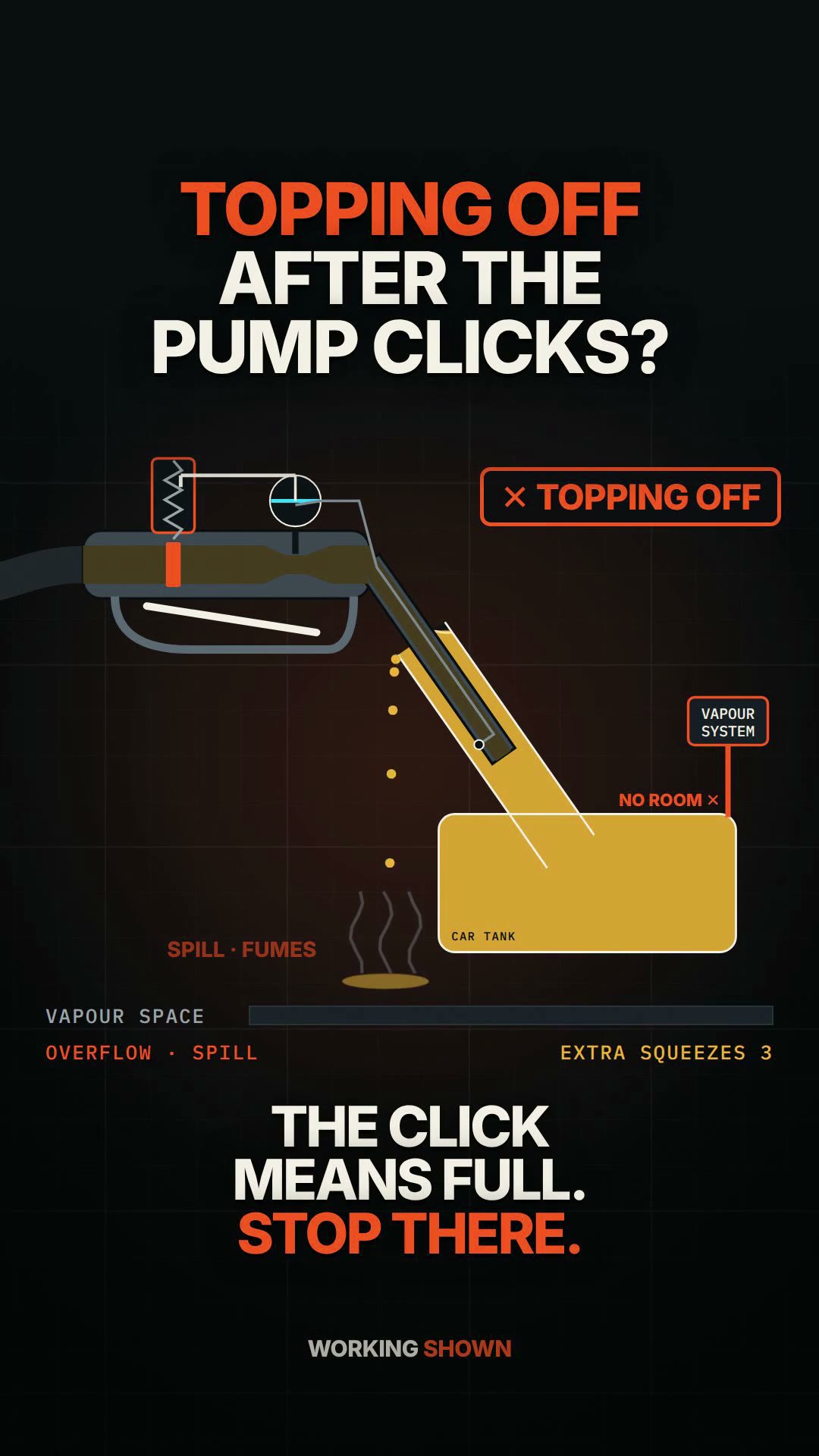
U03 · · posted 12 Oct 2026
Do you keep squeezing after the pump clicks off?
Line by line
Every claim, with its source.
Every on-screen and caption claim is listed here with the source wording it rests on. Sources were fetched on 2026-10-09. The shut-off mechanism itself is sourced in reels/05-fuel/claims.md (rows hole, venturi, trip), and this file reuses those rows by reference.
Source key
- EPA-2004: U.S. EPA Region 3 news release, "Don't Top off Your Gas Tank -- Save Money at the Gas Pump and Help Protect the Environment", 6/28/2004. https://www.epa.gov/archive/epapages/newsroom_archive/newsreleases/714cf2672631269e852570d60070fe91.html
- EPA-1999: U.S. EPA news release, "Want to Save at the Pump? Don't Top Off!", 7/26/1999 (release 99-337). https://www.epa.gov/archive/epapages/newsroom_archive/newsreleases/95efa29176fe1e1a852570d60070fa5c.html
- ODEQ: State of Oregon Department of Environmental Quality, brochure "Don't "Top Off" the Tank". https://www.oregon.gov/deq/FilterDocs/NoTopOff.pdf
- Honda: Honda owner's manual (WR-V 2017, Honda Cars India online manual), "How to Refuel". https://hondacarindia.com/ownersmanual/webom/eng/wr-v/2017/details/106350046-11688
| Shot / text | Claim | Source and verbatim support |
|---|---|---|
| hook "TOPPING OFF AFTER THE PUMP CLICKS?" | Topping off means adding fuel after the automatic shut-off. | ODEQ: "If you're pumping your own gas, stop pumping as soon as the nozzle clicks off". EPA-2004: "If you continue clicking on the nozzle, that extra gasoline will either be sucked into the vapor recovery tube or overflow." |
| fill → click (both halves) | Fuel covers the sensing hole at the tip, suction trips the valve, and the nozzle clicks off. | See reels/05-fuel/claims.md rows hole, venturi and trip (Elaflex, US3542092A). EPA-2004 also says: "There is a sensing hole located at the tip of the nozzle. When that hole is covered with gas, the pump shuts off." |
| ✕ extra squeezes click straight off again | Each re-squeeze trips again at once because the hole is still covered. | Inference from 05 trip: Elaflex, "When fuel reaches the sensing port, suction builds up rapidly until it lifts the diaphragm (4) and trips the automatic action which shuts the valve." (Drawn, not stated on screen.) |
| answer "THE CLICK MEANS FULL." | The automatic shut-off means the tank is full. | EPA-2004: "When the pump automatically shuts off, that's the signal your gas tank is filled." Honda: "When the tank is full, the filler nozzle will click off automatically." |
| answer "STOP THERE." / ✓ STOP AT THE CLICK | Stop at the first click. | ODEQ: "stop pumping as soon as the nozzle clicks off". Honda: "Do not continue to add fuel after the filler nozzle has automatically stopped." |
| ✓ "VAPOUR SPACE" left in the tank at the click | The shut-off leaves room in the tank. | Honda: "The filler nozzle automatically stops to leave space in the fuel tank so that fuel does not overflow as a result of changes in air temperature." Honda: "This leaves space in the fuel tank in case the fuel expands with a change in the temperature." |
| "VAPOUR SYSTEM" box, needs that room | The vapour system needs room in the tank to work. | ODEQ: "You need extra room in your gas tank for the vapor collection system to work properly". EPA-2004 (car side): "Putting more gas into an already full tank can actually damage your car's vapor recovery system." |
| ✕ space fills → "NO ROOM" | Topping off fills the tank past full. | Honda: "Additional fuel can exceed the full tank capacity." EPA-2004: "Putting more gas into an already full tank can actually damage your car's vapor recovery system." |
| ✕ "OVERFLOW · SPILL" + fumes off the puddle | Topping off can overflow and spill fuel, and the spilt fuel gives off vapour. | EPA-2004: "that extra gasoline will either be sucked into the vapor recovery tube or overflow." ODEQ: "Topping off your gas tank spills gas allowing vapors into the air." |
| caption: you pay for fuel you don't get | Extra fuel may go back to the station rather than into the tank. | EPA-2004: "Those extra drops of gasoline may not end up in your tank, even though you pay for them." ODEQ: "Topping off the gas tank can result in paying for gas that is fed back into the station's tanks because your gas tank is full". |
| caption: fumes are harmful | Gasoline vapour is harmful to breathe. | ODEQ: "Gasoline vapors are harmful to breathe" and "Gas vapors are a source of several air pollutants including benzene, which is known to cause cancer". EPA-2004: "Being exposed to gasoline fumes can increase health risks." |
What the drawing simplifies
- The nozzle, filler neck and tank are the reel-05 schematic, not to scale (the 05 caveats apply).
- The vapour space is drawn as a pocket across the top of the tank while fuel stands in the filler neck. The sources say the shut-off "leave[s] space in the fuel tank" (Honda) but don't describe how it's trapped; the drawing shows the result only.
- "VAPOUR SYSTEM" is a generic box on a line from the tank top. Its position and routing are illustrative. No component (e.g. a charcoal canister) is named, because no official source we fetched names one in this context.
- The ✕ half doesn't show liquid fuel entering the vapour line. The sources support "damage" and "needs extra room", not a specific liquid path on the car side.
- There are no quantities on screen (no volumes, no percentages), so no unit conversions are needed.
Checked, and cut
- "Liquid fuel saturates the charcoal canister": this appears in repair-shop blogs and press articles, not in any official or manufacturer source we fetched.
- The EPA's "vapor recovery tube" (EPA-2004) refers to the station's Stage II nozzle hardware, which isn't drawn in the r05 rig, so it was left out of the visual.
- Any repair cost: no primary source.
Sources
Found an error?
Tell us at hello@workingshown.xyz or in the comments. We check it against the sources, pin the correction, fix the caption, and log it on the corrections page.