 WORKING
Receipts / U04
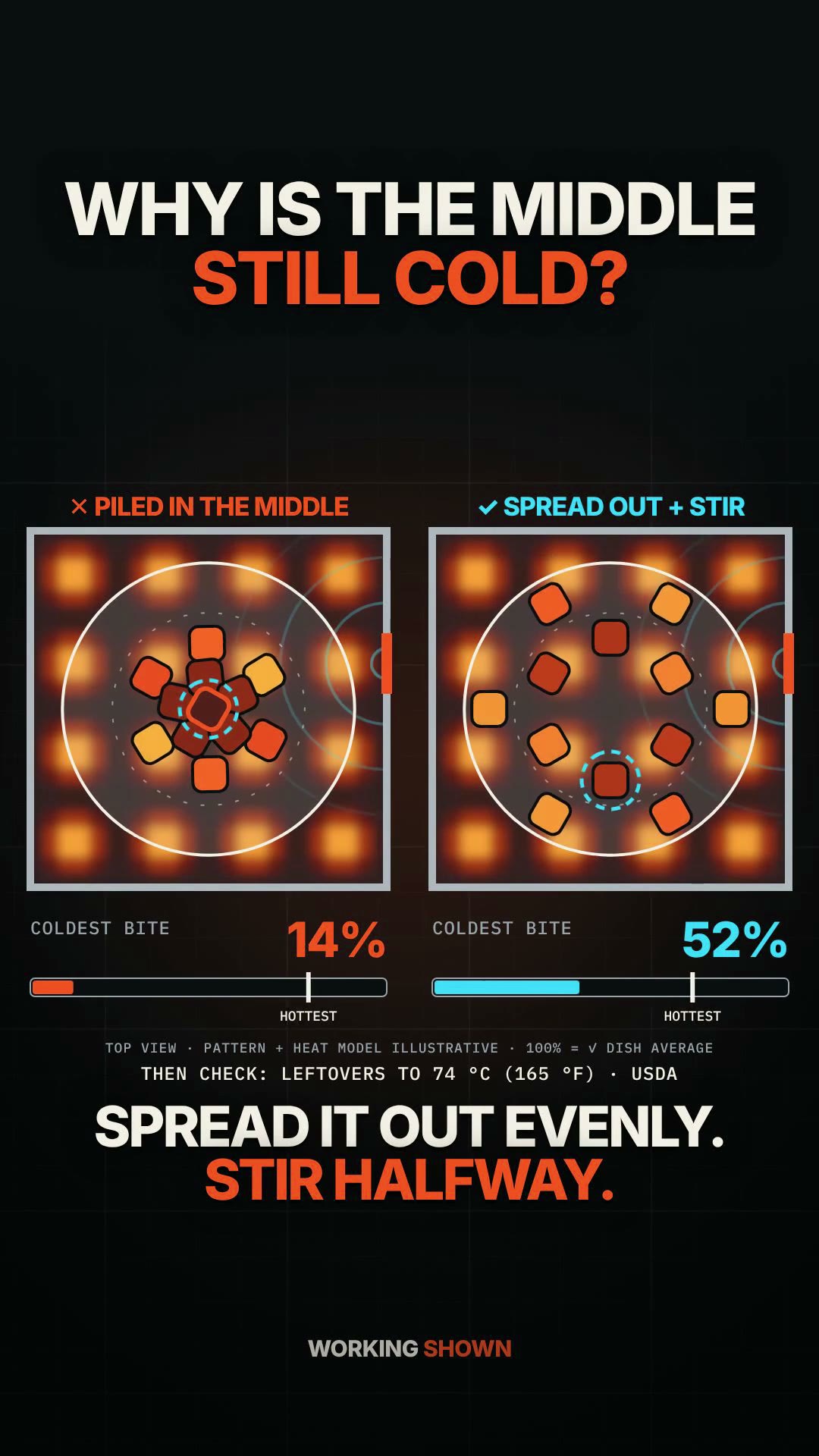
Every claim, with its source.
Every on-screen and caption claim is listed here with the source wording it rests on. Sources fetched on 2026-10-09.
Primary source (the action)
USDA Food Safety and Inspection Service, Cooking Safely in the Microwave Oven (fact sheet, "Revised June 2011"). The live page at fsis.usda.gov returned HTTP 403 to our fetcher, so the text was read from the government's own archived copy on GovInfo: https://www.govinfo.gov/content/pkg/GOVPUB-A110-PURL-gpo127402/pdf/GOVPUB-A110-PURL-gpo127402.pdf (live page: https://www.fsis.usda.gov/food-safety/safe-food-handling-and-preparation/food-safety-basics/cooking-safely-microwave-oven). The orchestrator should re-check the live page wording by browser before publishing.
| Shot | Claim (on screen / caption) | Source and verbatim support |
|---|---|---|
| why | "Microwaves heat unevenly and leave cold spots, where bacteria can survive." (hook premise, caption) | USDA FSIS: "Microwave ovens can cook unevenly and leave "cold spots," where harmful bacteria can survive." |
| spread | "SPREAD IT OUT EVENLY." (answer); ✓ dish: pieces spread out, not piled | USDA FSIS: "Arrange food items evenly in a covered dish and add some liquid if needed." Health Canada (Microwave food safety, modified 2024-07-17, https://www.canada.ca/en/services/health/publications/food-nutrition/infogrphic-microwave-cooking.html): "Cut food into small portions and evenly arrange it to minimize overlapping." |
| cover | "Cover it." (caption only, not drawn) | USDA FSIS: "Cover the dish with a lid or plastic wrap; loosen or vent the lid or wrap to let steam escape. The moist heat that is created will help destroy harmful bacteria and ensure uniform cooking." |
| stir | "STIR HALFWAY." (answer, ✓ dish label) | USDA FSIS: "Stir or rotate food midway through the microwaving time to eliminate cold spots where harmful bacteria can survive, and for more even cooking." |
| thick-outside | Not used on screen or in the caption (kept for reference; it is extension advice, not USDA wording) | Supporting, not federal: Clemson Cooperative Extension (C. J. Patrick, Homemaker's Column: Microwave Cooking, 2022-08-01, https://blogs.clemson.edu/savannahvalley/homemakers-column-microwave-cooking/): "arrange them in a dish or on a rack, so thick parts are toward the outside of the plate and thin slices are in the center." Univ. of Kentucky Cooperative Extension (FN-SSB-072): "Place the toughest, thickest parts of vegetables toward the outside of the cooking dish because they will cook faster." |
| middle | ✕ dish: the buried middle of the pile heats slowly | Reel 01 claims.md, row conduction (FDA: "the outer layers are heated and cooked primarily by microwaves while the inside is cooked mainly by the conduction of heat from the hot outer layers"), and row depth (1.4 cm penetration in water at 25 °C). Also USDA FSIS on large cuts: medium power "allows heat to reach the center without overcooking outer areas." |
| pattern | Hot/cold standing-wave pattern in the cavity; turntable | Reel 01 claims.md, row turntable (US 4,636,605: "The standing microwave pattern creates cold spots …") and v2 row Hot/cold-spot heatmap (illustrative). Same pattern as L01. |
| target | "THEN CHECK: LEFTOVERS TO 74 °C (165 °F) · USDA" | USDA FSIS: "Reheat leftovers to 165 °F." and "After reheating foods in the microwave oven, allow standing time. Then, use a clean food thermometer to check that food has reached 165 °F." 74 °C is a conversion of 165 °F (73.9 °C). |
| standing | "let it stand" (caption only) | USDA FSIS: "Always allow standing time, which completes the cooking, before checking the internal temperature with a food thermometer." |
Readout ("COLDEST BITE nn%")
not a measured value. It is the output of a small illustrative model in studio/src/loops/U04.tsx: each piece gains heat in proportion to the drawn (illustrative) field at its position as the turntable turns, times an exposure factor (heap core 0.1, heap middle layer 0.35, outside pieces 1.0, reflecting the conduction row), plus slow conduction inside the heap. 100% = the average heat of the spread-and-stirred dish when heating stops. End-of-heating values: ✕ coldest ≈ 26%, ✓ coldest ≈ 78%. No temperature is mapped onto it; it is labelled "HEAT MODEL ILLUSTRATIVE".
What the drawing simplifies
schematic top view, not to scale; the hot/cold pattern and heat model are illustrations, not a simulation of a real oven (labelled on screen).
Checked, and cut
- "Arrange it in a ring": no official (USDA/FDA/Health Canada) wording found; only food blogs. The answer says "SPREAD IT OUT EVENLY" instead. The ✓ dish's pieces happen to sit on two circles, which is an even arrangement, not a "ring" claim.
- Converting the model's relative heat to °C/°F: no basis; left as a percentage.
Sources
Found an error?
Tell us at hello@workingshown.xyz or in the comments. We check it against the sources, pin the correction, fix the caption, and log it on the corrections page.