 WORKING
Receipts / U06
Line by line
Every claim, with its source.
Every on-screen and caption claim is listed here with the source wording it rests on. Sources fetched on 2026-11-14. The drawing is a schematic, not to scale; a day and a night are compressed into 12 s.
Source key
- Firestone: Firestone Complete Auto Care, "Should I Inflate My Tires in Cold Weather?", 30 Oct 2018. https://www.firestonecompleteautocare.com/blog/tires/should-i-inflate-tires-cold-weather/
- NHTSA: NHTSA, Tires page (quoted in
reels/U02-tyre-pressure/claims.md, rows cold and placard). https://www.nhtsa.gov/equipment/tires - Gas law: for a fixed amount of air in a fixed volume, absolute pressure is proportional to absolute temperature (Gay-Lussac's law). https://en.wikipedia.org/wiki/Gay-Lussac%27s_law
| Shot / text | Claim | Source and verbatim support |
|---|---|---|
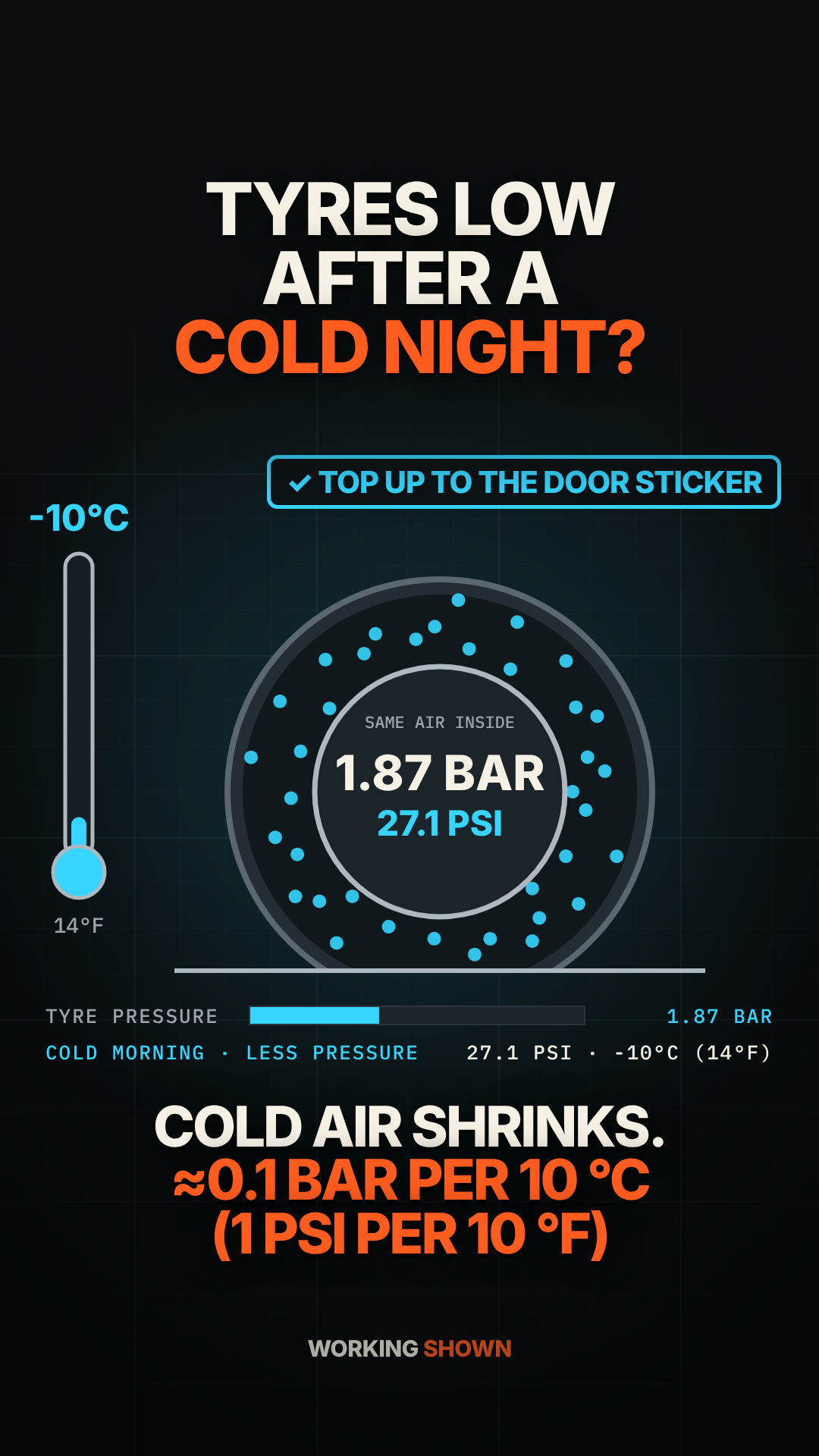
| hook "TYRES LOW AFTER A COLD NIGHT?" | Low temperatures lower tyre pressure. | Firestone: "low temperatures often mean low tire pressure". |
| answer "COLD AIR SHRINKS." / "SAME AIR INSIDE" / slower dots | The air isn't lost; cold slows the molecules. | Firestone: "when the temperature drops, molecules in the air move slower and huddle together." And: "your tire pressure should bounce back after the cold spell passes (assuming it does pass and your tires have no leaks or holes)". |
| answer "≈0.1 BAR PER 10 °C (1 PSI PER 10 °F)" | Size of the effect. | Firestone: "tires lose or gain 1-2 PSI (pounds per square inch) for every 10℉ change in temperature." Our figure is the low end, computed from the gas law (next row): 0.33 bar over 30 °C = 0.11 bar per 10 °C; 4.8 psi over 54 °F = 0.9 psi per 10 °F. |
| gauge 2.20 bar (31.9 psi) at 20 °C (68 °F) → 1.87 bar (27.1 psi) at −10 °C (14 °F) | The live readout. | Computed from the gas law for a sealed tyre: P_gauge = (2.2 + 1.013) × (273.15 + T) / 293.15 − 1.013 bar. At −10 °C: 3.213 × 263.15 / 293.15 − 1.013 = 1.87 bar. 1 bar = 14.5038 psi. The 2.2 bar starting pressure is an example inside Firestone's range: "Recommended tire pressure usually falls between 30-35 PSI for passenger cars." |
| "✓ TOP UP TO THE DOOR STICKER" | Set the pressure to the vehicle's recommended value. | Firestone: "Find your recommended tire pressure. You can find it written in your owner's manual or on a sticker attached to your door jamb, glove box, or fuel hatch." Also U02 row placard (NHTSA). |
| caption "check the tyres cold, before driving" | Measure cold. | Firestone: "Measure your tire pressure before driving, not after, for the most accurate reading. This practice is referred to as setting the cold tire pressure." Also U02 row cold (NHTSA). |
| caption "low pressure shouldn't be ignored" | Don't ignore it. | Firestone: "low tire pressure shouldn't be ignored." |
Sources
Found an error?
Tell us at hello@workingshown.xyz or in the comments. We check it against the sources, pin the correction, fix the caption, and log it on the corrections page.