 WORKING
Receipts / U07
Line by line
Every claim, with its source.
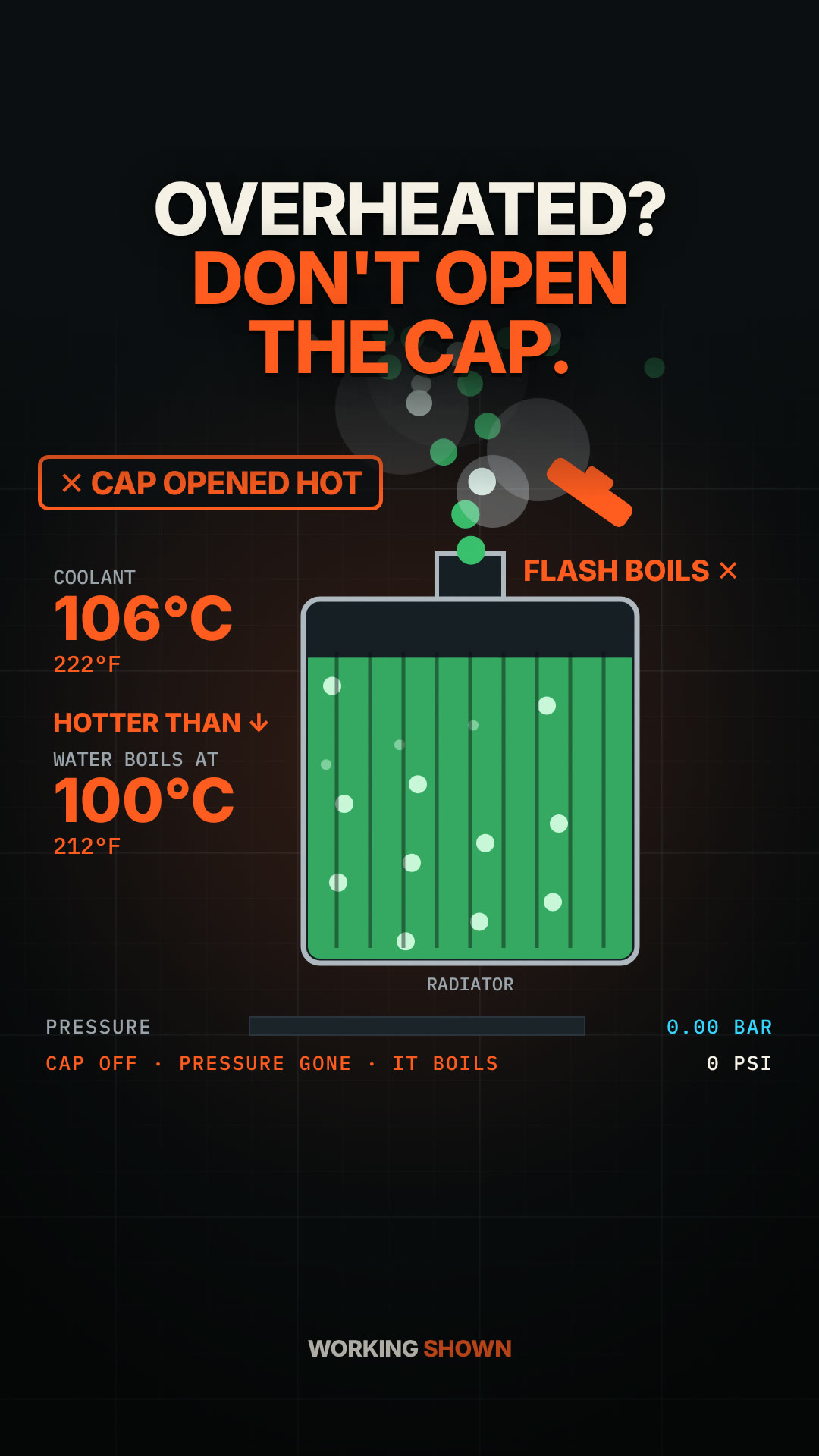
Every on-screen and caption claim is listed here with the source wording it rests on. Sources fetched on 2026-11-14. The drawing is a schematic, not to scale; the cooling time is compressed into a few seconds. Temperatures and pressures on screen are example values.
Source key
- Firestone: Firestone Complete Auto Care, "What to Do (& Not Do) When Your Car Overheats", 11 Aug 2026. https://www.firestonecompleteautocare.com/blog/maintenance/when-car-overheats/
- WP-RAD: Wikipedia, "Radiator (engine cooling)", section "Coolant pressure". https://en.wikipedia.org/wiki/Radiator_(engine_cooling)
- WP-PC: Wikipedia, "Pressure cooking" (boiling point of water under pressure; also used in
reels/L28-pressure-cooker/claims.md). https://en.wikipedia.org/wiki/Pressure_cooking
| Shot / text | Claim | Source and verbatim support |
|---|---|---|
| hook "OVERHEATED? DON'T OPEN THE CAP." | Don't open the radiator cap on a hot engine. | Firestone: "Never open the radiator cap, pour cold water on the engine, or check coolant while the engine is still hot." |
| answer "IT'S UNDER PRESSURE." / pressure arrows, 1.03 bar (15 psi) | The cooling system is pressurised, set by the cap. | WP-RAD: "the coolant is kept at higher-than-atmospheric pressure to increase its boiling point. A calibrated pressure-relief valve is usually incorporated in the radiator's fill cap. This pressure varies between models, but typically ranges from 4 to 30 psi (30 to 200 kPa)." Our 15 psi (1.03 bar) is an example inside that range. |
| "WATER BOILS AT 121 °C (250 °F)" sealed, "100 °C (212 °F)" open | Boiling point of water at 15 psi gauge vs open air. | WP-PC: "121 °C (250 °F)" at 15 psi (gauge). 100 °C (212 °F) is the boiling point at atmospheric pressure. Values in between are a straight line between those two points (illustrative). The figure is for water; a coolant mix boils somewhat higher, so the label says "water". |
| "COOLANT 110 °C (230 °F)" | Example temperature of an overheated engine's coolant. | Example value, chosen between the two boiling points so the drawing shows the effect. Not a sourced measurement. |
| ✕ cap off → "FLASH BOILS", answer "OPEN IT HOT AND IT BOILS AT ONCE." | With the pressure released, coolant hotter than its open-air boiling point boils at once. | Follows from the two rows above: at 110 °C the liquid is below the 121 °C sealed boiling point and above the 100 °C open one. Firestone on the hazard: "Touching a hot radiator cap or engine component can result in serious burns." and "“normal” operating temperatures for coolant are still very hot for humans. DO NOT TOUCH." WP-RAD: "radiator caps often contain a mechanism that attempts to relieve the internal pressure before the cap can be fully opened." |
| "✓ ENGINE OFF · LET IT COOL" | Pull over, shut off, let it cool. | Firestone: "As soon as it's safe, pull over and shut off the engine. Allow the engine to cool for at least 15–30 minutes before attempting to open the hood." and "Let the engine cool." |
| ✓ cool, 0 bar → cap off, "NOTHING" | Once cool, the pressure is gone and the cap can come off. | Firestone: "Once the engine has cooled, visually inspect the coolant reservoir." WP-RAD: "When the engine is switched off, the cooling system cools and liquid level drops." The 45 °C (113 °F) end value is an example. |
Sources
Found an error?
Tell us at hello@workingshown.xyz or in the comments. We check it against the sources, pin the correction, fix the caption, and log it on the corrections page.